
Details
- Instrument:
- Cello Double Bass Piano
- Ensembles:
- String Orchestra
- Genres:
- Classical
- Composers:
- Doris Gazda
- Publishers:
- Carl Fischer Music
- UPC:
- 798408060954
- ISBN:
- 9780825860959
- Format:
- Score Set of Parts Score and Parts
- Item types:
- Physical
- Level:
- Beginning Intermediate
- Artist:
- Doris Gazda
- Usages:
- School and Community
- Main Key:
- C major
- Number of Pages:
- 12
- Size:
- 8.5 x 11 inches
- Shipping Weight:
- 1.19 pounds
SKU: CF.CAS29
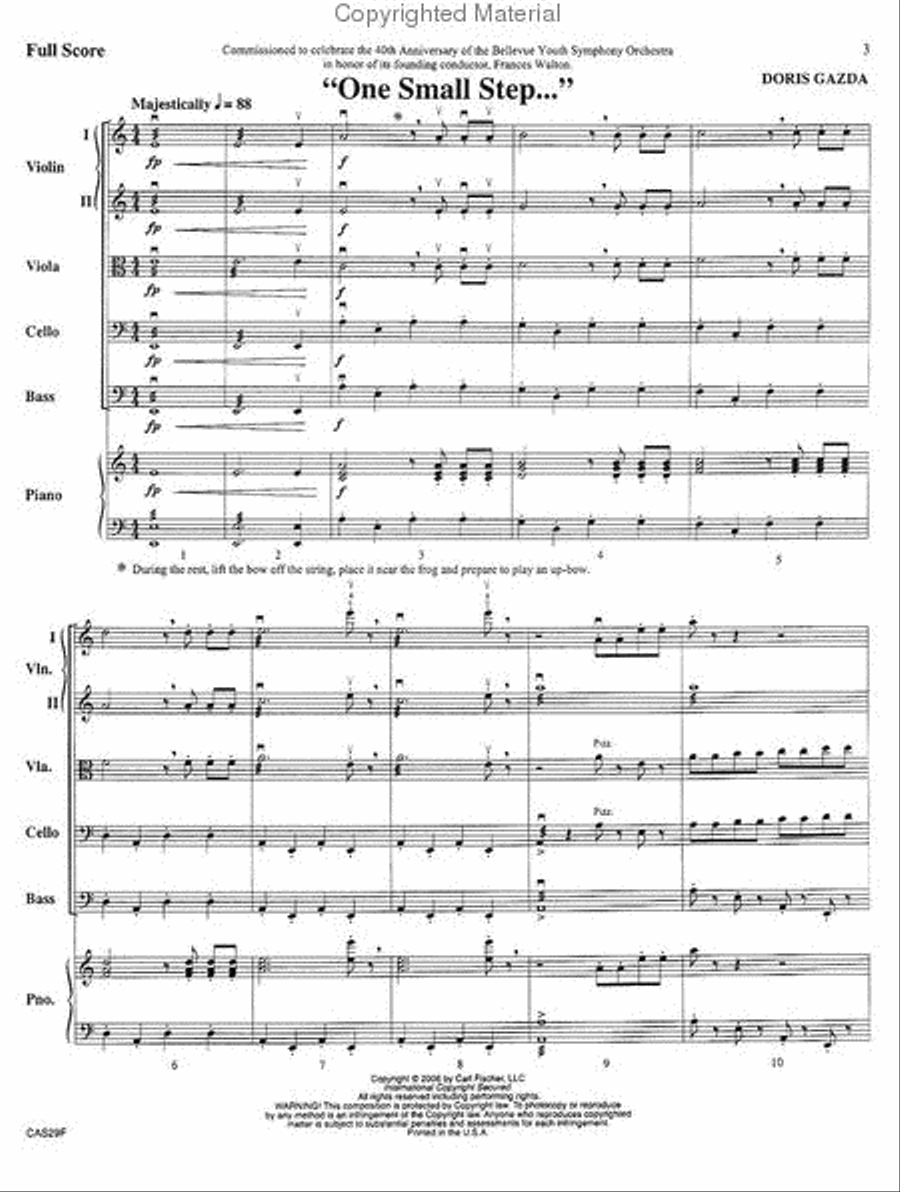
Composed by Doris Gazda. This edition: Medium Easy/Medium. Folio. Carl Fischer Concert String Orchestra Series. Classical. Score and Parts. With Standard notation. 12 pages. Carl Fischer Music #CAS29. Published by Carl Fischer Music (CF.CAS29).ISBN 9780825860959. UPC: 798408060954. 8.5 x 11 inches. Key: C major.
A programatic work by composer Doris Gazda that sets out to depict the historic moon landing by the Apollo 11 astronauts and the famous first step by Neil Armstrong. A sound portrait of this remarkable event in America history.
In July, 1959 the world watched and listened as the astronauts of Apollo 11 traveled from the Earth to the moon. The mission, launched by NASA, successfully carried men to the surface of the moon and returned them safely to earth. The spaceship was made up of a command module, "Columbia," and a lunar module, "Eagle." Astronauts Neil Armstrong, flight commander, and Buzz Aldrin, pilot of the lunar module, actually walked on the moon. The third astronaut, Michael Collins, piloted Columbia, the command module that orbited the moon while Armstrong and Aldrin were on the lunar surface.The 238,000-mile trip to the moon took four days. Apollo 11 fell into orbit 60 miles above the moon's surface. The Eagle separated from Columbia, orbited the moon nine miles above the surface and then made a powered descent, touching down on the moon in the Seat of Tranquility. Six hours after landing, Armstrong stepped onto the moon's surface uttering these memorable words that brought to reality the possibilities of space travel and exploration, "That's one small step for man, one giant leap for mankind."Armstrong and Aldrin spent two hours walking on the lunar surface. They set up some scientific equipment, raised an American flag and left a plaque signed by the Apollo 11 crew and President Richard Nixon, reading:"Here men from planet earth first set foot upon the moon. July 1969 A.D. We came in peace for all mankind."Twenty-one hours after landing, the Eagle with Armstrong and Aldrin onboard, left the moon to reunite with Columbia. After docking successfully, all three men got into Columbia. They jettisoned the Eagle and Columbia left lunar orbit to make the return trip. Two days later Columbia re-entered the Earth's atmosphere and splashed down in the Pacific Ocean.
- More by this Composer:
- Doris Gazda Doris Gazda Cello Doris Gazda Double Bass Doris Gazda Piano
- Instrument:
- Strings Cello Strings Double Bass Piano and Keyboard Piano
- Artists:
- Doris Gazda
- Ensemble:
- String Orchestra
- Publisher:
- Carl Fischer Music