Order two or more copies of the same title and we'll automatically give you 5% off list price on that title.
To get 2+ Pricing , just add two or more copies of a title to your shopping cart. Your discount will be immediately applied to your order.
Sale titles, hymnals, and ShowKits (MTI's Broadway Junior Collection, Getting to Know... Collection (G2K) and MTI's Kids Collection) do not qualify for 2+ Pricing
If you have any questions or comments regarding 2+ Pricing , please visit our Help Center to find more information or chat with our support team
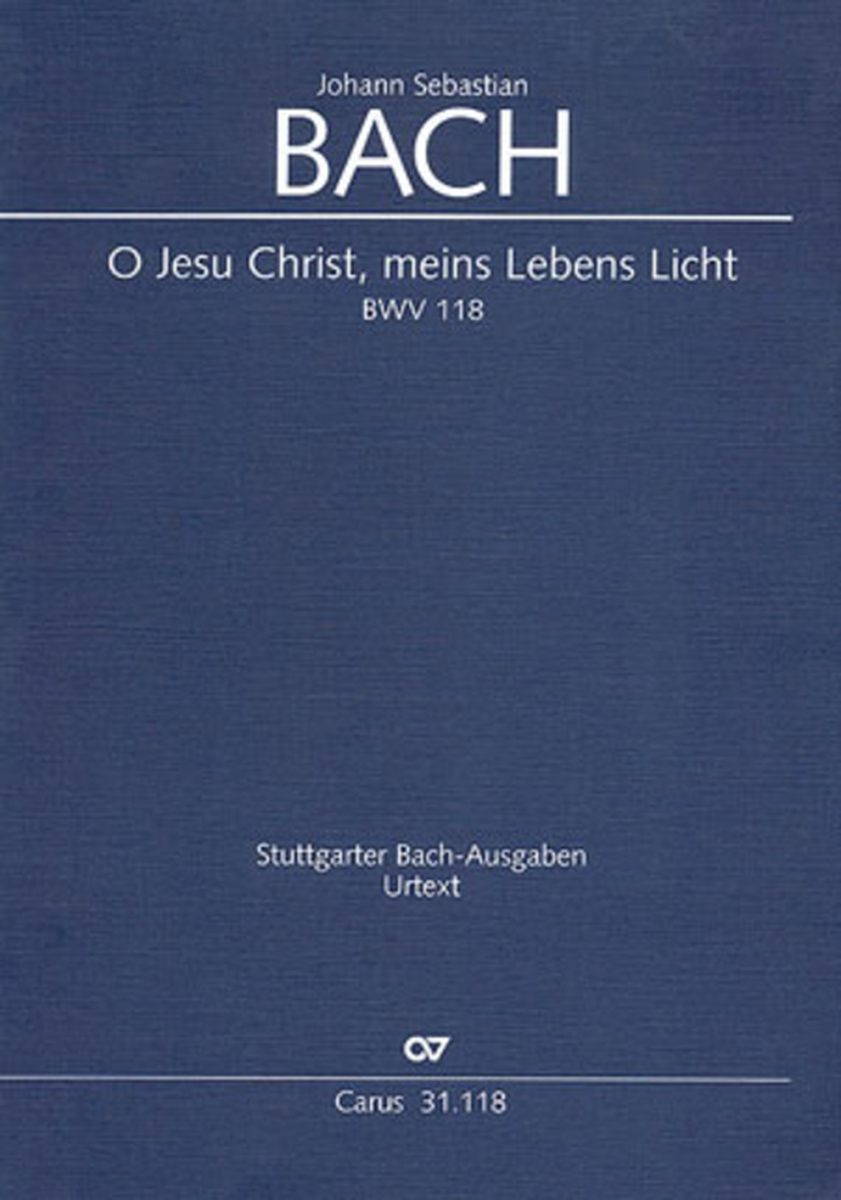
Funeral motet. Composed by Johann Sebastian Bach. Edited by Ulrich Leisinger. This edition: urtext. Stuttgart Urtext Edition: Bach vocal. German title: O Jesu Christ, Mein'S Lebens Licht Motette. Sacred vocal music, Motets, Mourning, death. Set of parts. Composed 1736/37 thru the first half of the 1740s. BWV 118. Duration 7 minutes. Carus Verlag #CV 31.118/19. Published by Carus Verlag (CA.3111819).
ISBN 9790007134198. 9 x 12 inches. Key: B flat major. Language: German/English. Text: Martin Behm.
Two versions survived: 1st version composed 1736/37, 2nd version in the first half of the 1740s. The versions differ only in instrumentation, and both are integrated in this edition.
Johann Sebastian Bach’s funeral composition O Jesu Christ, meins Lebens Licht (O Jesus Christ, my life, my light) BWV 118, exists in two versions which differ in essentials only as regards their instrumentation. The first version, whose source material indicates that it dates from 1736 or 1737, makes use only of brass instruments. The later version, which belongs to the period around 1746/47, requires stringed instruments instead of the cornetts and trombones; there is also specific provision for 3 oboes and a bassoon (presumably to support the voices). The unusual term "Litui" is believed to refer to two horns pitched in a high B flat.
Bach made only minor changes to the musical substance of the work when he revised it, so it appears justifiable to print both versions. The only formal alteration which Bach made in the later version was the repetition of the instrumental prelude and interlude once again at the conclusion of the work.
Funeral motet. Composed by Johann Sebastian Bach. Edited by Ulrich Leisinger. This edition: urtext. Stuttgart Urtext Edition: Bach vocal. German title: O Jesu Christ, Mein'S Lebens Licht Motette. Sacred vocal music, Motets, Mourning, death. Set of parts. Composed 1736/37 thru the first half of the 1740s. BWV 118. Duration 7 minutes. Carus Verlag #CV 31.118/19. Published by Carus Verlag (CA.3111819).
ISBN 9790007134198. 9 x 12 inches. Key: B flat major. Language: German/English. Text: Martin Behm.
Two versions survived: 1st version composed 1736/37, 2nd version in the first half of the 1740s. The versions differ only in instrumentation, and both are integrated in this edition.
Johann Sebastian Bach’s funeral composition O Jesu Christ, meins Lebens Licht (O Jesus Christ, my life, my light) BWV 118, exists in two versions which differ in essentials only as regards their instrumentation. The first version, whose source material indicates that it dates from 1736 or 1737, makes use only of brass instruments. The later version, which belongs to the period around 1746/47, requires stringed instruments instead of the cornetts and trombones; there is also specific provision for 3 oboes and a bassoon (presumably to support the voices). The unusual term "Litui" is believed to refer to two horns pitched in a high B flat.
Bach made only minor changes to the musical substance of the work when he revised it, so it appears justifiable to print both versions. The only formal alteration which Bach made in the later version was the repetition of the instrumental prelude and interlude once again at the conclusion of the work.
Preview: O Jesus Christ, my life, my light
Tell A Friend
Tell a friend (or remind yourself) about this product. We'll instantly send an email containing product info and a link to it. You may also enter a personal message.
We do not use or store email addresses from this form for any other purpose than sending your share email.
After purchase, you can download your MP3 from your Sheet Music Plus Digital Library - no software installation is necessary! You can also listen to your MP3 at any time in your Digital Library.
Learn about Smart Music
After purchase, you can download your Smart Music from your Sheet Music Plus Digital Library - no software installation is necessary! You can also download at any time in your Digital Library.
Learn about Digital Video
After purchase you can download your video from your Digital Library. Your video is in XX format and is playable on most pre-installed video players.