22211910
Miserere (1739)
22211910
22211910
22211910
Copyright Material for Preview Only - Sheet Music Plus
Choir
SKU: UT.HS-309
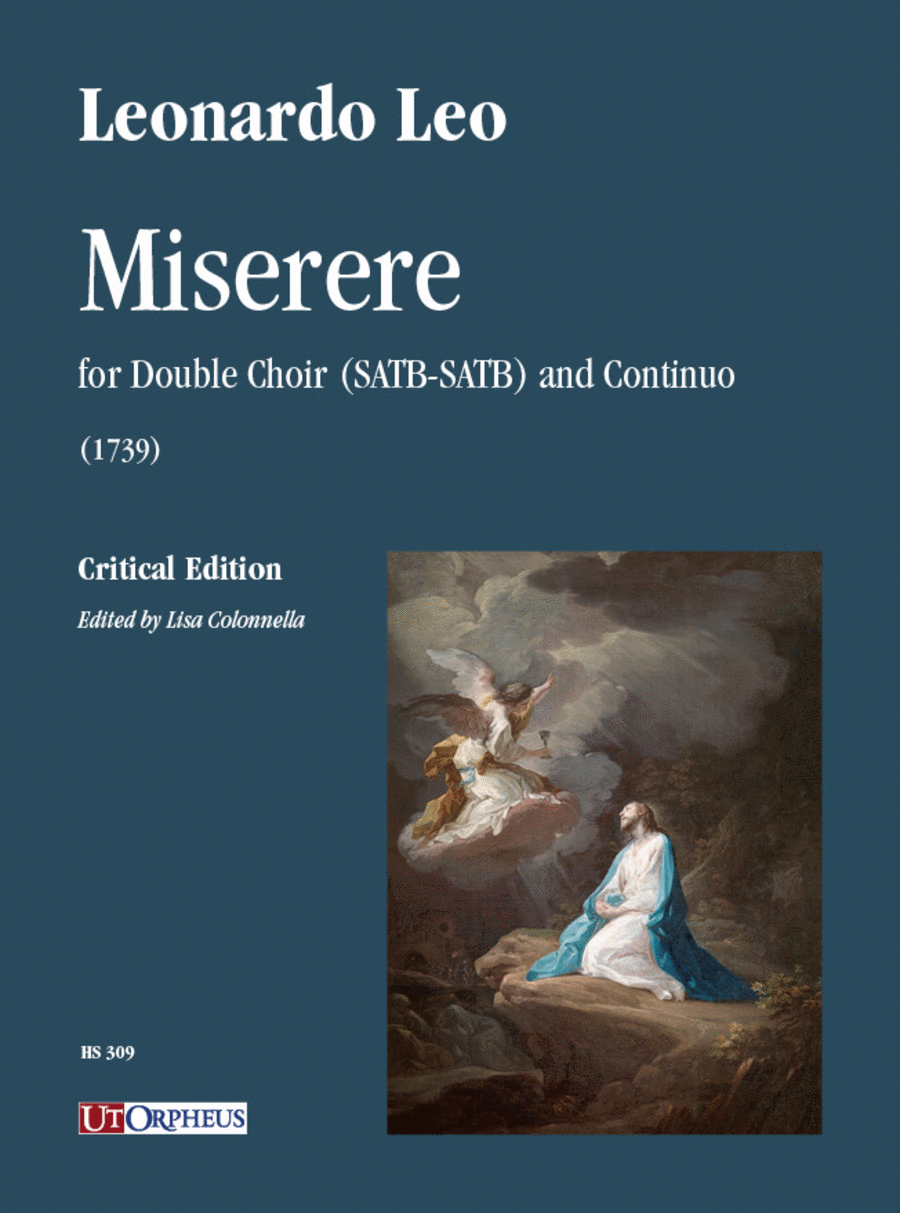
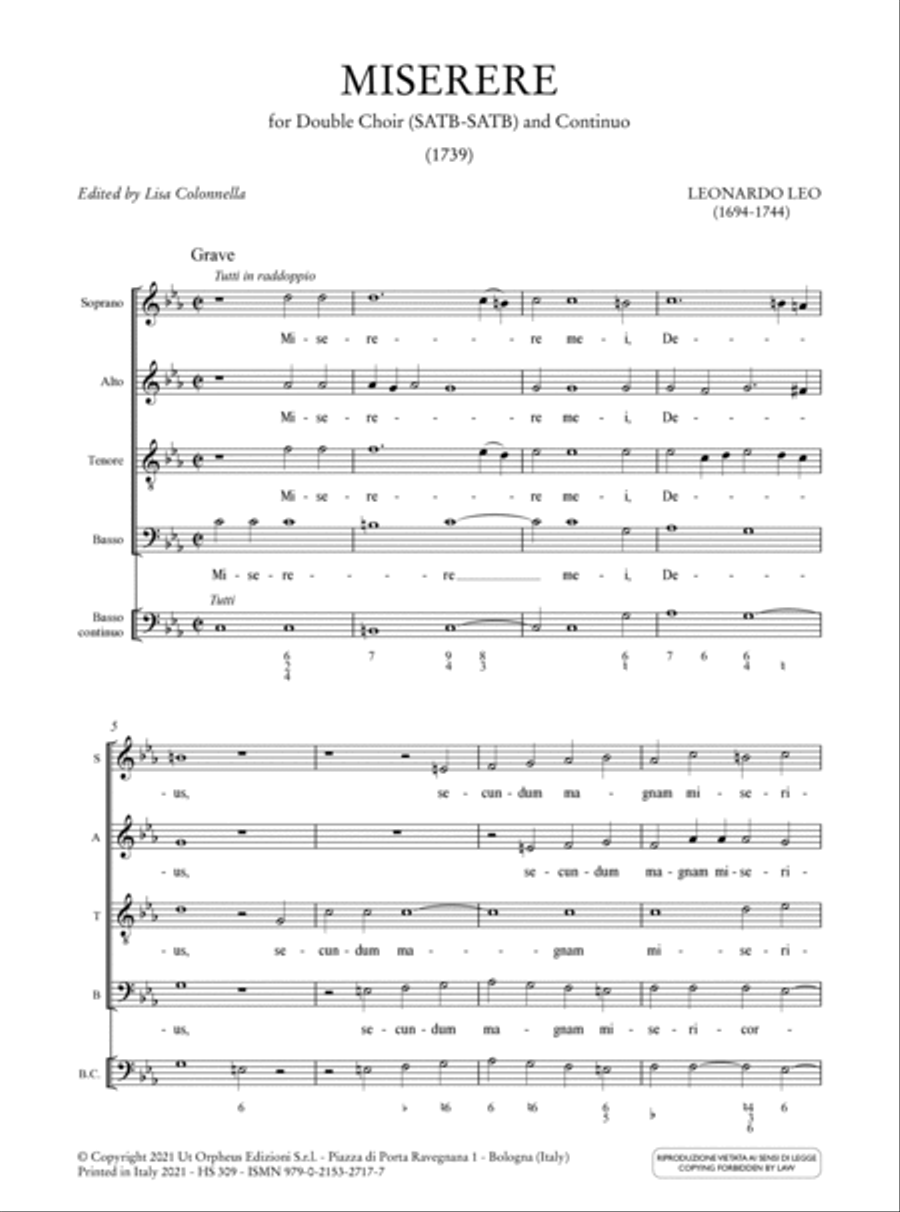
For Double Choir (SATB-SATB) and Continuo. Composed by Leonardo Leo. Edited by Lisa Colonnella. Saddle stitching. Classical. Choral score. Ut Orpheus #HS 309. Published by Ut Orpheus (UT.HS-309).
ISBN 9790215327177. 9 x 12 inches.
The Miserere for two choirs and basso continuo by Leonardo Leo, dated 1739, was seen as one of the best examples of stylistic purity, equal to the greatest Palestrina model of the "old style", and brought great renown to its composer. The first performances of the composition in Turin, where the composer stayed between 1739 and 1740 for the staging of two of his works at the Teatro Regio, were so well received that the news reached Naples, where it was performed continuously from 1740 to the early twentieth century, during the celebrations of Holy Week. Even Verdi, who had the opportunity to study the manuscript score in 1857, was in admiration of this composition, and Wagner, who heard it in 1880, made a profoundly flattering comment about it ("This is real music, all the rest is just a game. The composition stands as a mighty dome, solidly built, eminent and necessary; each modulation is extraordinary, because it is created according to the manner of the voices").
The handwritten manuscript of the work, from which this edition is taken, is held in the Library of the S. Pietro a Majella Conservatory of Music in Naples, with the classification 15.8.57 (olim Rari 1.6.157).
Choir
SKU: UT.HS-309
For Double Choir (SATB-SATB) and Continuo. Composed by Leonardo Leo. Edited by Lisa Colonnella. Saddle stitching. Classical. Choral score. Ut Orpheus #HS 309. Published by Ut Orpheus (UT.HS-309).
ISBN 9790215327177. 9 x 12 inches.
The Miserere for two choirs and basso continuo by Leonardo Leo, dated 1739, was seen as one of the best examples of stylistic purity, equal to the greatest Palestrina model of the "old style", and brought great renown to its composer. The first performances of the composition in Turin, where the composer stayed between 1739 and 1740 for the staging of two of his works at the Teatro Regio, were so well received that the news reached Naples, where it was performed continuously from 1740 to the early twentieth century, during the celebrations of Holy Week. Even Verdi, who had the opportunity to study the manuscript score in 1857, was in admiration of this composition, and Wagner, who heard it in 1880, made a profoundly flattering comment about it ("This is real music, all the rest is just a game. The composition stands as a mighty dome, solidly built, eminent and necessary; each modulation is extraordinary, because it is created according to the manner of the voices").
The handwritten manuscript of the work, from which this edition is taken, is held in the Library of the S. Pietro a Majella Conservatory of Music in Naples, with the classification 15.8.57 (olim Rari 1.6.157).
Tell a friend (or remind yourself) about this product. We'll instantly send an email containing product info and a link to it. You may also enter a personal message.
We do not use or store email addresses from this form for any other purpose than sending your share email.
Read our Privacy Policy.
After purchase, you can download your MP3 from your Sheet Music Plus Digital Library - no software installation is necessary! You can also listen to your MP3 at any time in your Digital Library.
After purchase, you can download your Smart Music from your Sheet Music Plus Digital Library - no software installation is necessary! You can also download at any time in your Digital Library.
After purchase you can download your video from your Digital Library. Your video is in XX format and is playable on most pre-installed video players.