Order two or more copies of the same title and we'll automatically give you 5% off list price on that title.
To get 2+ Pricing , just add two or more copies of a title to your shopping cart. Your discount will be immediately applied to your order.
Sale titles, hymnals, and ShowKits (MTI's Broadway Junior Collection, Getting to Know... Collection (G2K) and MTI's Kids Collection) do not qualify for 2+ Pricing
If you have any questions or comments regarding 2+ Pricing , please visit our Help Center to find more information or chat with our support team
Composed by Ludwig van Beethoven. Edited by Jonathan Del Mar. This edition: urtext edition. In a slipcase. Study score, anthology. Baerenreiter Verlag #TP00915. Published by Baerenreiter Verlag (BA.TP00915).
ISBN 9790006203178. 9.25 x 6.69 inches.
Beethoven was almost thirty years old when he ventured to compose a string quartet for the first time. Could he have been intimidated by the influential models of this young genre of Haydn and Mozart? When Beethoven completed his six string quartets op. 18 in 1799 – almost exactly one year after Haydn’s six quartets op. 76 – he was by no means completing a work of his youth. Nevertheless, they are often called his “early” quartets in order to distinguish them from the “middle quartets” op. 59, op. 74 and op. 95 (1807–1816) as well as the “late” quartets op. 127, op. 130, op. 131, op. 132, op. 135 and the “Große Fuge” op. 133.
This genre occupied Beethoven for the rest of his life – even his last completed composition was a string quartet. His works revolutionised this central chamber music genre, just as his symphonies did for that respective genre: for 200 years, Beethoven’s string quartets have been perceived as giants in the realm of string instrument music in terms of quality, musical innovation and influence.
New: Now the study score with op. 74 and 95 (TP00918) also includes the “Allegretto” in B minor in a scholarly critical edition. Written by Beethoven in 1817, this miniature for string quartet was only rediscovered in the late 1990s.
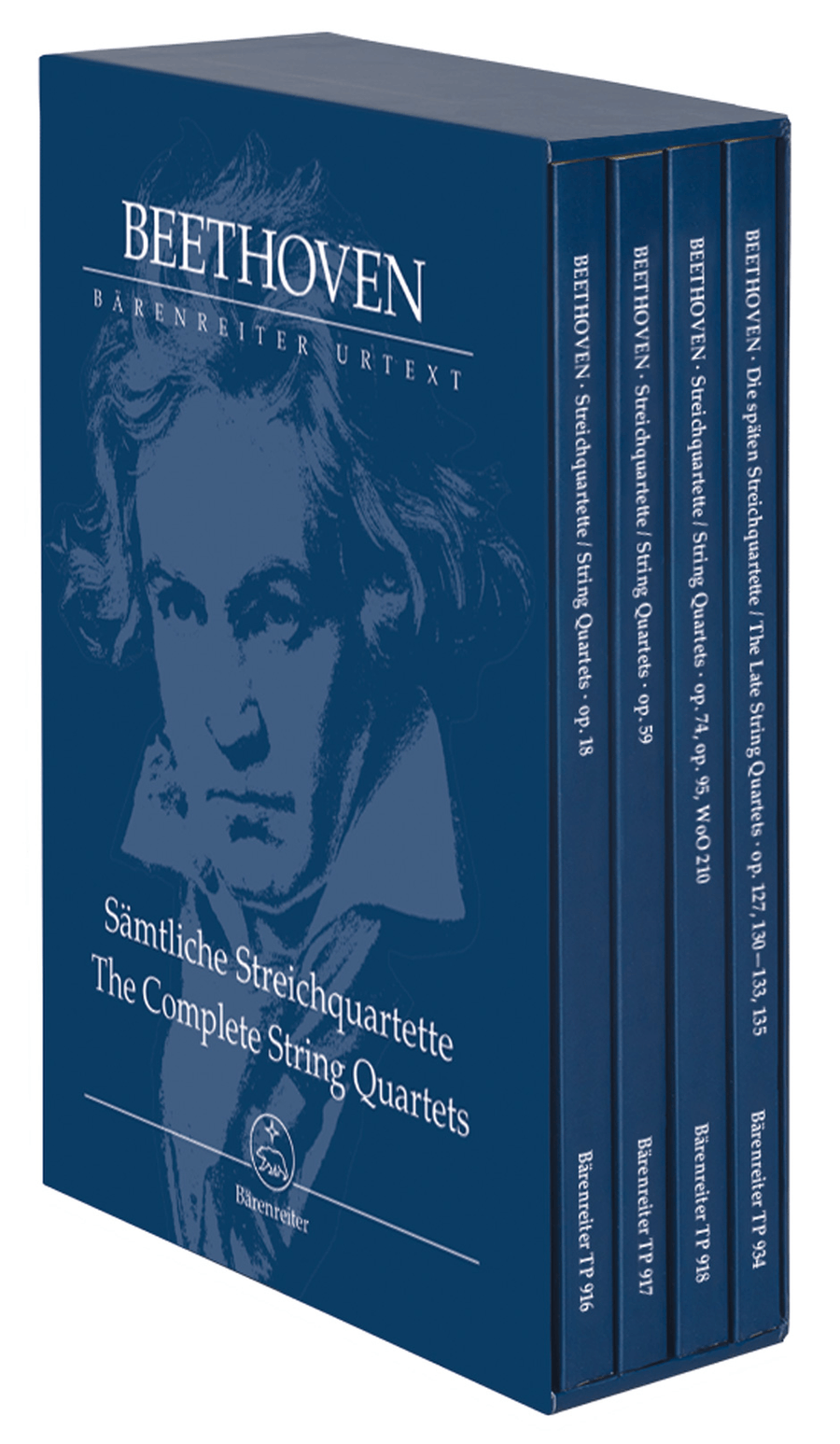
The slipcase includes: String Quartets op. 18. TP00916 String Quartets op. 59. TP00917 String Quartets op. 74 and 95 with the “Allegretto” in B minor. TP00918 String Quartets op. 127, op. 130, op. 131, op. 132, op. 135 and the “Große Fuge” op. 133. TP00934
About Barenreiter Urtext
What can I expect from a Barenreiter Urtext edition?
MUSICOLOGICALLY SOUND - A reliable musical text based on all available sources - A description of the sources - Information on the genesis and history of the work - Valuable notes on performance practice - Includes an introduction with critical commentary explaining source discrepancies and editorial decisions
... AND PRACTICAL - Page-turns, fold-out pages, and cues where you need them - A well-presented layout and a user-friendly format - Excellent print quality - Superior paper and binding
Composed by Ludwig van Beethoven. Edited by Jonathan Del Mar. This edition: urtext edition. In a slipcase. Study score, anthology. Baerenreiter Verlag #TP00915. Published by Baerenreiter Verlag (BA.TP00915).
ISBN 9790006203178. 9.25 x 6.69 inches.
Beethoven was almost thirty years old when he ventured to compose a string quartet for the first time. Could he have been intimidated by the influential models of this young genre of Haydn and Mozart? When Beethoven completed his six string quartets op. 18 in 1799 – almost exactly one year after Haydn’s six quartets op. 76 – he was by no means completing a work of his youth. Nevertheless, they are often called his “early” quartets in order to distinguish them from the “middle quartets” op. 59, op. 74 and op. 95 (1807–1816) as well as the “late” quartets op. 127, op. 130, op. 131, op. 132, op. 135 and the “Große Fuge” op. 133.
This genre occupied Beethoven for the rest of his life – even his last completed composition was a string quartet. His works revolutionised this central chamber music genre, just as his symphonies did for that respective genre: for 200 years, Beethoven’s string quartets have been perceived as giants in the realm of string instrument music in terms of quality, musical innovation and influence.
New: Now the study score with op. 74 and 95 (TP00918) also includes the “Allegretto” in B minor in a scholarly critical edition. Written by Beethoven in 1817, this miniature for string quartet was only rediscovered in the late 1990s.
The slipcase includes: String Quartets op. 18. TP00916 String Quartets op. 59. TP00917 String Quartets op. 74 and 95 with the “Allegretto” in B minor. TP00918 String Quartets op. 127, op. 130, op. 131, op. 132, op. 135 and the “Große Fuge” op. 133. TP00934
About Barenreiter Urtext
What can I expect from a Barenreiter Urtext edition?
MUSICOLOGICALLY SOUND - A reliable musical text based on all available sources - A description of the sources - Information on the genesis and history of the work - Valuable notes on performance practice - Includes an introduction with critical commentary explaining source discrepancies and editorial decisions
... AND PRACTICAL - Page-turns, fold-out pages, and cues where you need them - A well-presented layout and a user-friendly format - Excellent print quality - Superior paper and binding
Preview: The Complete String Quartets
Tell A Friend
Tell a friend (or remind yourself) about this product. We'll instantly send an email containing product info and a link to it. You may also enter a personal message.
We do not use or store email addresses from this form for any other purpose than sending your share email.
After purchase, you can download your MP3 from your Sheet Music Plus Digital Library - no software installation is necessary! You can also listen to your MP3 at any time in your Digital Library.
Learn about Smart Music
After purchase, you can download your Smart Music from your Sheet Music Plus Digital Library - no software installation is necessary! You can also download at any time in your Digital Library.
Learn about Digital Video
After purchase you can download your video from your Digital Library. Your video is in XX format and is playable on most pre-installed video players.