19808581
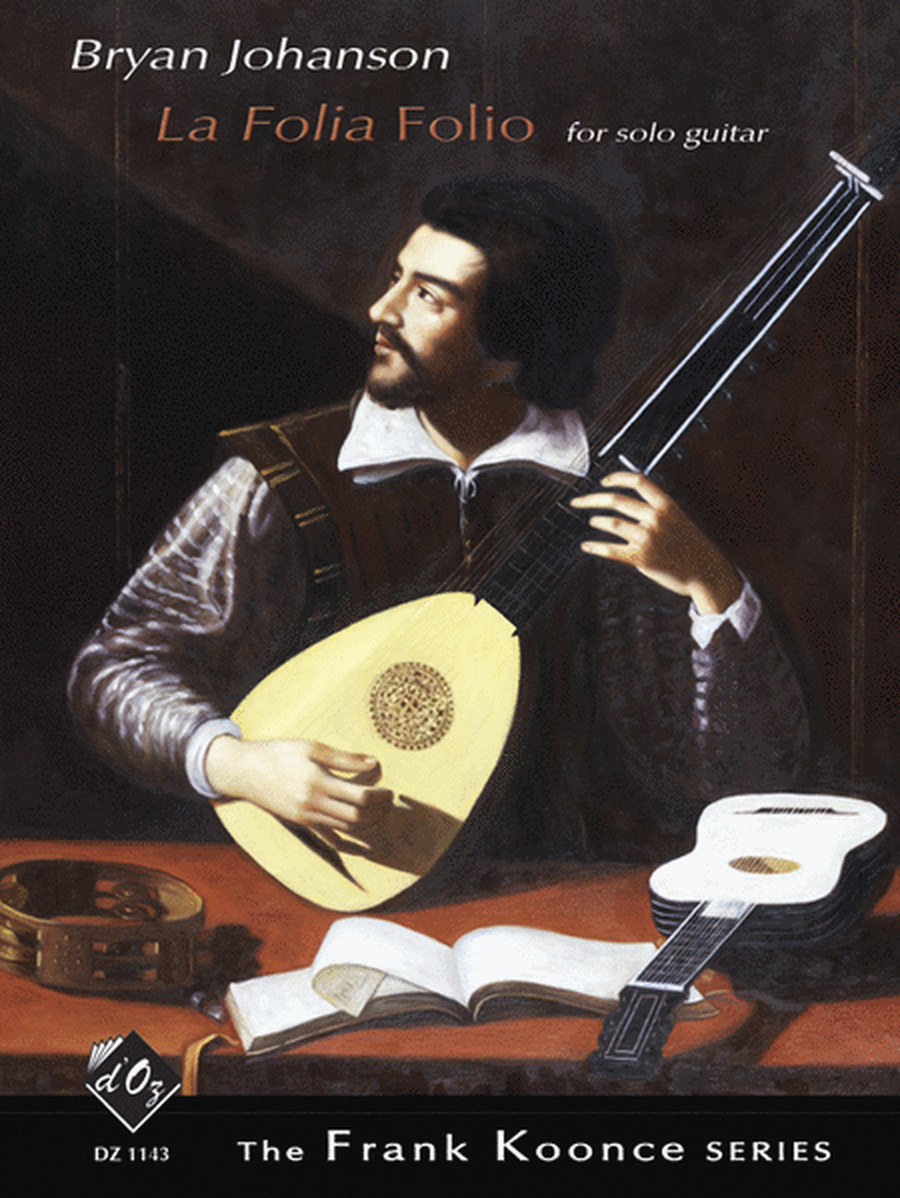
La Folia Folio
19808581
19808581
19808581
Copyright Material for Preview Only - Sheet Music Plus
Guitar solo - Advanced
SKU: DZ.DZ-1143
Composed by Bryan Johanson. Edited by Frank Koonce. Arranged by Frank Koonce. Score. Les Productions d'OZ #DZ 1143. Published by Les Productions d'OZ (DZ.DZ-1143).
ISBN 9782896550425.
Frank Koonce Series
The folía was "a very noisy Portuguese dance, performed with tambourines and other instruments, by women wearing masks and men dressed like women." The name translates as "mad," "without a brain," or "empty headed." By the early seventeenth century, through its proliferation in guitar tablatures, the folía had acquired certain characteristics for which it became universally known: "It would always be set in a minor key, most often d minor. The ostinato bass and the chord progression, i-V-i-VII-III-VII-i-V-i, finally became unique to the folía––unlike in the previous century when this chord scheme, or ones very similar, comprised several dances such as the passamezzo antico, romanesca, and the fedele." After 1672, a simple melody by Jean-Baptiste Lully also became associated with the folía; however, many composers and performers continued to use only the chord progression as a basis for improvisation. This progression remains one of the most popular and important formulas for musical variations on all instruments.
In the program notes for his recording of this piece, Bryan Johanson tells us:
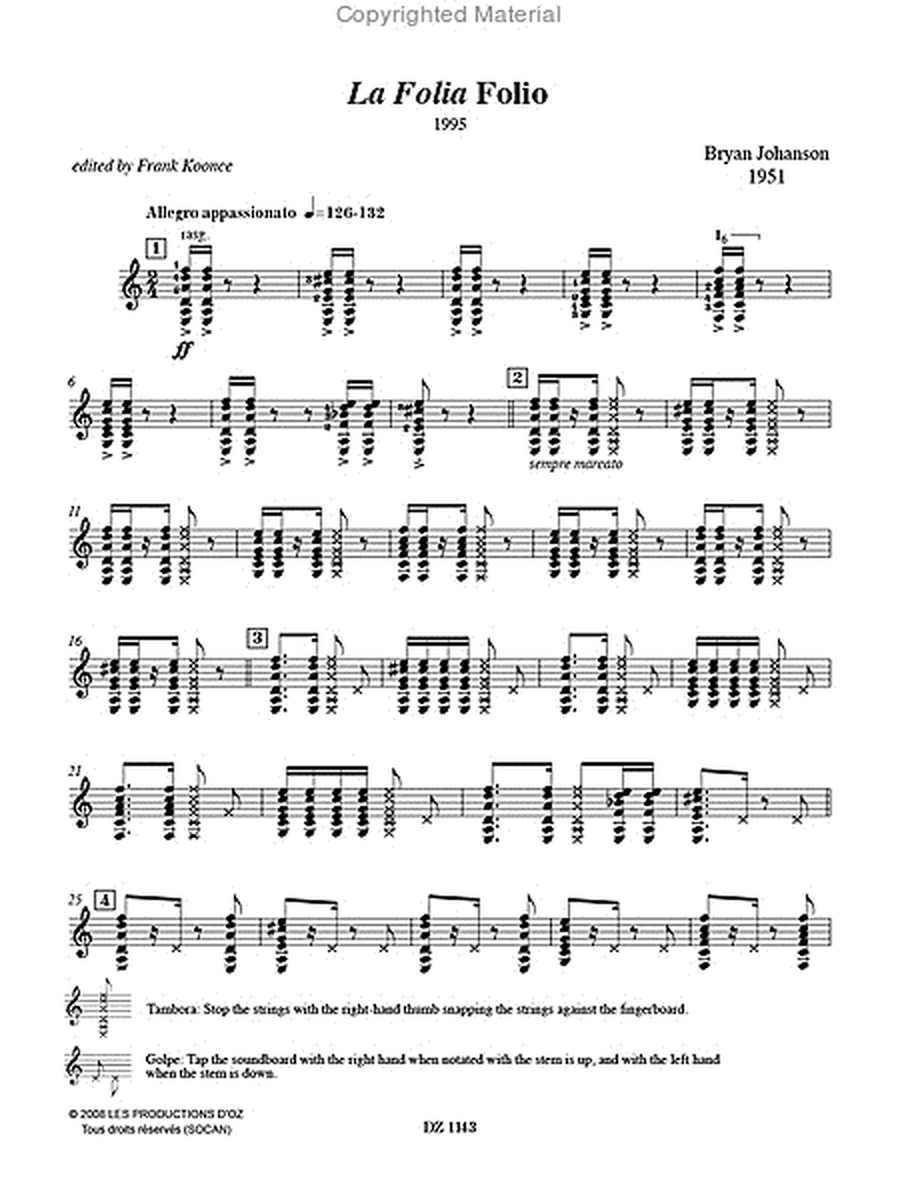
"La Folia Folio was commissioned by Canadian guitarist Harold Micay. He wanted a work that he could splash around in. The result is a set of variations based on the chord progression from the famous theme La Folia d’Espagna. That work has a rich and long history of attracting composers. There are sets of variations by A. Scarlatti, C.P.E. Bach, Vivaldi, Corelli, Liszt, Nielsen and Rachmaninoff, not to mention dozens of sets by guitar guys like Sanz, Corbetta, Sor and Giuliani. I have tried to stress the dance nature of the theme by using only the harmonic progression, omitting the melody altogether, though there is a weird paraphrase of it about halfway through. The work is a blast to play and I enjoy splashing in it as often as I can.".
Guitar solo - Advanced
SKU: DZ.DZ-1143
Composed by Bryan Johanson. Edited by Frank Koonce. Arranged by Frank Koonce. Score. Les Productions d'OZ #DZ 1143. Published by Les Productions d'OZ (DZ.DZ-1143).
ISBN 9782896550425.
Frank Koonce Series
The folía was "a very noisy Portuguese dance, performed with tambourines and other instruments, by women wearing masks and men dressed like women." The name translates as "mad," "without a brain," or "empty headed." By the early seventeenth century, through its proliferation in guitar tablatures, the folía had acquired certain characteristics for which it became universally known: "It would always be set in a minor key, most often d minor. The ostinato bass and the chord progression, i-V-i-VII-III-VII-i-V-i, finally became unique to the folía––unlike in the previous century when this chord scheme, or ones very similar, comprised several dances such as the passamezzo antico, romanesca, and the fedele." After 1672, a simple melody by Jean-Baptiste Lully also became associated with the folía; however, many composers and performers continued to use only the chord progression as a basis for improvisation. This progression remains one of the most popular and important formulas for musical variations on all instruments.
In the program notes for his recording of this piece, Bryan Johanson tells us:
"La Folia Folio was commissioned by Canadian guitarist Harold Micay. He wanted a work that he could splash around in. The result is a set of variations based on the chord progression from the famous theme La Folia d’Espagna. That work has a rich and long history of attracting composers. There are sets of variations by A. Scarlatti, C.P.E. Bach, Vivaldi, Corelli, Liszt, Nielsen and Rachmaninoff, not to mention dozens of sets by guitar guys like Sanz, Corbetta, Sor and Giuliani. I have tried to stress the dance nature of the theme by using only the harmonic progression, omitting the melody altogether, though there is a weird paraphrase of it about halfway through. The work is a blast to play and I enjoy splashing in it as often as I can.".
Tell a friend (or remind yourself) about this product. We'll instantly send an email containing product info and a link to it. You may also enter a personal message.
We do not use or store email addresses from this form for any other purpose than sending your share email.
Read our Privacy Policy.
After purchase, you can download your MP3 from your Sheet Music Plus Digital Library - no software installation is necessary! You can also listen to your MP3 at any time in your Digital Library.
After purchase, you can download your Smart Music from your Sheet Music Plus Digital Library - no software installation is necessary! You can also download at any time in your Digital Library.
After purchase you can download your video from your Digital Library. Your video is in XX format and is playable on most pre-installed video players.