Order two or more copies of the same title and we'll automatically give you 5% off list price on that title.
To get 2+ Pricing , just add two or more copies of a title to your shopping cart. Your discount will be immediately applied to your order.
Sale titles, hymnals, and ShowKits (MTI's Broadway Junior Collection, Getting to Know... Collection (G2K) and MTI's Kids Collection) do not qualify for 2+ Pricing
If you have any questions or comments regarding 2+ Pricing , please visit our Help Center to find more information or chat with our support team
Composed by Robert W. Padgett. Baroque,Classical,Contest,Festival,Instructional,Traditional. Score. 3 pages. Padgett Music Llc #741707. Published by Padgett Music Llc (A0.1141383).
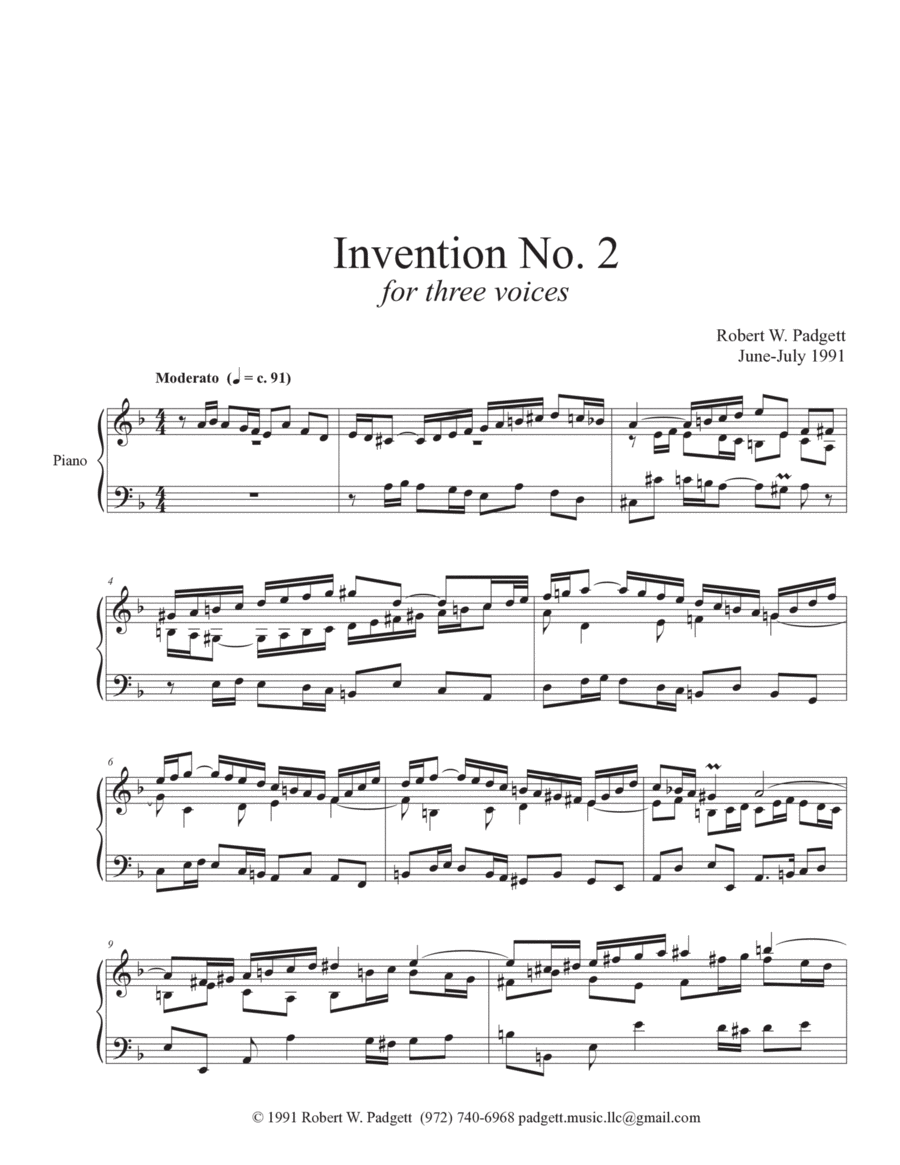
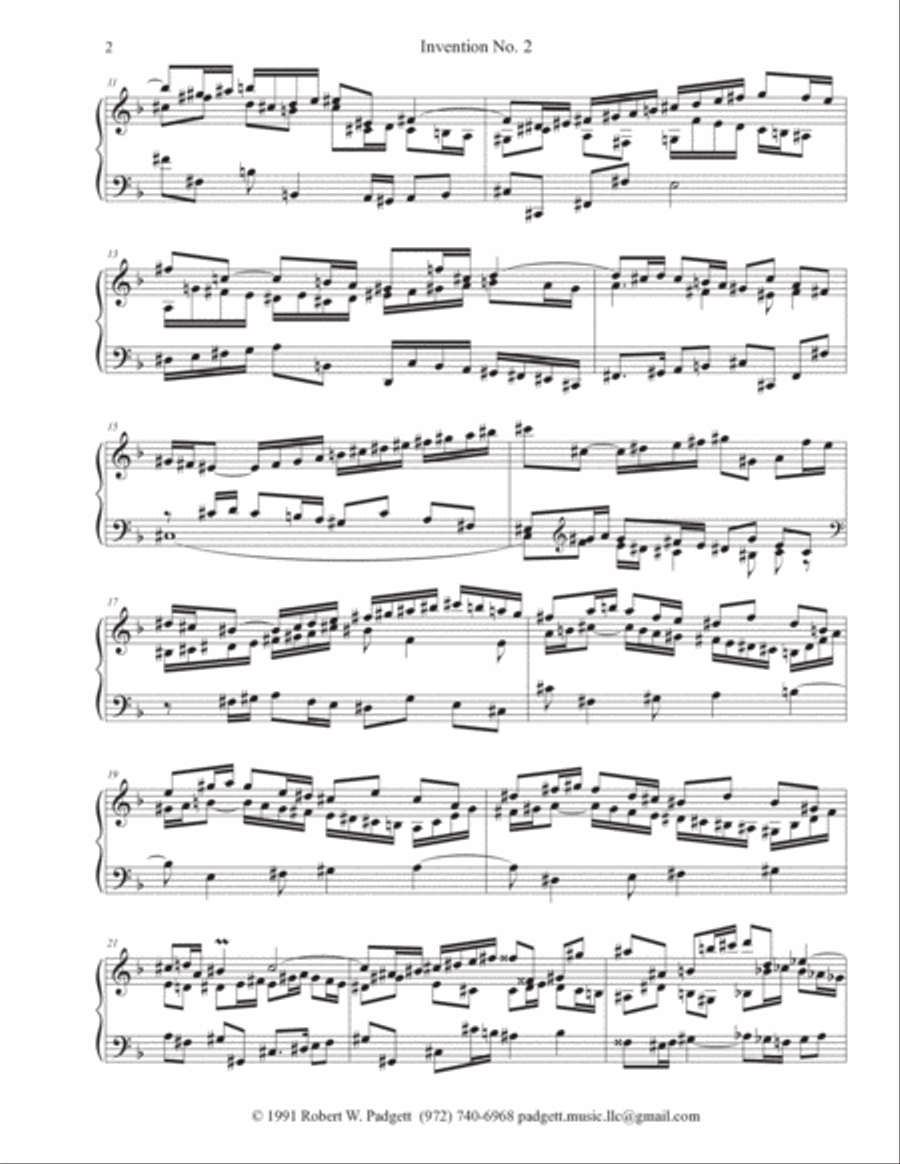
This three-part Invention No. 2 in D minor was composed in the summer of 1991. I shared it with my modal and tonal counterpoint instructor, Professor Richard Wilson, and he responded favorably to my venturesome modulations and use of the Neapolitan chord. Similar to my first invention in A minor, the motive is announced by the upper voice before it is restated an octave lower by the lower voice in bar 2 to form a stretto. In bar 3, the middle voice states the motive in the dominant key of A minor with the lower and upper voices playing the first and second countermotives respectively. An episode ensues and arrives at a half cadence in bar 8. The opening fragment of the motive is exploited in conjunction with a pedal tone and a variant of the second countermotive to navigate through a series of contrasting keys. At bar 14, the motive is reasserted in F-sharp minor layered over itself in stretto with a C-sharp pedal tone in bar 15. The voices from the episode in bars 5-8 are reshuffled in bars 18-21 as another exercise in invertible counterpoint. In measure 16, the motive and two countermotives are reprised in C-sharp minor, a half step below the tonic key. Starting in bar 18, the episode from bars 6-8 is reprised in F-sharp minor with the first and second countermotives exchanging positions. This is followed in bars 16-27 by a varied restatement of the episodic sequence from bars 8-17 that cadences in bar 27 before a restatement of the subject in bar 28 in G minor with slightly embellished countermotives. Bars 32-35 present a restatement of the episode from bars 5-8 with the motive relocated to the lower voice and the two countermotives in intimate proximity in the two upper voices. An unexpected descending scale in a series of compound harmonic 10ths forms an inversion of the second half of the motive and sets the stage for a perfect cadence to a Picardy Third in D major. After so many years, I remain especially pleased with the effect of that ending.
This product was created by a member of ArrangeMe, Hal Leonard's global
self-publishing community of independent composers, arrangers, and songwriters.
ArrangeMe allows for the publication of unique arrangements of both popular
titles and original compositions from a wide variety of voices and backgrounds.
About Digital Downloads
Digital Downloads are downloadable sheet music files that can be viewed directly on
your computer, tablet or mobile device. Once you download your digital sheet music,
you can view and print it at home, school, or anywhere you want to make music, and
you don't have to be connected to the internet. Just purchase, download and play!
PLEASE NOTE: Your Digital Download will have a watermark at the bottom of each page
that will include your name, purchase date and number of copies purchased. You are
only authorized to print the number of copies that you have purchased. You may not
digitally distribute or print more copies than purchased for use (i.e., you may not
print or digitally distribute individual copies to friends or students).
Composed by Robert W. Padgett. Baroque,Classical,Contest,Festival,Instructional,Traditional. Score. 3 pages. Padgett Music Llc #741707. Published by Padgett Music Llc (A0.1141383).
This three-part Invention No. 2 in D minor was composed in the summer of 1991. I shared it with my modal and tonal counterpoint instructor, Professor Richard Wilson, and he responded favorably to my venturesome modulations and use of the Neapolitan chord. Similar to my first invention in A minor, the motive is announced by the upper voice before it is restated an octave lower by the lower voice in bar 2 to form a stretto. In bar 3, the middle voice states the motive in the dominant key of A minor with the lower and upper voices playing the first and second countermotives respectively. An episode ensues and arrives at a half cadence in bar 8. The opening fragment of the motive is exploited in conjunction with a pedal tone and a variant of the second countermotive to navigate through a series of contrasting keys. At bar 14, the motive is reasserted in F-sharp minor layered over itself in stretto with a C-sharp pedal tone in bar 15. The voices from the episode in bars 5-8 are reshuffled in bars 18-21 as another exercise in invertible counterpoint. In measure 16, the motive and two countermotives are reprised in C-sharp minor, a half step below the tonic key. Starting in bar 18, the episode from bars 6-8 is reprised in F-sharp minor with the first and second countermotives exchanging positions. This is followed in bars 16-27 by a varied restatement of the episodic sequence from bars 8-17 that cadences in bar 27 before a restatement of the subject in bar 28 in G minor with slightly embellished countermotives. Bars 32-35 present a restatement of the episode from bars 5-8 with the motive relocated to the lower voice and the two countermotives in intimate proximity in the two upper voices. An unexpected descending scale in a series of compound harmonic 10ths forms an inversion of the second half of the motive and sets the stage for a perfect cadence to a Picardy Third in D major. After so many years, I remain especially pleased with the effect of that ending.
This product was created by a member of ArrangeMe, Hal Leonard's global
self-publishing community of independent composers, arrangers, and songwriters.
ArrangeMe allows for the publication of unique arrangements of both popular
titles and original compositions from a wide variety of voices and backgrounds.
About Digital Downloads
Digital Downloads are downloadable sheet music files that can be viewed directly on
your computer, tablet or mobile device. Once you download your digital sheet music,
you can view and print it at home, school, or anywhere you want to make music, and
you don't have to be connected to the internet. Just purchase, download and play!
PLEASE NOTE: Your Digital Download will have a watermark at the bottom of each page
that will include your name, purchase date and number of copies purchased. You are
only authorized to print the number of copies that you have purchased. You may not
digitally distribute or print more copies than purchased for use (i.e., you may not
print or digitally distribute individual copies to friends or students).
Preview: Invention No. 2 in D minor for three voices
Tell a friend (or remind yourself) about this product. We'll instantly send an email containing product info and a link to it. You may also enter a personal message.
We do not use or store email addresses from this form for any other purpose than sending your share email.
After purchase, you can download your MP3 from your Sheet Music Plus Digital Library - no software installation is necessary! You can also listen to your MP3 at any time in your Digital Library.
Learn about Smart Music
After purchase, you can download your Smart Music from your Sheet Music Plus Digital Library - no software installation is necessary! You can also download at any time in your Digital Library.
Learn about Digital Video
After purchase you can download your video from your Digital Library. Your video is in XX format and is playable on most pre-installed video players.