From the Shadowland 6 pieces for piano solo Piano Solo - Digital Sheet Music

A group of mystically alluring pieces of French character, which may be performed individually, in sets of two, or as a series.The movements are:1 "Tombeau" [2/2, c, E+]"Tombeau" is a lament whose obsessive melodic motif recalls the fixedly pensive theme of the "Allegretto" from Beethoven's Seventh Symphony.2 "Mélisande" [3/4, c, M]"Mélisande," named after the leading female character of the celebrated play, Pélleas et Mélisande, by Nobel laureate Maurice Maeterlinck, commemorates both the author and the tragic role he created. This character is perhaps best known in context of Debussy's opera based on the play--one of the greatest masterpieces of French music literature.3 "She Dances No More" [3/4, a, E]"She Dances No More," a deeply touching miniature, has become one of Ford's best loved and most widely performed piano pieces.4 "Phantom Gondolier" [2/4:6/8, A, M]"Phantom Gondolier" depicts the ghostly apparition of a Venetian boatman whose lilting song wafts almost imperceptibly over wave and mist.5 "Cortège" [2/2, e, M]"Cortège," epitaph-like in its succinctness, summons to mind a dignified memorial procession.6 "Lost Pagoda" [2/2, e, M+]"Lost Pagoda" offers a brief glimpse through the medium of sound of some enchanted monument which all too soon vanishes beneath the tides of time.(Two further, more technically advanced movements are also available under "From the Shadowland (supplement) for piano solo")From the Shadowland consists of six short pieces for piano solo written between the years 1975 and 1990. A supplementary volume contains two additional works-"Fairy Ring" and "Fountain of Prophecy"-both of which are lengthier and more technically complex. All eight pieces, however, convey a darkly mysterious and often delicately poignant mood. Ford has taken as his point of departure the programmatic character piece of the nineteenth and early twentieth centuries, imbuing each movement with an unmistakably Gallic sensibility (the composer, who is fluent in French, traces his ancestry to Medieval Normandy) while forging from historical idioms his own uniquely personal style. "Tombeau" is a moving lament whose obsessive melodic motif recalls the fixedly pensive theme of the "Allegretto" from Beethoven's Seventh Symphony. "Mélisande," named after the hapless heroine of the celebrated play by Nobel laureate Maurice Maeterlinck, is expressly designated a "tombeau" in memory of the latter. "She Dances No More" evokes the quiet tragedy of a young dancer whom Fate has forced to abandon the thing she loves most. "Phantom Gondolier" depicts the ghostly apparition of a Venetian boatman whose song wafts almost imperceptibly over wave and mist. "Cortège," epitaph-like in its succinctness, summons to mind a solemn procession. "Lost Pagoda" offers a brief glimpse of some great ruin which seems to topple irretrievably into oblivion. Not intended as a suite per se, the first and second, third and fourth, and fifth and sixth pieces in From the Shadowland comprise three two-movement "pairs" whose tonalities are C minor, A (minor/major) and E (minor/major) respectively. It is left to the performer's discretion to play as many or as few of the pieces as (s)he wishes, in any appropriate grouping or order.

Digital Download
$8.40
$10.50
You save: $2.10 ~ 20%

WELCOME20 activated

Access Instantly
Download and print your PDF sheet music right away.
Quantity
1
Get a 10% discount with SMP Plus subscription

Details

Instrument:
Piano Solo
Genres:
20th Century
Publishers:
David Warin Solomons2
Series:
ArrangeMe
Format:
Score
Item types:
Digital
Level:
Intermediate
Usages:
School and Community
Number of Pages:
8

Piano Solo - Level 3 - Digital Download

SKU: A0.958444

Composed by Joseph Dillon Ford. 20th Century. Score. 8 pages. David Warin Solomons2 #3687595. Published by David Warin Solomons2 (A0.958444).

A group of mystically alluring pieces of French character, which may be performed individually, in sets of two, or as a series.

The movements are:
1 "Tombeau" [2/2, c, E+]
"Tombeau" is a lament whose obsessive melodic motif recalls the fixedly pensive theme of the "Allegretto" from Beethoven's Seventh Symphony.

2 "Mélisande" [3/4, c, M]
"Mélisande," named after the leading female character of the celebrated play, Pélleas et Mélisande, by Nobel laureate Maurice Maeterlinck, commemorates both the author and the tragic role he created. This character is perhaps best known in context of Debussy's opera based on the play--one of the greatest masterpieces of French music literature.

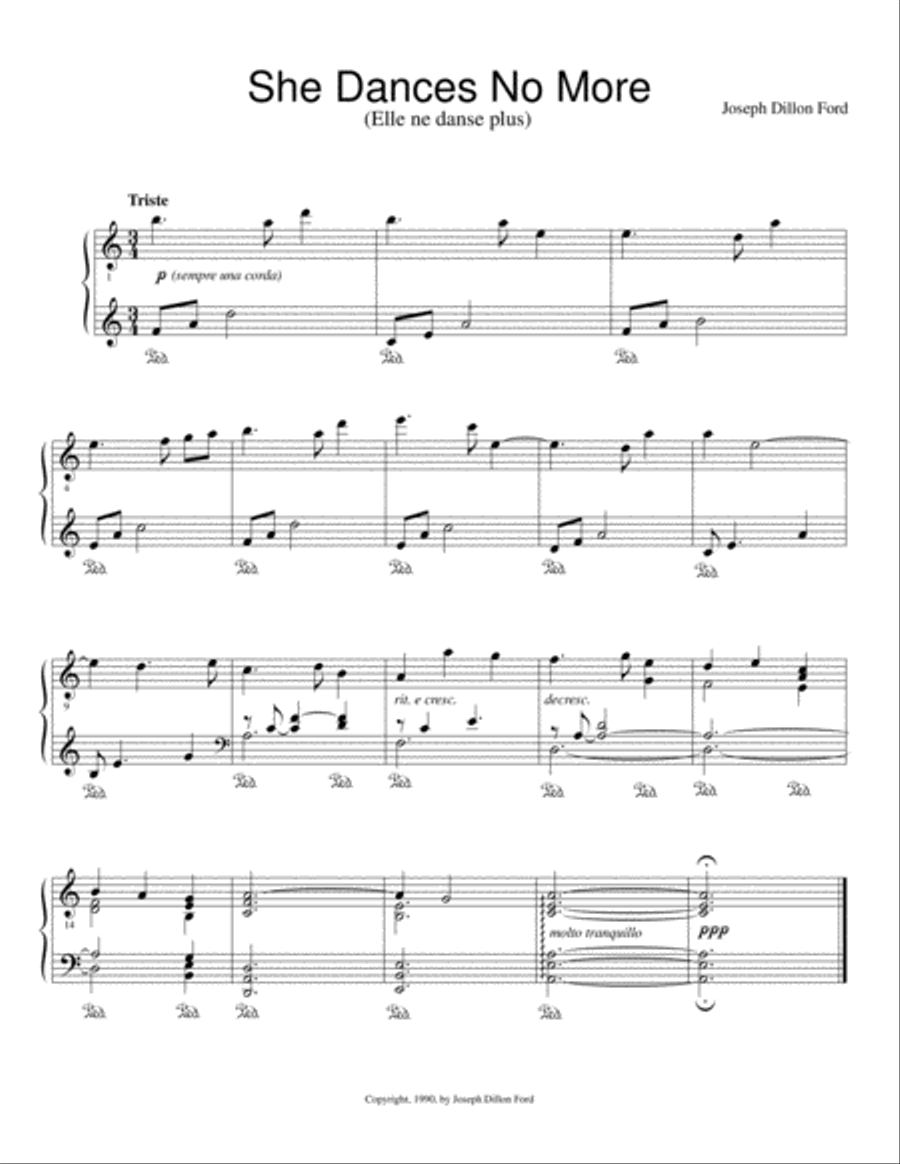
3 "She Dances No More" [3/4, a, E]
"She Dances No More," a deeply touching miniature, has become one of Ford's best loved and most widely performed piano pieces.

4 "Phantom Gondolier" [2/4:6/8, A, M]
"Phantom Gondolier" depicts the ghostly apparition of a Venetian boatman whose lilting song wafts almost imperceptibly over wave and mist.

5 "Cortège" [2/2, e, M]
"Cortège," epitaph-like in its succinctness, summons to mind a dignified memorial procession.

6 "Lost Pagoda" [2/2, e, M+]
"Lost Pagoda" offers a brief glimpse through the medium of sound of some enchanted monument which all too soon vanishes beneath the tides of time.

(Two further, more technically advanced movements are also available under "From the Shadowland (supplement) for piano solo")

From the Shadowland consists of six short pieces for piano solo written between the years 1975 and 1990. A supplementary volume contains two additional works-"Fairy Ring" and "Fountain of Prophecy"-both of which are lengthier and more technically complex. All eight pieces, however, convey a darkly mysterious and often delicately poignant mood. Ford has taken as his point of departure the programmatic character piece of the nineteenth and early twentieth centuries, imbuing each movement with an unmistakably Gallic sensibility (the composer, who is fluent in French, traces his ancestry to Medieval Normandy) while forging from historical idioms his own uniquely personal style.
"Tombeau" is a moving lament whose obsessive melodic motif recalls the fixedly pensive theme of the "Allegretto" from Beethoven's Seventh Symphony.
"Mélisande," named after the hapless heroine of the celebrated play by Nobel laureate Maurice Maeterlinck, is expressly designated a "tombeau" in memory of the latter.
"She Dances No More" evokes the quiet tragedy of a young dancer whom Fate has forced to abandon the thing she loves most.
"Phantom Gondolier" depicts the ghostly apparition of a Venetian boatman whose song wafts almost imperceptibly over wave and mist.
"Cortège," epitaph-like in its succinctness, summons to mind a solemn procession.
"Lost Pagoda" offers a brief glimpse of some great ruin which seems to topple irretrievably into oblivion.
Not intended as a suite per se, the first and second, third and fourth, and fifth and sixth pieces in From the Shadowland comprise three two-movement "pairs" whose tonalities are C minor, A (minor/major) and E (minor/major) respectively. It is left to the performer's discretion to play as many or as few of the pieces as (s)he wishes, in any appropriate grouping or order.
About ArrangeMe

This product was created by a member of ArrangeMe, Hal Leonard's self-publishing community for independent composers, arrangers, and songwriters. Discover unique arrangements of popular titles and original compositions from diverse creators. The length, difficulty, and pricing are determined by the arranger or composer.

About Digital Downloads

Digital Downloads let you instantly access sheet music on your computer, tablet, or mobile device. Print your sheet music anywhere, anytime, or play it straight from your device—no internet connection is required after download.

Each Digital Download includes a watermark with your name, purchase date, and the number of copies purchased. You may only print or use the number of copies purchased. Redistribution or unauthorized printing is prohibited.