20004805
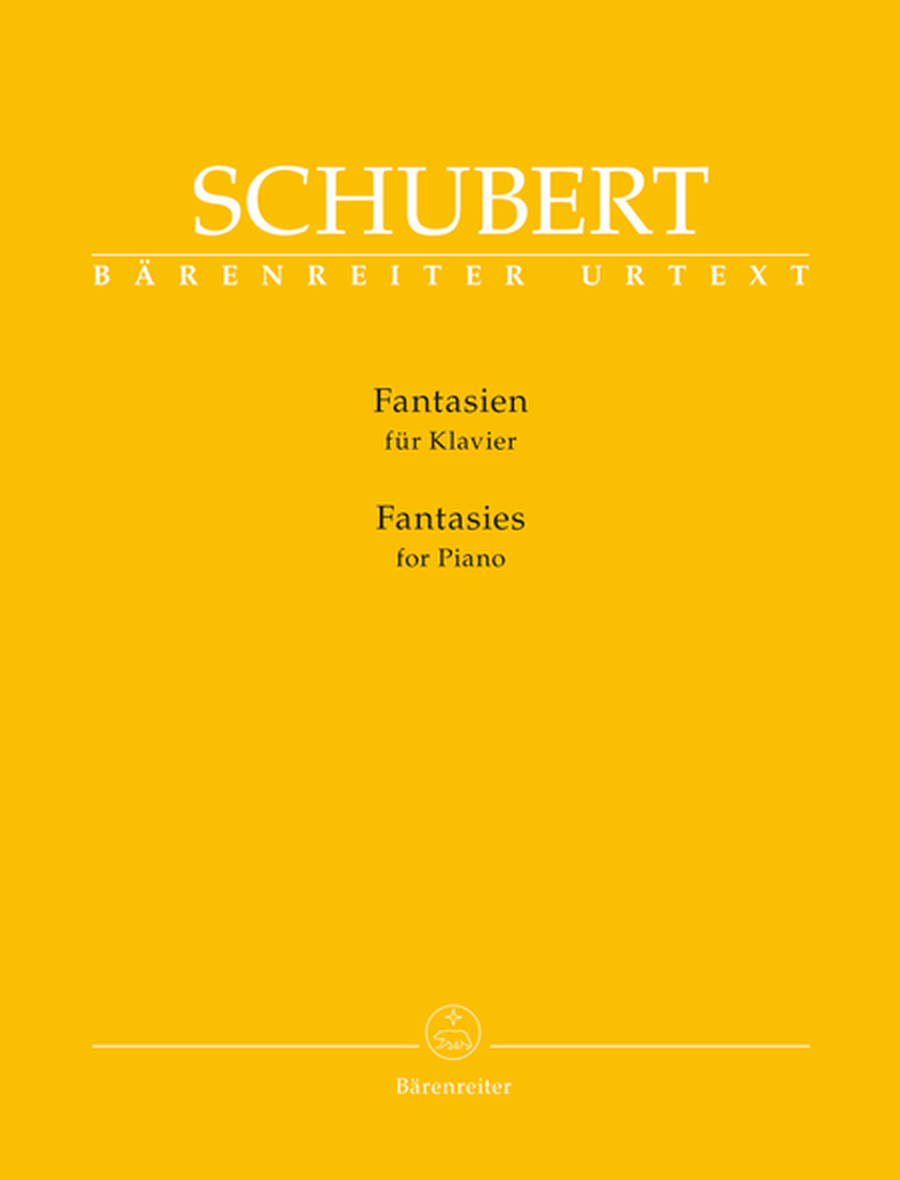
Fantasies for Piano
20004805
20004805
20004805
Copyright Material for Preview Only - Sheet Music Plus
Piano - Level 6
SKU: BA.BA10862
Composed by Franz Schubert. Edited by David Goldberger and Walther Durr. This edition: urtext edition. Stapled. Barenreiter Urtext. Replaces BA 19101. Performance score, anthology. Baerenreiter Verlag #BA10862. Published by Baerenreiter Verlag (BA.BA10862).
ISBN 9790006526659. 12.2 x 9.65 inches. Language: German/English. Preface: Dürr, Walther / Aschauer, Mario.
Early evidence of Schubert’s interest in music of the past can be found in his “Fantasy in C minor” of 1811 (D 2 E), with its echoes of Mozart’s fantasy in the same key. A recurring motivic snippet in the virtuosic “Graz Fantasy” in C major (D 605 A), probably composed between 1818 and 1821, already foreshadows the monumental “Wanderer Fantasy” of 1822 (op. 15 - D 760).
Printed with spacious new engraving, BA 10862 unites Schubert’s great fantasies for solo piano in a single volume and presents the early work “Fantasy in C minor” for the first time in a scholarly-critical Urtext edition. It offers advanced pupils, students and professional pianists a richly varied, musically and technically thrilling addition to their repertoire. The edition features notes on performance practice, an informative preface, practical page turns and an elegant engraving.
The most famous of the fantasies, the Wanderer Fantasy, now appears in a separate edition (BA 10870).
While Schubert was playing the Wanderer Fantasy for a circle of friends, he faltered and exclaimed impatiently: The Devil should play this stuff!”
Yet it wasn’t the Devil but Liszt – like Schumann a great admirer of the piece – who later arranged the Wanderer Fantasy for piano and orchestra and again for two pianos. It was also Liszt who gave the work the nickname it has retained to the present day.
About Barenreiter Urtext
What can I expect from a Barenreiter Urtext edition?
MUSICOLOGICALLY SOUND
- A reliable musical text based on all available sources
- A description of the sources
- Information on the genesis and history of the work
- Valuable notes on performance practice
- Includes an introduction with critical commentary explaining source discrepancies and editorial decisions
... AND PRACTICAL
- Page-turns, fold-out pages, and cues where you need them
- A well-presented layout and a user-friendly format
- Excellent print quality
- Superior paper and binding

Piano - Level 6
SKU: BA.BA10862
Composed by Franz Schubert. Edited by David Goldberger and Walther Durr. This edition: urtext edition. Stapled. Barenreiter Urtext. Replaces BA 19101. Performance score, anthology. Baerenreiter Verlag #BA10862. Published by Baerenreiter Verlag (BA.BA10862).
ISBN 9790006526659. 12.2 x 9.65 inches. Language: German/English. Preface: Dürr, Walther / Aschauer, Mario.
Early evidence of Schubert’s interest in music of the past can be found in his “Fantasy in C minor” of 1811 (D 2 E), with its echoes of Mozart’s fantasy in the same key. A recurring motivic snippet in the virtuosic “Graz Fantasy” in C major (D 605 A), probably composed between 1818 and 1821, already foreshadows the monumental “Wanderer Fantasy” of 1822 (op. 15 - D 760).
Printed with spacious new engraving, BA 10862 unites Schubert’s great fantasies for solo piano in a single volume and presents the early work “Fantasy in C minor” for the first time in a scholarly-critical Urtext edition. It offers advanced pupils, students and professional pianists a richly varied, musically and technically thrilling addition to their repertoire. The edition features notes on performance practice, an informative preface, practical page turns and an elegant engraving.
The most famous of the fantasies, the Wanderer Fantasy, now appears in a separate edition (BA 10870).
While Schubert was playing the Wanderer Fantasy for a circle of friends, he faltered and exclaimed impatiently: The Devil should play this stuff!”
Yet it wasn’t the Devil but Liszt – like Schumann a great admirer of the piece – who later arranged the Wanderer Fantasy for piano and orchestra and again for two pianos. It was also Liszt who gave the work the nickname it has retained to the present day.
About Barenreiter Urtext
What can I expect from a Barenreiter Urtext edition?
MUSICOLOGICALLY SOUND
- A reliable musical text based on all available sources
- A description of the sources
- Information on the genesis and history of the work
- Valuable notes on performance practice
- Includes an introduction with critical commentary explaining source discrepancies and editorial decisions
... AND PRACTICAL
- Page-turns, fold-out pages, and cues where you need them
- A well-presented layout and a user-friendly format
- Excellent print quality
- Superior paper and binding
Tell a friend (or remind yourself) about this product. We'll instantly send an email containing product info and a link to it. You may also enter a personal message.
We do not use or store email addresses from this form for any other purpose than sending your share email.
Read our Privacy Policy.
After purchase, you can download your MP3 from your Sheet Music Plus Digital Library - no software installation is necessary! You can also listen to your MP3 at any time in your Digital Library.
After purchase, you can download your Smart Music from your Sheet Music Plus Digital Library - no software installation is necessary! You can also download at any time in your Digital Library.
After purchase you can download your video from your Digital Library. Your video is in XX format and is playable on most pre-installed video players.