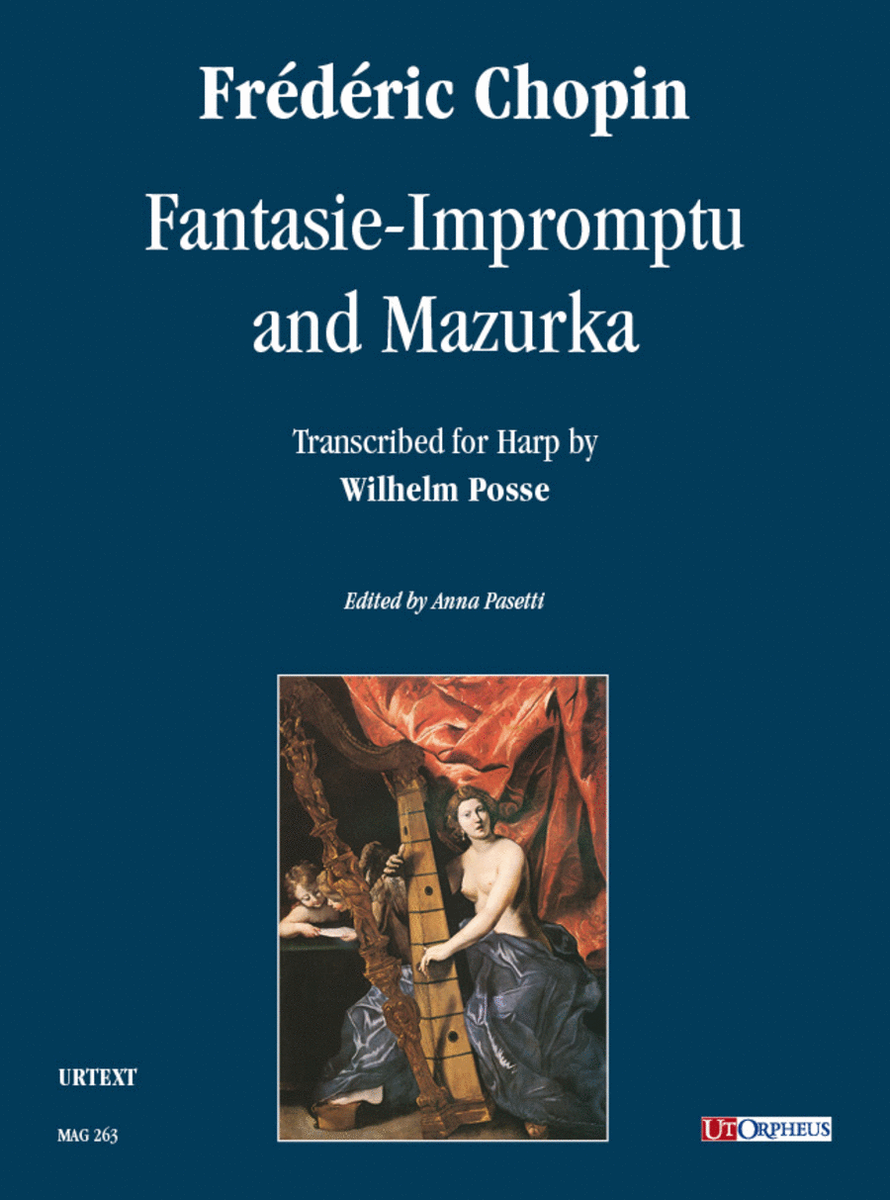
For Harp. Composed by Frederic Chopin. Edited by Anna Pasetti. Saddle stitching. Magadis. Classical. Score. Ut Orpheus #MAG 263. Published by Ut Orpheus (UT.MAG-263).
ISBN 9790215326408. 9 x 12 inches.
Wilhelm Posse’s compositions for harp are rich and varied, and range from the easy pieces dedicated to his students to the virtuoso concert pieces; we must also remember his didactic works, in particular the Six Small Studies and the universally known Eight Great Concert Studies. It is not easy to draw a balance of his legacy in the harp world. On one hand his technical vision of virtuosity combined with a great stability of the hand and rigor of the fingerings certainly contributed to the development of the 20th Century harp technique; on the other hand, his use of the pedals, often driven by two together with the same foot (a very old French technique), has gradually become more and more difficult on modern harps. From the point of view of his contribution to the harp repertoire, the constant run-up to the piano has heavily influenced his compositional production, making him often completely miss the idiomatic effects of 19th Century harp music (except for the use of harmonic sounds), which were so loved by his friend Liszt in the compositions of Parish Alvars. This edition is based on the first print, published in Leipzig by Zimmerman in 1919, in two separate volumes.
For Harp. Composed by Frederic Chopin. Edited by Anna Pasetti. Saddle stitching. Magadis. Classical. Score. Ut Orpheus #MAG 263. Published by Ut Orpheus (UT.MAG-263).
ISBN 9790215326408. 9 x 12 inches.
Wilhelm Posse’s compositions for harp are rich and varied, and range from the easy pieces dedicated to his students to the virtuoso concert pieces; we must also remember his didactic works, in particular the Six Small Studies and the universally known Eight Great Concert Studies. It is not easy to draw a balance of his legacy in the harp world. On one hand his technical vision of virtuosity combined with a great stability of the hand and rigor of the fingerings certainly contributed to the development of the 20th Century harp technique; on the other hand, his use of the pedals, often driven by two together with the same foot (a very old French technique), has gradually become more and more difficult on modern harps. From the point of view of his contribution to the harp repertoire, the constant run-up to the piano has heavily influenced his compositional production, making him often completely miss the idiomatic effects of 19th Century harp music (except for the use of harmonic sounds), which were so loved by his friend Liszt in the compositions of Parish Alvars. This edition is based on the first print, published in Leipzig by Zimmerman in 1919, in two separate volumes.
Preview: Fantasie-Impromptu and Mazurka
Tell A Friend
Tell a friend (or remind yourself) about this product. We'll instantly send an email containing product info and a link to it. You may also enter a personal message.
We do not use or store email addresses from this form for any other purpose than sending your share email.
After purchase, you can download your MP3 from your Sheet Music Plus Digital Library - no software installation is necessary! You can also listen to your MP3 at any time in your Digital Library.
Learn about Smart Music
After purchase, you can download your Smart Music from your Sheet Music Plus Digital Library - no software installation is necessary! You can also download at any time in your Digital Library.
Learn about Digital Video
After purchase you can download your video from your Digital Library. Your video is in XX format and is playable on most pre-installed video players.