22657553
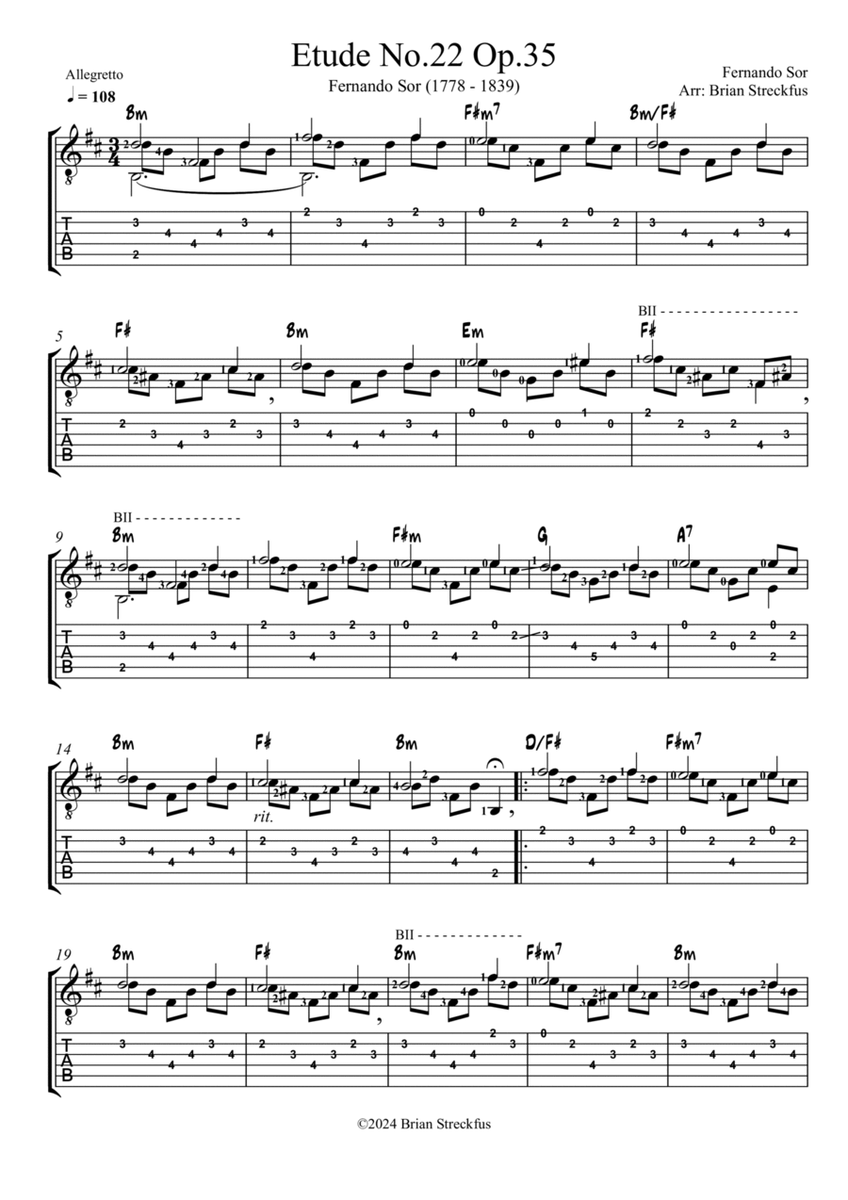
Etude No 22 Op 35
22657553
22657553
22657553
Copyright Material for Preview Only - Sheet Music Plus
Guitar - Level 3 - Digital Download
SKU: A0.1356984
Composed by Fernando Sor. Arranged by Brian Streckfus. This edition: pdf, streaming. 19th Century, Classical, Instructional, Romantic Period. Guitar Tab. 3 pages. Brian Streckfus #941611. Published by Brian Streckfus (A0.1356984).
Pages: 2 + 1 (includes a blank version for crafting your own decisions)
Key: B minor
This is one of Sor's more famous etudes. I make these to save other musician's time. Fingerings, position markers, ledger lines, and analysis are tedious to do, and I'd say most people don't "enjoy" doing it. Most people, hobbyists especially want to skip the tedious work and get to playing! If I had versions like this when I studied classical guitar at colleges, I would have had to work half as hard.
Features:
1. Tablature Added
2. Blank version for starting from scratch
3. Chord Nomenclature added
4. Dynamics added
5. Fingerings Added
6. Slides/Guide fingers added
7. Modern Fonts
8. Commas as suggested phrase endings (breaths)
Tips:
1. Realizing that you are in position two most of the time helps. In the key of B minor, fret 1s aren't supposed to happen as they would be out of key. This piece does have key changes, so some fret 1s do happen.
2. Nearly all measures are arpeggios, so it's best to summarize each measure as a chord shape. If you read the music one note at a time, your playing will most likely sound choppy. It is possible to get the entire measure ready on beat one. You won't see many classical publications with chord names, but they are crucial for a piece like this in order think quickly and plan fingers ahead quickly.
3. Similiar to the last point, there are a lot of bars in this piece. Realizing when you are barring and not barring will be helpful.
4. I try to strategically leave out fingerings. Too many fingerings and the piece will look overly intimidating. Often, if I leave out a fingering, it's because it is a counter-intuitive fingering to use, and therefor the student should pencil it in themselves as a strong reminder of a difficult moment. I also leave out fingerings if I strongly sense there are multiple correct ways of playing a passage.
5. I notated some notes as a half note to suggest that it is a main melody that should be sustained. I recommend using rest stroke to make these notes extra loud. Rest stroke is when your fingers automatically rest in the next string, and it tends to be more powerful and warmer than others.
6. m. 3 is really F#m7(omit3). Some harmonies in this piece are actually quite novel and difficult to name.
This product was created by a member of ArrangeMe, Hal Leonard's global
self-publishing community of independent composers, arrangers, and songwriters.
ArrangeMe allows for the publication of unique arrangements of both popular
titles and original compositions from a wide variety of voices and backgrounds.
About Digital Downloads
Digital Downloads are downloadable sheet music files that can be viewed directly on
your computer, tablet or mobile device. Once you download your digital sheet music,
you can view and print it at home, school, or anywhere you want to make music, and
you don't have to be connected to the internet. Just purchase, download and play!
PLEASE NOTE: Your Digital Download will have a watermark at the bottom of each page
that will include your name, purchase date and number of copies purchased. You are
only authorized to print the number of copies that you have purchased. You may not
digitally distribute or print more copies than purchased for use (i.e., you may not
print or digitally distribute individual copies to friends or students).
Guitar - Level 3 - Digital Download
SKU: A0.1356984
Composed by Fernando Sor. Arranged by Brian Streckfus. This edition: pdf, streaming. 19th Century, Classical, Instructional, Romantic Period. Guitar Tab. 3 pages. Brian Streckfus #941611. Published by Brian Streckfus (A0.1356984).
Pages: 2 + 1 (includes a blank version for crafting your own decisions)
Key: B minor
This is one of Sor's more famous etudes. I make these to save other musician's time. Fingerings, position markers, ledger lines, and analysis are tedious to do, and I'd say most people don't "enjoy" doing it. Most people, hobbyists especially want to skip the tedious work and get to playing! If I had versions like this when I studied classical guitar at colleges, I would have had to work half as hard.
Features:
1. Tablature Added
2. Blank version for starting from scratch
3. Chord Nomenclature added
4. Dynamics added
5. Fingerings Added
6. Slides/Guide fingers added
7. Modern Fonts
8. Commas as suggested phrase endings (breaths)
Tips:
1. Realizing that you are in position two most of the time helps. In the key of B minor, fret 1s aren't supposed to happen as they would be out of key. This piece does have key changes, so some fret 1s do happen.
2. Nearly all measures are arpeggios, so it's best to summarize each measure as a chord shape. If you read the music one note at a time, your playing will most likely sound choppy. It is possible to get the entire measure ready on beat one. You won't see many classical publications with chord names, but they are crucial for a piece like this in order think quickly and plan fingers ahead quickly.
3. Similiar to the last point, there are a lot of bars in this piece. Realizing when you are barring and not barring will be helpful.
4. I try to strategically leave out fingerings. Too many fingerings and the piece will look overly intimidating. Often, if I leave out a fingering, it's because it is a counter-intuitive fingering to use, and therefor the student should pencil it in themselves as a strong reminder of a difficult moment. I also leave out fingerings if I strongly sense there are multiple correct ways of playing a passage.
5. I notated some notes as a half note to suggest that it is a main melody that should be sustained. I recommend using rest stroke to make these notes extra loud. Rest stroke is when your fingers automatically rest in the next string, and it tends to be more powerful and warmer than others.
6. m. 3 is really F#m7(omit3). Some harmonies in this piece are actually quite novel and difficult to name.
This product was created by a member of ArrangeMe, Hal Leonard's global
self-publishing community of independent composers, arrangers, and songwriters.
ArrangeMe allows for the publication of unique arrangements of both popular
titles and original compositions from a wide variety of voices and backgrounds.
About Digital Downloads
Digital Downloads are downloadable sheet music files that can be viewed directly on
your computer, tablet or mobile device. Once you download your digital sheet music,
you can view and print it at home, school, or anywhere you want to make music, and
you don't have to be connected to the internet. Just purchase, download and play!
PLEASE NOTE: Your Digital Download will have a watermark at the bottom of each page
that will include your name, purchase date and number of copies purchased. You are
only authorized to print the number of copies that you have purchased. You may not
digitally distribute or print more copies than purchased for use (i.e., you may not
print or digitally distribute individual copies to friends or students).
Tell a friend (or remind yourself) about this product. We'll instantly send an email containing product info and a link to it. You may also enter a personal message.
We do not use or store email addresses from this form for any other purpose than sending your share email.
Read our Privacy Policy.
After purchase, you can download your MP3 from your Sheet Music Plus Digital Library - no software installation is necessary! You can also listen to your MP3 at any time in your Digital Library.
After purchase, you can download your Smart Music from your Sheet Music Plus Digital Library - no software installation is necessary! You can also download at any time in your Digital Library.
After purchase you can download your video from your Digital Library. Your video is in XX format and is playable on most pre-installed video players.