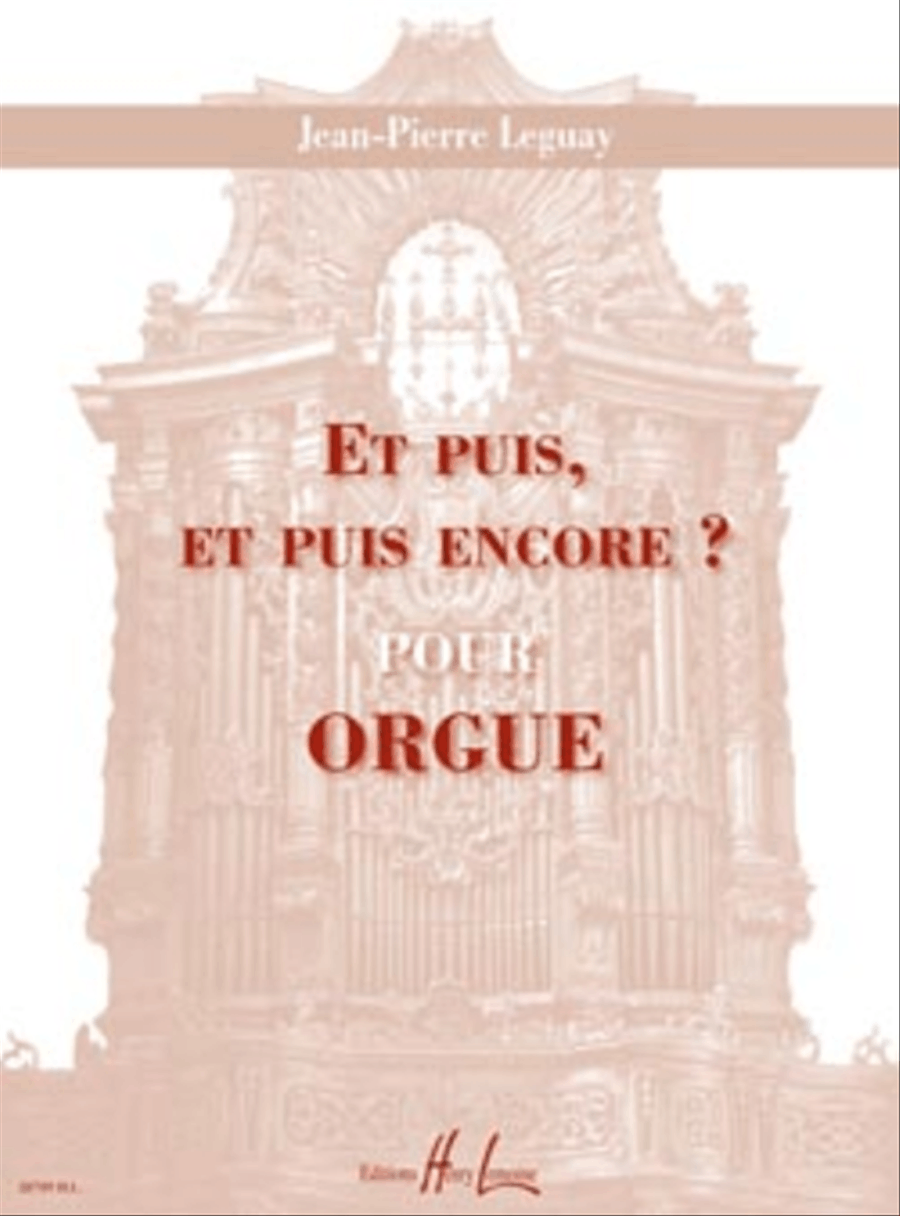
Composed by Jean-Pierre Leguay. Instrumental music. Contemporary. Score. 22 pages. Editions Henry Lemoine #28789. Published by Editions Henry Lemoine (LM.28789).
ISBN 9790230987899.
The title of the work is taken from Charles Baudelaire's poem Le Voyage. Without commenting on Baudelaire, but in a more or less concealed manner, the poem fostered the composition. Et puis, et puis encore ? progresses through five sections: Choeur à choeur, Double I, Tiento, Double II, Molto lento. Each of them ends with a calculated pause and a double bar that clearly places it as link in the overall continuity. The performer can either play every section, or only certain sections grouped according to a construction drawn from the following complete list:
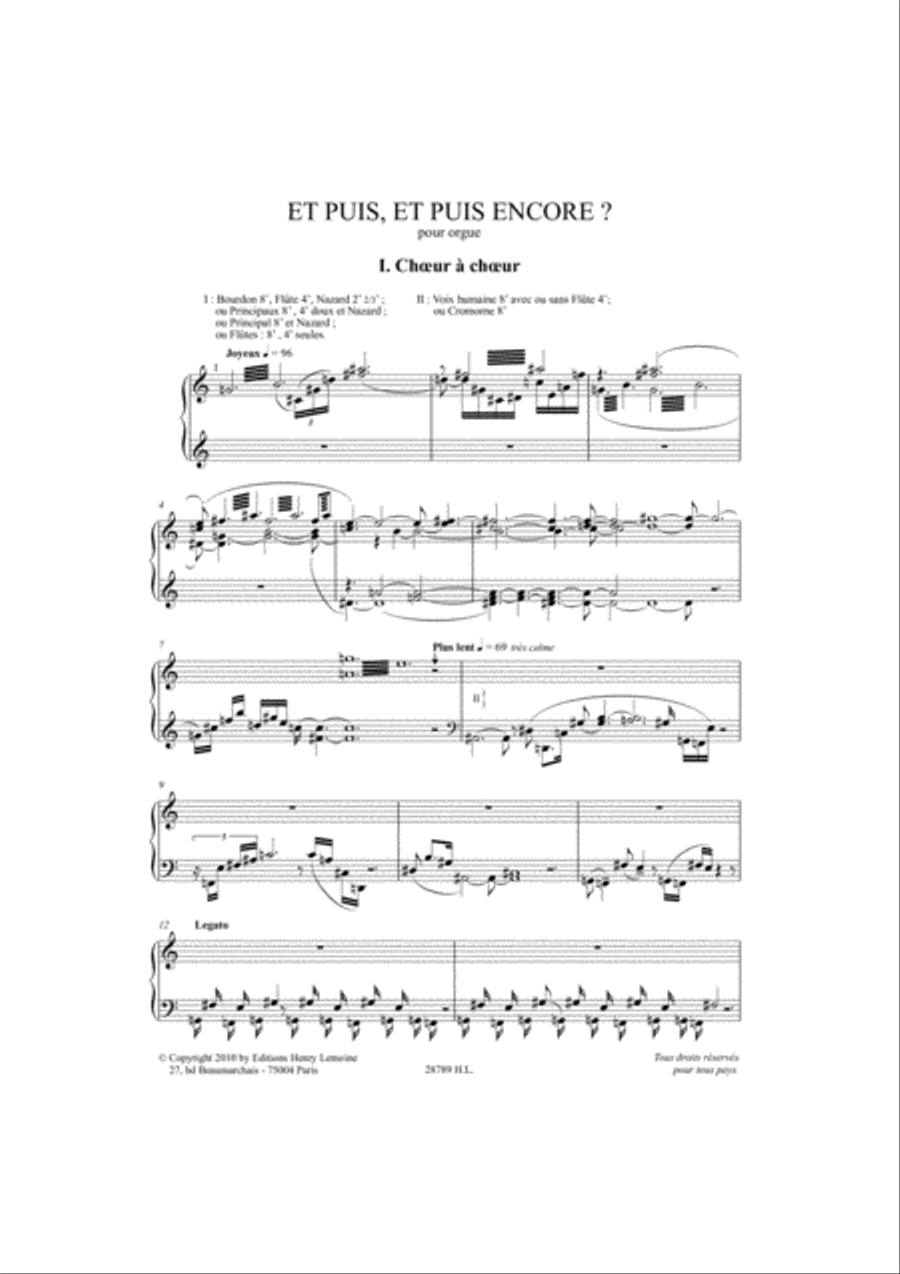
If during one of these groupings - each retaining through their direction something of the work's progression - two sections are in the same order as in the complete version of the score, it is preferable that at the end of the first of the two sections, the amplitude of the breath be respected. If there is some discontinuity with relation to the original version, the performer is at liberty to determine the nature of the sequence. Choeur à choeur, Tiento and Molto lento can be played individually. Et puis, et puis encore ? is written in such a way that it can be played on a single or double manual organ not extending beyond C 5, with or without short octave, and without using the pedals. Choeur à choeur: on two manuals, or on a single manual with register changes - Double I and Double II: on a single manual, or on two coupled - Tiento: on a single manual with no stops, or on two. The left hand in Tiento never extends beyond B 2, to include the cornets extending down to C. The slur between a chord and a rest draws attention to the exact length of the chord. The trills and tremolos, as well as the groups of semiquavers and demisemiquavers are played without an initial stress or slowed ending.
Composed by Jean-Pierre Leguay. Instrumental music. Contemporary. Score. 22 pages. Editions Henry Lemoine #28789. Published by Editions Henry Lemoine (LM.28789).
ISBN 9790230987899.
The title of the work is taken from Charles Baudelaire's poem Le Voyage. Without commenting on Baudelaire, but in a more or less concealed manner, the poem fostered the composition. Et puis, et puis encore ? progresses through five sections: Choeur à choeur, Double I, Tiento, Double II, Molto lento. Each of them ends with a calculated pause and a double bar that clearly places it as link in the overall continuity. The performer can either play every section, or only certain sections grouped according to a construction drawn from the following complete list:
If during one of these groupings - each retaining through their direction something of the work's progression - two sections are in the same order as in the complete version of the score, it is preferable that at the end of the first of the two sections, the amplitude of the breath be respected. If there is some discontinuity with relation to the original version, the performer is at liberty to determine the nature of the sequence. Choeur à choeur, Tiento and Molto lento can be played individually. Et puis, et puis encore ? is written in such a way that it can be played on a single or double manual organ not extending beyond C 5, with or without short octave, and without using the pedals. Choeur à choeur: on two manuals, or on a single manual with register changes - Double I and Double II: on a single manual, or on two coupled - Tiento: on a single manual with no stops, or on two. The left hand in Tiento never extends beyond B 2, to include the cornets extending down to C. The slur between a chord and a rest draws attention to the exact length of the chord. The trills and tremolos, as well as the groups of semiquavers and demisemiquavers are played without an initial stress or slowed ending.
Jean-Pierre Leguay Traduction: Jacqueline Rose
Preview: Et puis, et puis encore ?
Tell A Friend
Tell a friend (or remind yourself) about this product. We'll instantly send an email containing product info and a link to it. You may also enter a personal message.
We do not use or store email addresses from this form for any other purpose than sending your share email.
After purchase, you can download your MP3 from your Sheet Music Plus Digital Library - no software installation is necessary! You can also listen to your MP3 at any time in your Digital Library.
Learn about Smart Music
After purchase, you can download your Smart Music from your Sheet Music Plus Digital Library - no software installation is necessary! You can also download at any time in your Digital Library.
Learn about Digital Video
After purchase you can download your video from your Digital Library. Your video is in XX format and is playable on most pre-installed video players.