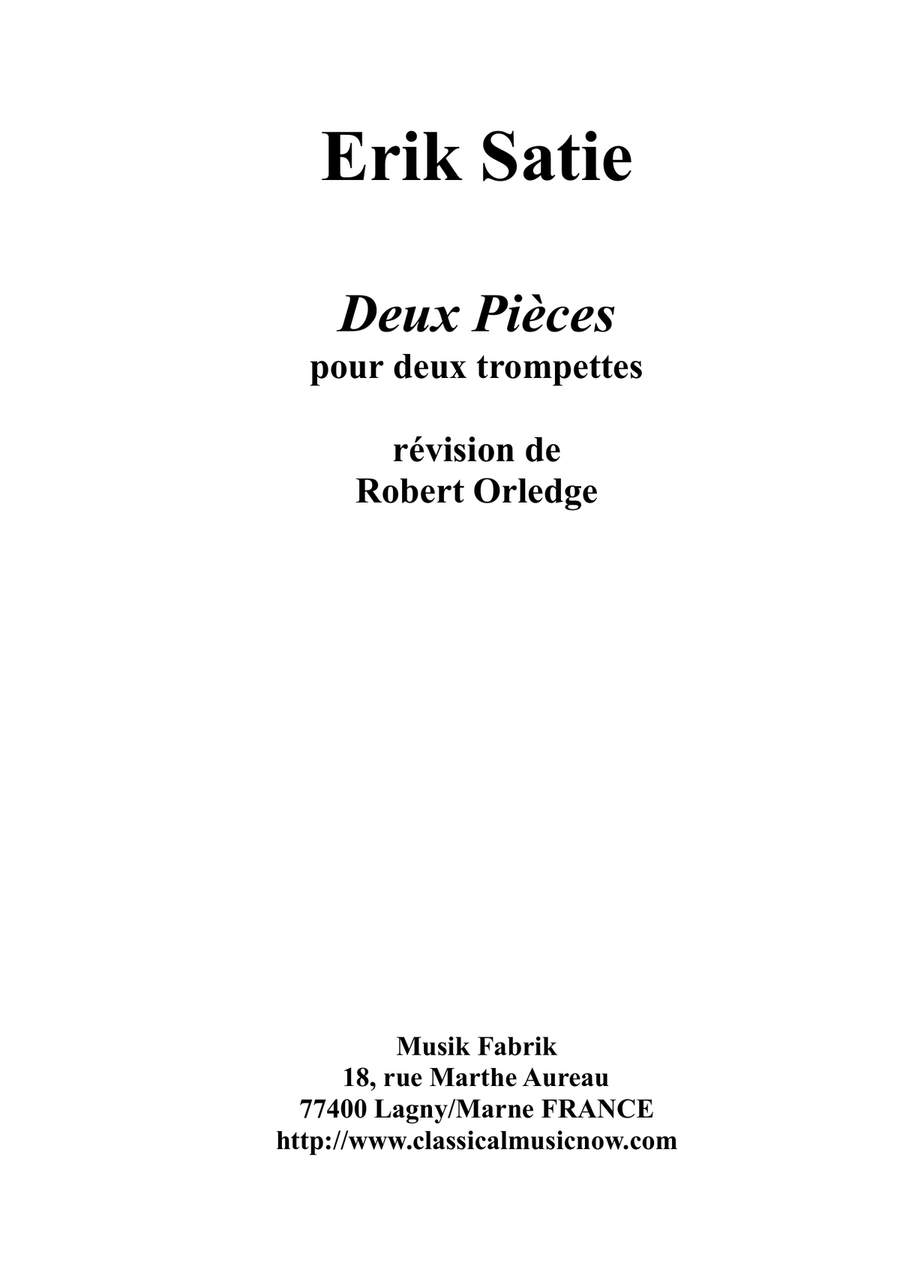
Composed by Erik Satie. Arranged by Robert Orledge. This edition: pdf. 20th Century, Classical, Contemporary. Score. 6 pages. Musik Fabrik Music Publishing #1218363. Published by Musik Fabrik Music Publishing (A0.1651720).
Satie’s interest in the trumpet dates from his late post-war period and seems to have been stimulated by commissions from avant-garde ephemeral journals. Thus the tiny Marche de Cocagne of November 1919 appeared as a frontispiece for Bertrand Guégan’s Almanach de Cocagne pour l’An 1920 (on page 7 beneath a woodcut by Raoul Dufy), and the Sonnerie pour réveiller le bon gros Roi des Singes (lequel qui ne dort toujours que d’un oeil) appeared in the first number of Leigh Henry’s journal Fanfare on 1 October 1921, alongside three others by Granville Bantock, Manuel de Falla and Eugène Goossens on pages 10-11. Joseph Holbrooke, Poulenc, Prokofiev and Sir Arthur Bliss contributed fanfares to issue No. 2, and a selection of these (including Satie’s) were performed at the opening of Goossens’ orchestral concert at the Queen’s Hall, London on 27 October 1921. One interesting sideline is that Guégan originally sent Satie a poem to set for his Almanach, and it was only because Satie felt he needed more than a few weeks to do this properly, that h substituted his little Marche de Cocagne, which had originally been written for the group of artists who met at Adrienne Monnier’s Latin Quarter bookshop ‘La Maison des Amis des Livres’ who were dubbed the ‘Potassons after the poet Léon-Paul Fargue’s fat cat, whose exploits Satie also celebrated in the last of his Ludions song cycle in 1923. He then used his extrovert, chromatic march to form the outer sections of the second of his Trois Petites Piecès montées whose orchestration he completed in late January 1920.
The lengthy title Fanfare for the good old King of the Monkeys (who only ever sleeps with one eye) might seem both bizarre and disproportionate for such a tiny piece, unless we know that Satie was fascinated by eyes and their power and especially by the concept of the single eye. The plot of his surrealist play Le Piège de Méduse (1913) revolves around Astolfo’s ability to ‘dance with one eye’ and Satie reported in his article ‘The Musician’s Day’ that ‘My sleep is deep, but I keep one eye open’. While many of his single eye references appear humorous or whimsical on the surface, some have more sinister associations with the evil eye of the devil or the all-seeing eye of ancient Egyptian mythology. In the text of ‘Méditation’, the last of the Avant-dernières pensées of 1915, the devil is mistaken for the wind of genius passing by, who gazes on the poet/creator ‘with an evil eye: a glass eye’. Satie, who believed himself haunted by the devil, was the poet in question. So, this little Sonnerie is a deeper and more personal piece than one might expect, and it is also a rare example of a Satie piece that survived in its original contrapuntal conception (including a canon at the third by inversion which is suddenly left high and dry in bar 8, followed by invertible counterpoint in bars 9-12).
Satie had learned his craft at the Schola Cantorum well, but his natural sense of proportion and occasion told him to make his last four bars more straightforward and climactic, though sufficiently quirky in harmonic terms to identify him unmistakably as their author. Who would ever imagine that the Sonnerie was originally written in D major and gained its brightness and essential character through a last-minute upward transposition - a stroke of genius?
This product was created by a member of ArrangeMe, Hal Leonard's global
self-publishing community of independent composers, arrangers, and songwriters.
ArrangeMe allows for the publication of unique arrangements of both popular
titles and original compositions from a wide variety of voices and backgrounds.
About Digital Downloads
Digital Downloads are downloadable sheet music files that can be viewed directly on
your computer, tablet or mobile device. Once you download your digital sheet music,
you can view and print it at home, school, or anywhere you want to make music, and
you don't have to be connected to the internet. Just purchase, download and play!
PLEASE NOTE: Your Digital Download will have a watermark at the bottom of each page
that will include your name, purchase date and number of copies purchased. You are
only authorized to print the number of copies that you have purchased. You may not
digitally distribute or print more copies than purchased for use (i.e., you may not
print or digitally distribute individual copies to friends or students).
Composed by Erik Satie. Arranged by Robert Orledge. This edition: pdf. 20th Century, Classical, Contemporary. Score. 6 pages. Musik Fabrik Music Publishing #1218363. Published by Musik Fabrik Music Publishing (A0.1651720).
Satie’s interest in the trumpet dates from his late post-war period and seems to have been stimulated by commissions from avant-garde ephemeral journals. Thus the tiny Marche de Cocagne of November 1919 appeared as a frontispiece for Bertrand Guégan’s Almanach de Cocagne pour l’An 1920 (on page 7 beneath a woodcut by Raoul Dufy), and the Sonnerie pour réveiller le bon gros Roi des Singes (lequel qui ne dort toujours que d’un oeil) appeared in the first number of Leigh Henry’s journal Fanfare on 1 October 1921, alongside three others by Granville Bantock, Manuel de Falla and Eugène Goossens on pages 10-11. Joseph Holbrooke, Poulenc, Prokofiev and Sir Arthur Bliss contributed fanfares to issue No. 2, and a selection of these (including Satie’s) were performed at the opening of Goossens’ orchestral concert at the Queen’s Hall, London on 27 October 1921. One interesting sideline is that Guégan originally sent Satie a poem to set for his Almanach, and it was only because Satie felt he needed more than a few weeks to do this properly, that h substituted his little Marche de Cocagne, which had originally been written for the group of artists who met at Adrienne Monnier’s Latin Quarter bookshop ‘La Maison des Amis des Livres’ who were dubbed the ‘Potassons after the poet Léon-Paul Fargue’s fat cat, whose exploits Satie also celebrated in the last of his Ludions song cycle in 1923. He then used his extrovert, chromatic march to form the outer sections of the second of his Trois Petites Piecès montées whose orchestration he completed in late January 1920.
The lengthy title Fanfare for the good old King of the Monkeys (who only ever sleeps with one eye) might seem both bizarre and disproportionate for such a tiny piece, unless we know that Satie was fascinated by eyes and their power and especially by the concept of the single eye. The plot of his surrealist play Le Piège de Méduse (1913) revolves around Astolfo’s ability to ‘dance with one eye’ and Satie reported in his article ‘The Musician’s Day’ that ‘My sleep is deep, but I keep one eye open’. While many of his single eye references appear humorous or whimsical on the surface, some have more sinister associations with the evil eye of the devil or the all-seeing eye of ancient Egyptian mythology. In the text of ‘Méditation’, the last of the Avant-dernières pensées of 1915, the devil is mistaken for the wind of genius passing by, who gazes on the poet/creator ‘with an evil eye: a glass eye’. Satie, who believed himself haunted by the devil, was the poet in question. So, this little Sonnerie is a deeper and more personal piece than one might expect, and it is also a rare example of a Satie piece that survived in its original contrapuntal conception (including a canon at the third by inversion which is suddenly left high and dry in bar 8, followed by invertible counterpoint in bars 9-12).
Satie had learned his craft at the Schola Cantorum well, but his natural sense of proportion and occasion told him to make his last four bars more straightforward and climactic, though sufficiently quirky in harmonic terms to identify him unmistakably as their author. Who would ever imagine that the Sonnerie was originally written in D major and gained its brightness and essential character through a last-minute upward transposition - a stroke of genius?
This product was created by a member of ArrangeMe, Hal Leonard's global
self-publishing community of independent composers, arrangers, and songwriters.
ArrangeMe allows for the publication of unique arrangements of both popular
titles and original compositions from a wide variety of voices and backgrounds.
About Digital Downloads
Digital Downloads are downloadable sheet music files that can be viewed directly on
your computer, tablet or mobile device. Once you download your digital sheet music,
you can view and print it at home, school, or anywhere you want to make music, and
you don't have to be connected to the internet. Just purchase, download and play!
PLEASE NOTE: Your Digital Download will have a watermark at the bottom of each page
that will include your name, purchase date and number of copies purchased. You are
only authorized to print the number of copies that you have purchased. You may not
digitally distribute or print more copies than purchased for use (i.e., you may not
print or digitally distribute individual copies to friends or students).
Preview: Erik Satie : Two Pieces for two trumpets
Tell A Friend
Tell a friend (or remind yourself) about this product. We'll instantly send an email containing product info and a link to it. You may also enter a personal message.
We do not use or store email addresses from this form for any other purpose than sending your share email.
After purchase, you can download your MP3 from your Sheet Music Plus Digital Library - no software installation is necessary! You can also listen to your MP3 at any time in your Digital Library.
Learn about Smart Music
After purchase, you can download your Smart Music from your Sheet Music Plus Digital Library - no software installation is necessary! You can also download at any time in your Digital Library.
Learn about Digital Video
After purchase you can download your video from your Digital Library. Your video is in XX format and is playable on most pre-installed video players.