Details
SKU: A0.1180746
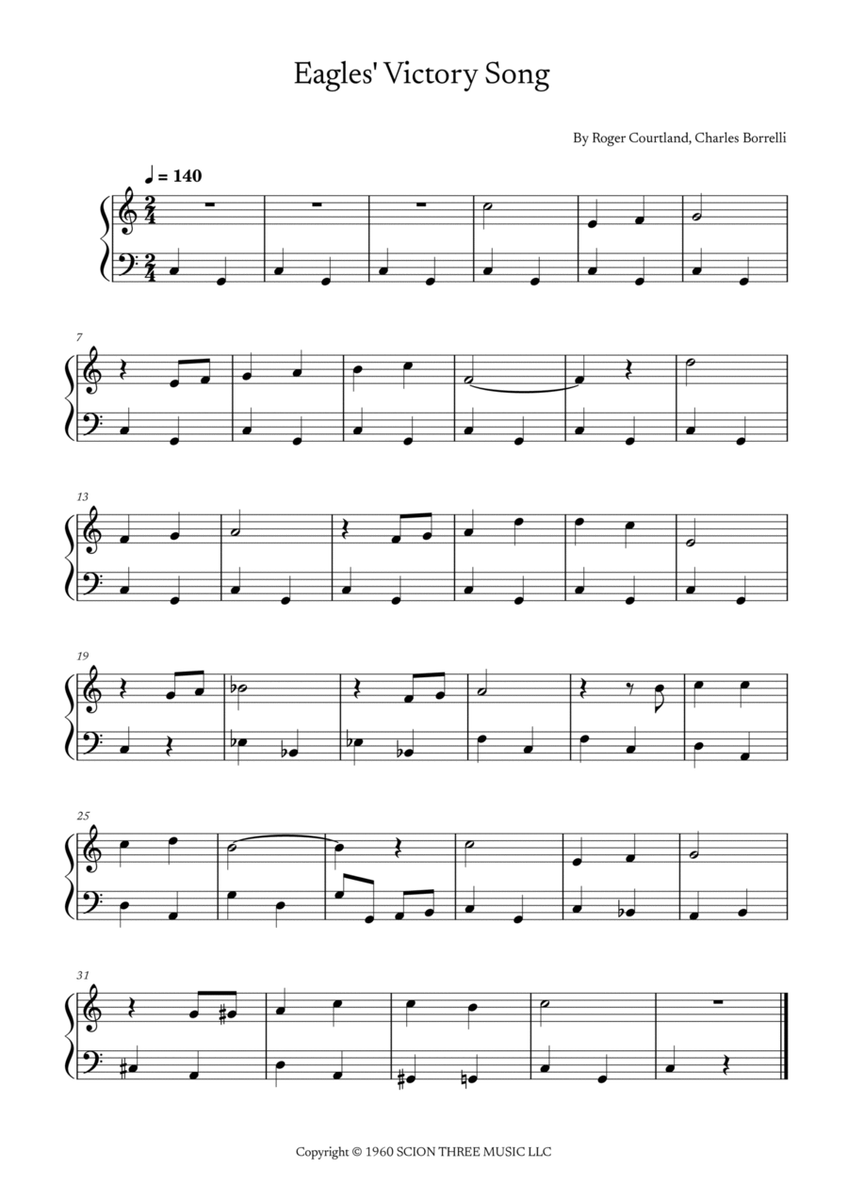
By Dirk Quinn Band. Composed by Charles Borrelli and Roger Courtland. Arranged by Marcony Carvalho. 20th Century,Classical,Historic,Patriotic,Pop. Score. 1 pages. Zedas Couve #780613. Published by Zedas Couve (A0.1180746)."The Eagles' Victory Song" was the creation of Charles Borrelli and Richard Courtland Harrison, a Washington, D.C. music teacher and arranger for jazz guitarist Charlie Byrd. The song was mistakenly credited to "R. Courtland" by the Copyright office and in various editions of Eagles programs from the late 1950s through the 1960s.
In 1963, Jerry Wolman purchased the Philadelphia Eagles. Wolman was a sports fan growing up and loved hearing the Washington Redskins' fight song "Hail to the Redskins" at games. Spawning from his admiration for the Redskins' song, Wolman searched for musicians to implement a team song for the Eagles, and founded The Philadelphia Eagles' Sound of Brass band in 1964. The group included 200 musicians and dancers, and was led by Arlen Saylor, who was appointed as the Eagles' entertainment director in 1966 and is credited with penning an arrangement of the fight song that the band played at home games during halftime in the 1960s. Wolman's push to popularize the fight song flew under the radar, however, and in 1969 the Sound of Brass band was discontinued.
The song came back into light in 1997, when Bobby Mansure, founder of an unofficial Eagles pep band, asked team management to allow the band to play in the parking lot during home games. Management gave Mansure's pep band an audition, allowing them to play at two preseason games to gauge fan reaction. The song went over so well that Mansure and the band retained a permanent position as the official Philadelphia Eagles Pep Band.
In 1998, following Mansure's reintroduction of the song, Eagles management attempted to rebuild its popularity among fans by changing some aspects of the song: they modified the key, changed the opening lyric from "Fight, Eagles Fight" to "Fly, Eagles Fly", and re-marketed the song with that as the title. In addition, they appended the popular "E-A-G-L-E-S" chant—which had emerged in the 1980s—to the end of the song. While management planned to play the song throughout the 1998 season, the Eagles' poor performance that year caused them to hold off reintroducing the song until the following year. The Eagles fared better during their 1999 season, and subsequently, the fight song was played after every score.
About ArrangeMe
This product was created by a member of ArrangeMe, Hal Leonard's self-publishing community for independent composers, arrangers, and songwriters. Discover unique arrangements of popular titles and original compositions from diverse creators. The length, difficulty, and pricing are determined by the arranger or composer.
About Digital Downloads
Digital Downloads let you instantly access sheet music on your computer, tablet, or mobile device. Print your sheet music anywhere, anytime, or play it straight from your device—no internet connection is required after download.
Each Digital Download includes a watermark with your name, purchase date, and the number of copies purchased. You may only print or use the number of copies purchased. Redistribution or unauthorized printing is prohibited.
- ArrangeMe:
- Zedas Couve
- Series:
- ArrangeMe
- Instrument:
- Piano and Keyboard Piano Easy Piano
- Publisher:
- Zedas Couve