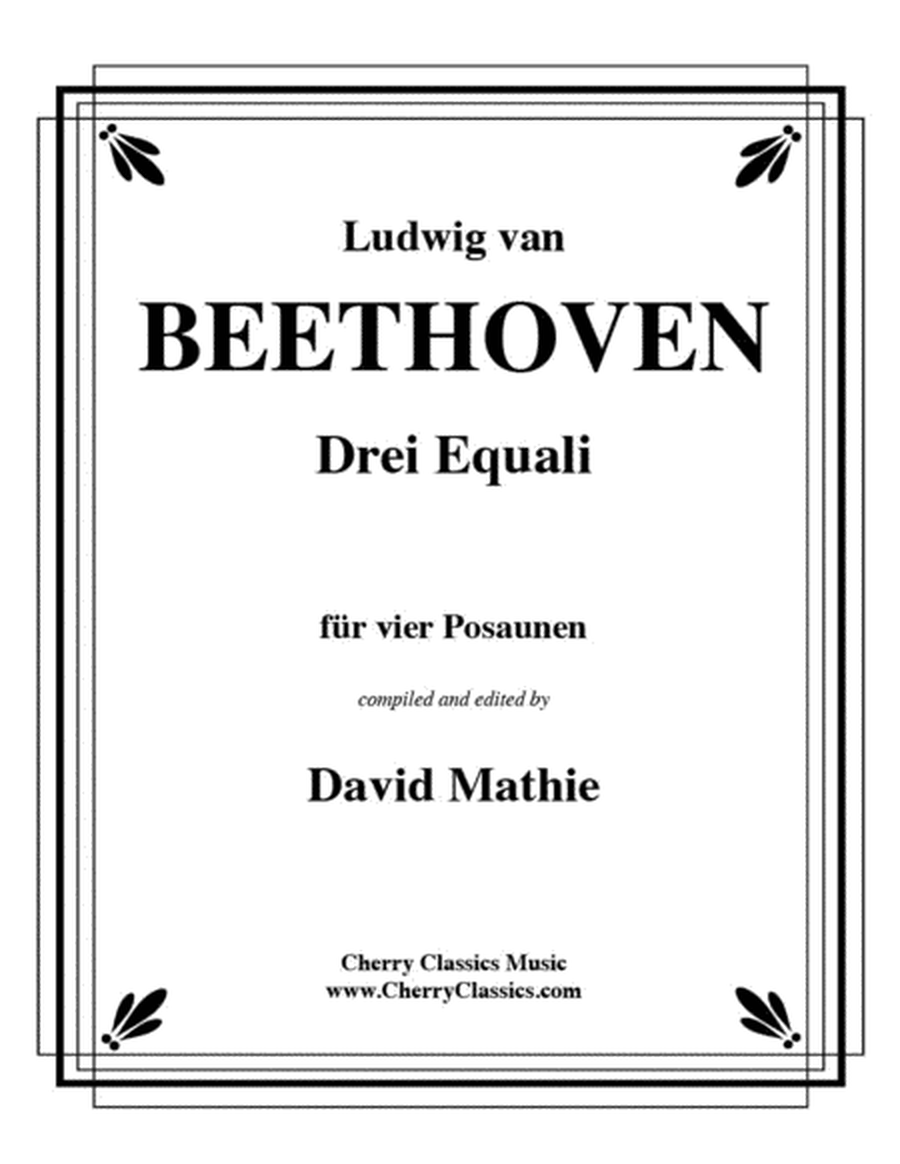
Composed by Ludwig van Beethoven. Arranged by David Mathie. German romantic. Score and parts. Cherry Classics #CC2475. Published by Cherry Classics (CY.CC2475).
Equali were works written for equal, or similar, instruments; in the eighteenth century they were almost always used for funeral services and usually employed a quartet of trombones. The most famous of these were the three Beethoven wrote for the Linz Cathedral in Austria on All Soul's Day 1812. Two of these were adapted later for male voices and were sung at Beethoven's funeral.
These pieces are some of the most famous works for trombones, no doubt due to the fact that they were composed by Beethoven. They were commissioned by Franz Xaver Gloggl, Kappelmeister of the city of Linz, while Beethoven was visiting his brother. According to later accounts by Gloggl's son, although his father had a complete collection of trombones (soprano, alto, tenor, bass or quart) the three Equali were performed by a traditional quartet of alto, tenor and bass trombones.
This edition offers a compromise: the original score and parts are given exactly as written in the complete works, and a version designed for the less experienced players: the three movements are transposed down one step, edited with minor musical suggestions, and all four parts are written in bass clef.
Dr. Mathie has done the Trombone world a great service in bringing this great work in its two forms to publication.
Composed by Ludwig van Beethoven. Arranged by David Mathie. German romantic. Score and parts. Cherry Classics #CC2475. Published by Cherry Classics (CY.CC2475).
Equali were works written for equal, or similar, instruments; in the eighteenth century they were almost always used for funeral services and usually employed a quartet of trombones. The most famous of these were the three Beethoven wrote for the Linz Cathedral in Austria on All Soul's Day 1812. Two of these were adapted later for male voices and were sung at Beethoven's funeral.
These pieces are some of the most famous works for trombones, no doubt due to the fact that they were composed by Beethoven. They were commissioned by Franz Xaver Gloggl, Kappelmeister of the city of Linz, while Beethoven was visiting his brother. According to later accounts by Gloggl's son, although his father had a complete collection of trombones (soprano, alto, tenor, bass or quart) the three Equali were performed by a traditional quartet of alto, tenor and bass trombones.
This edition offers a compromise: the original score and parts are given exactly as written in the complete works, and a version designed for the less experienced players: the three movements are transposed down one step, edited with minor musical suggestions, and all four parts are written in bass clef.
Dr. Mathie has done the Trombone world a great service in bringing this great work in its two forms to publication.
Preview: Drei Equali (Three Equale) for four Trombones
Tell A Friend
Tell a friend (or remind yourself) about this product. We'll instantly send an email containing product info and a link to it. You may also enter a personal message.
We do not use or store email addresses from this form for any other purpose than sending your share email.
After purchase, you can download your MP3 from your Sheet Music Plus Digital Library - no software installation is necessary! You can also listen to your MP3 at any time in your Digital Library.
Learn about Smart Music
After purchase, you can download your Smart Music from your Sheet Music Plus Digital Library - no software installation is necessary! You can also download at any time in your Digital Library.
Learn about Digital Video
After purchase you can download your video from your Digital Library. Your video is in XX format and is playable on most pre-installed video players.