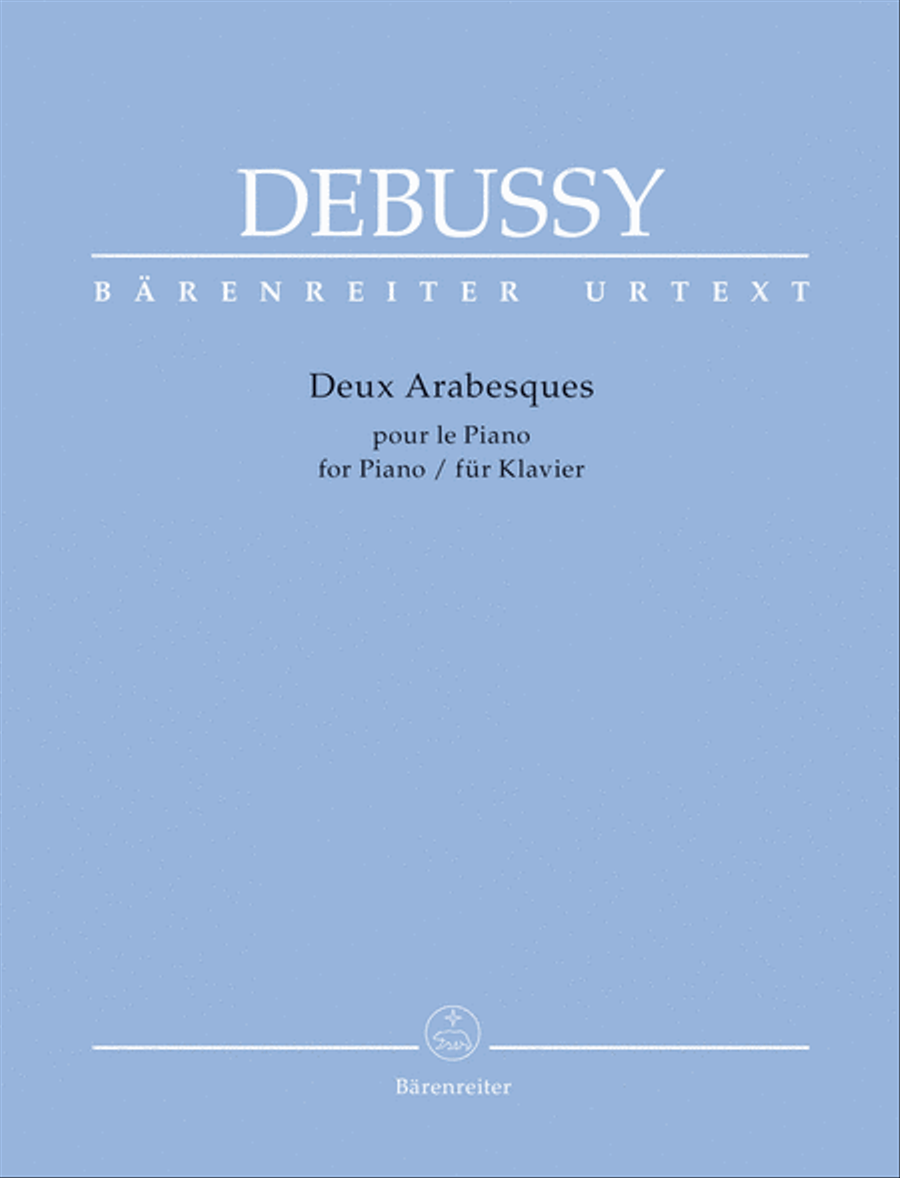
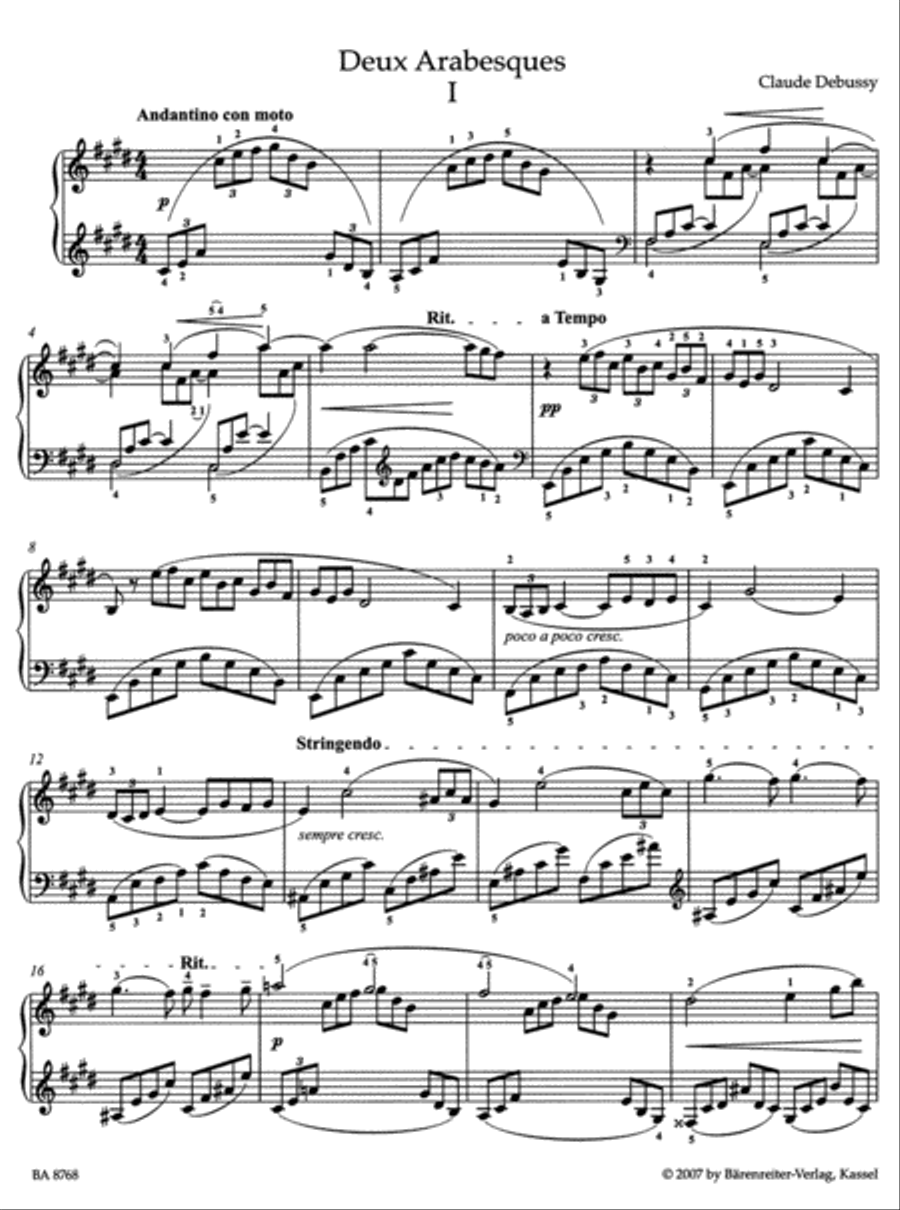
Composed by Claude Debussy. Edited by Regina Back. This edition: urtext edition. Stapled. Barenreiter Urtext. With fingering. Performance score. Baerenreiter Verlag #BA08768. Published by Baerenreiter Verlag (BA.BA08768).
ISBN 9790006532803. 12.2 x 9.57 inches. Fingerings by F. Palme.
Close on the heels of Regina Back’s critical edition of Debussy’s Children’s Corner come the equally popular Deux Arabesques in the definitive Urtext performing edition.
These two jewels of the piano literature were first published in 1891 and made available at the time in a relatively small print run of 300 copies. In 1903 the French publisher Durand attempting to capitalize on Debussy’s quickly growing fame published the Arabesque No.1 in an advertisement in Le Figaro and between 1904 and the new engraving with corrections and revisions in 1912 more than 50,000 copies were sold!
Bärenreiter’s new Urtext edition while drawing on all known sources, documents the geneses of the compositions until 1912 and the new edition is based on this corrected 1912 re-engraving.
About Barenreiter Urtext
What can I expect from a Barenreiter Urtext edition?
MUSICOLOGICALLY SOUND - A reliable musical text based on all available sources - A description of the sources - Information on the genesis and history of the work - Valuable notes on performance practice - Includes an introduction with critical commentary explaining source discrepancies and editorial decisions
... AND PRACTICAL - Page-turns, fold-out pages, and cues where you need them - A well-presented layout and a user-friendly format - Excellent print quality - Superior paper and binding
Composed by Claude Debussy. Edited by Regina Back. This edition: urtext edition. Stapled. Barenreiter Urtext. With fingering. Performance score. Baerenreiter Verlag #BA08768. Published by Baerenreiter Verlag (BA.BA08768).
ISBN 9790006532803. 12.2 x 9.57 inches. Fingerings by F. Palme.
Close on the heels of Regina Back’s critical edition of Debussy’s Children’s Corner come the equally popular Deux Arabesques in the definitive Urtext performing edition.
These two jewels of the piano literature were first published in 1891 and made available at the time in a relatively small print run of 300 copies. In 1903 the French publisher Durand attempting to capitalize on Debussy’s quickly growing fame published the Arabesque No.1 in an advertisement in Le Figaro and between 1904 and the new engraving with corrections and revisions in 1912 more than 50,000 copies were sold!
Bärenreiter’s new Urtext edition while drawing on all known sources, documents the geneses of the compositions until 1912 and the new edition is based on this corrected 1912 re-engraving.
About Barenreiter Urtext
What can I expect from a Barenreiter Urtext edition?
MUSICOLOGICALLY SOUND - A reliable musical text based on all available sources - A description of the sources - Information on the genesis and history of the work - Valuable notes on performance practice - Includes an introduction with critical commentary explaining source discrepancies and editorial decisions
... AND PRACTICAL - Page-turns, fold-out pages, and cues where you need them - A well-presented layout and a user-friendly format - Excellent print quality - Superior paper and binding
Preview: Deux Arabesques for Piano
Tell A Friend
Tell a friend (or remind yourself) about this product. We'll instantly send an email containing product info and a link to it. You may also enter a personal message.
We do not use or store email addresses from this form for any other purpose than sending your share email.
After purchase, you can download your MP3 from your Sheet Music Plus Digital Library - no software installation is necessary! You can also listen to your MP3 at any time in your Digital Library.
Learn about Smart Music
After purchase, you can download your Smart Music from your Sheet Music Plus Digital Library - no software installation is necessary! You can also download at any time in your Digital Library.
Learn about Digital Video
After purchase you can download your video from your Digital Library. Your video is in XX format and is playable on most pre-installed video players.