19783746
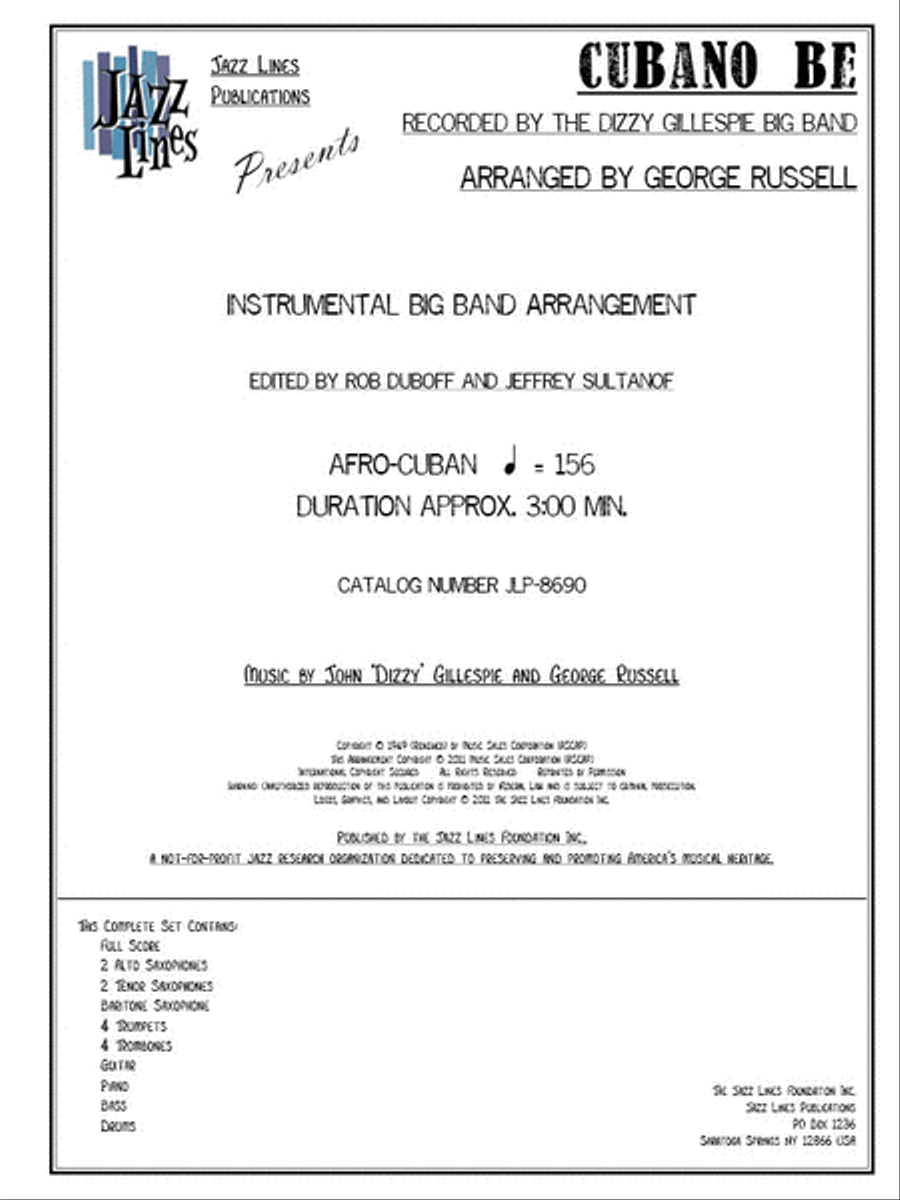
Cubano Be
19783746
19783746
19783746
Copyright Material for Preview Only - Sheet Music Plus
Big band (2 Alto Saxophones, 2 Tenor Saxophones, Baritone Saxophone, 4 Trumpets, 3 Trombones, Guitar, Piano, Bass, Drums) - Difficult
SKU: JL.JLP-8690
By The Dizzy Gillespie Big Band. Edited by Rob Duboff and Jeffrey Sultanof. Arranged by George Russell. Afro-Cuban. Score and parts. Published by Jazz Lines Publications (JL.JLP-8690).
This ground-breaking arrangement was written by George Russell in 1947 for the Dizzy Gillespie Big Band. It was first recorded live at Carnegie Hall then recorded at one of the last sessions Dizzy Gillespie made for RCA Victor in 1947 (before another recording ban took place during most of 1948). The importance of Cubano Be (and its sister piece, Cubano Bop) is that it signaled to the music community that Afro-Cuban rhythms (and Latin influences in general) could be merged with jazz. Through these performances and recordings, Afro-Cuban arrangements found their way to the concert hall. In 1949 J.J. Robbins & Sons published a stock arrangement of this tune that was nearly identical to the arrangement from Dizzy's book. The only major difference was that the published version was for 3 trumpets instead of 4. We have recreated the 4th trumpet part.
Big band (2 Alto Saxophones, 2 Tenor Saxophones, Baritone Saxophone, 4 Trumpets, 3 Trombones, Guitar, Piano, Bass, Drums) - Difficult
SKU: JL.JLP-8690
By The Dizzy Gillespie Big Band. Edited by Rob Duboff and Jeffrey Sultanof. Arranged by George Russell. Afro-Cuban. Score and parts. Published by Jazz Lines Publications (JL.JLP-8690).
This ground-breaking arrangement was written by George Russell in 1947 for the Dizzy Gillespie Big Band. It was first recorded live at Carnegie Hall then recorded at one of the last sessions Dizzy Gillespie made for RCA Victor in 1947 (before another recording ban took place during most of 1948). The importance of Cubano Be (and its sister piece, Cubano Bop) is that it signaled to the music community that Afro-Cuban rhythms (and Latin influences in general) could be merged with jazz. Through these performances and recordings, Afro-Cuban arrangements found their way to the concert hall. In 1949 J.J. Robbins & Sons published a stock arrangement of this tune that was nearly identical to the arrangement from Dizzy's book. The only major difference was that the published version was for 3 trumpets instead of 4. We have recreated the 4th trumpet part.
Tell a friend (or remind yourself) about this product. We'll instantly send an email containing product info and a link to it. You may also enter a personal message.
We do not use or store email addresses from this form for any other purpose than sending your share email.
Read our Privacy Policy.
After purchase, you can download your MP3 from your Sheet Music Plus Digital Library - no software installation is necessary! You can also listen to your MP3 at any time in your Digital Library.
After purchase, you can download your Smart Music from your Sheet Music Plus Digital Library - no software installation is necessary! You can also download at any time in your Digital Library.
After purchase you can download your video from your Digital Library. Your video is in XX format and is playable on most pre-installed video players.