Details
- Ensembles:
- Small Ensemble
- Genres:
- Standards Contemporary
- Composers:
- Carson Cooman
- Publishers:
- Musik Fabrik Music Publishing
- Series:
- ArrangeMe
- Format:
- Set of Parts Score and Parts
- Item types:
- Digital
- Level:
- Advanced
- Artist:
- Carson Cooman
- Usages:
- School and Community
- Number of Pages:
- 75
SKU: A0.533571
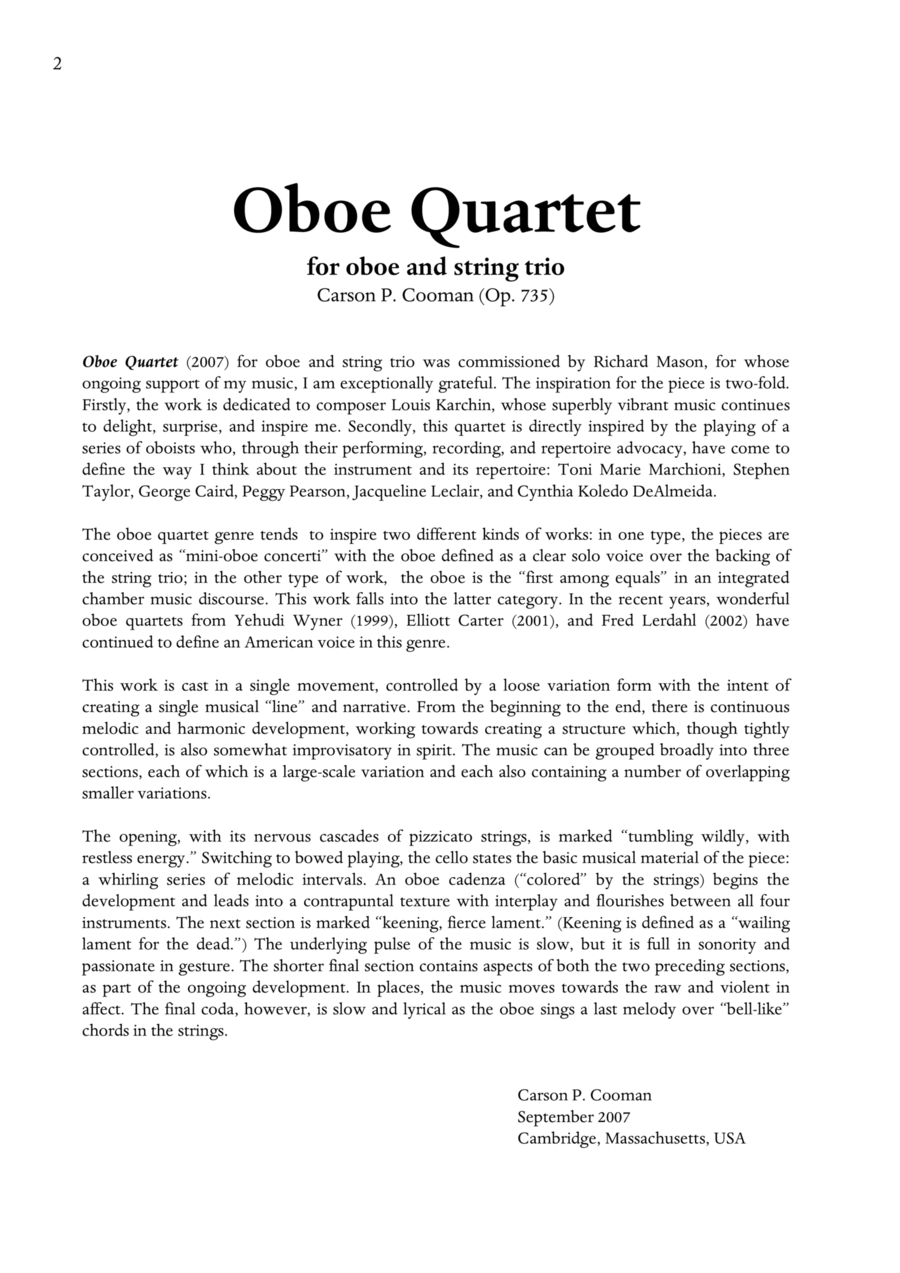
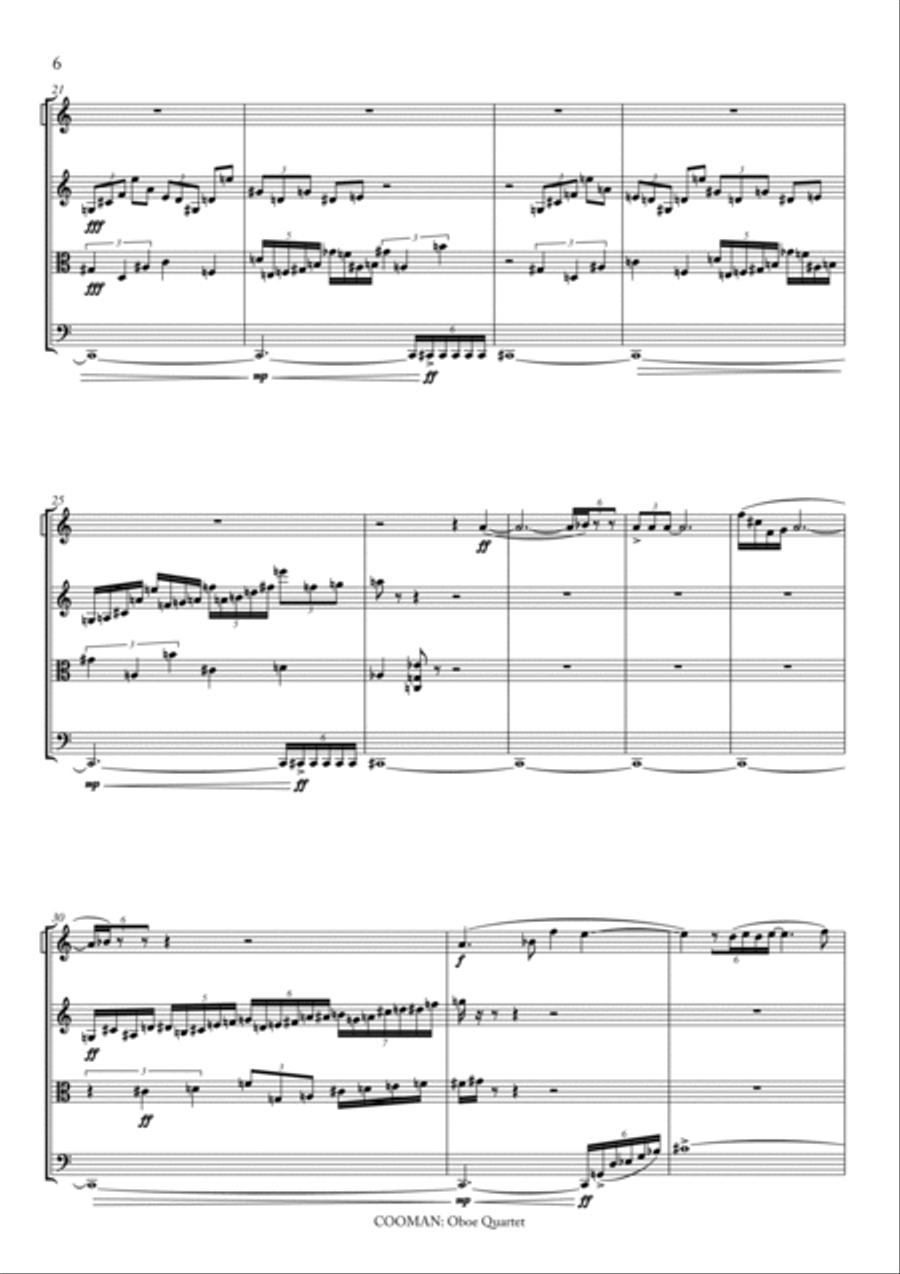
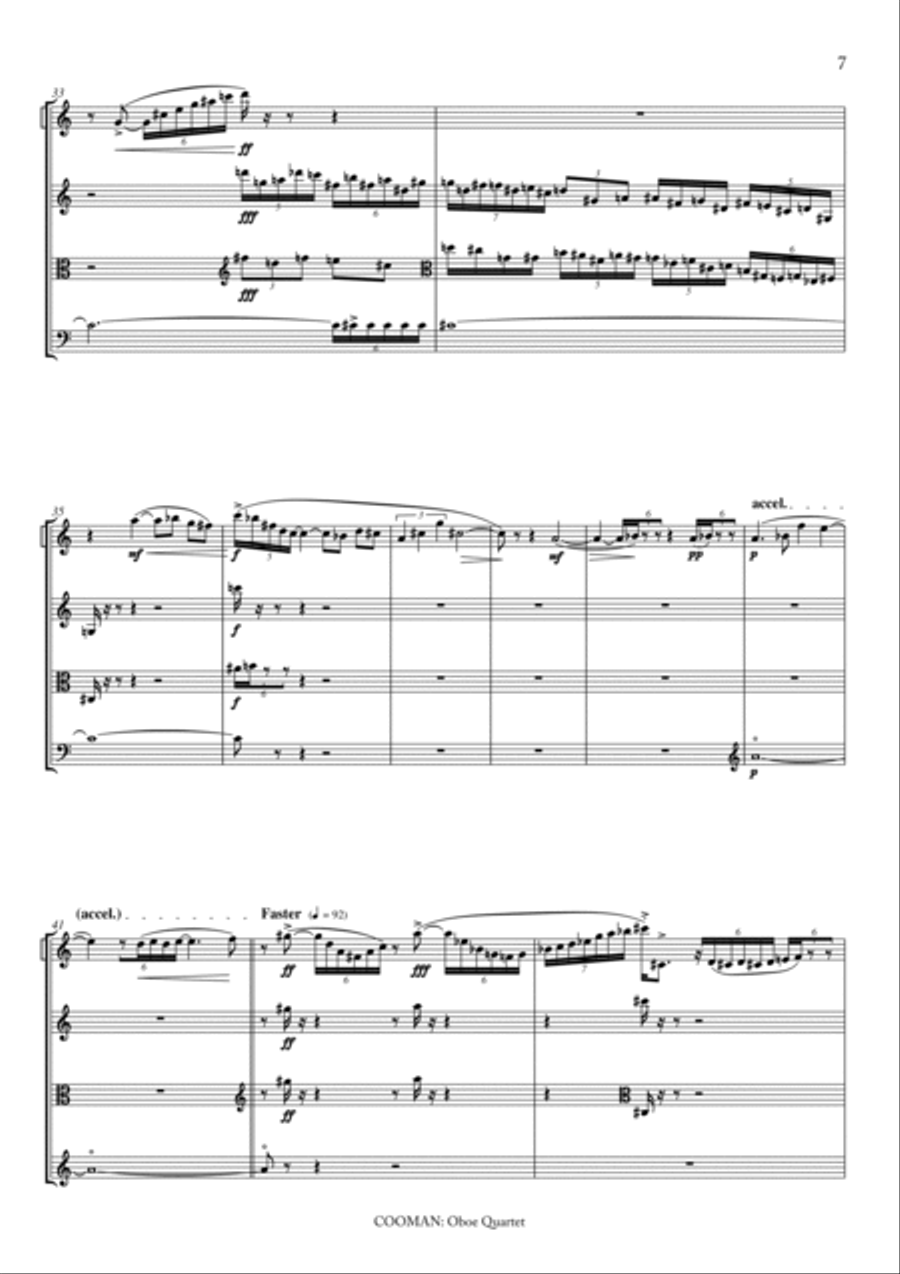
Composed by Carson Cooman. Contemporary,Standards. Score and parts. 75 pages. Musik Fabrik Music Publishing #3022637. Published by Musik Fabrik Music Publishing (A0.533571).Oboe Quartet (2007) for oboe and string trio was commissioned by Richard Mason, for whose ongoing support of my music, I am exceptionally grateful. The inspiration for the piece is two-fold. Firstly, the work is dedicated to composer Louis Karchin, whose superbly vibrant music continues to delight, surprise, and inspire me. Secondly, this quartet is directly inspired by the playing of a series of oboists who, through their performing, recording, and repertoire advocacy, have come to define the way I think about the instrument and its repertoire: Toni Marie Marchioni, Stephen Taylor, George Caird, Peggy Pearson, Jacqueline Leclair, and Cynthia Koledo DeAlmeida. The oboe quartet genre tends to inspire two different kinds of works: in one type, the pieces are conceived as “mini-oboe concerti” with the oboe defined as a clear solo voice over the backing of the string trio; in the other type of work, the oboe is the “first among equals” in an integrated chamber music discourse. This work falls into the latter category. In the recent years, wonderful oboe quartets from Yehudi Wyner (1999), Elliott Carter (2001), and Fred Lerdahl (2002) have continued to define an American voice in this genre. This work is cast in a single movement, controlled by a loose variation form with the intent of creating a single musical “line” and narrative. From the beginning to the end, there is continuous melodic and harmonic development, working towards creating a structure which, though tightly
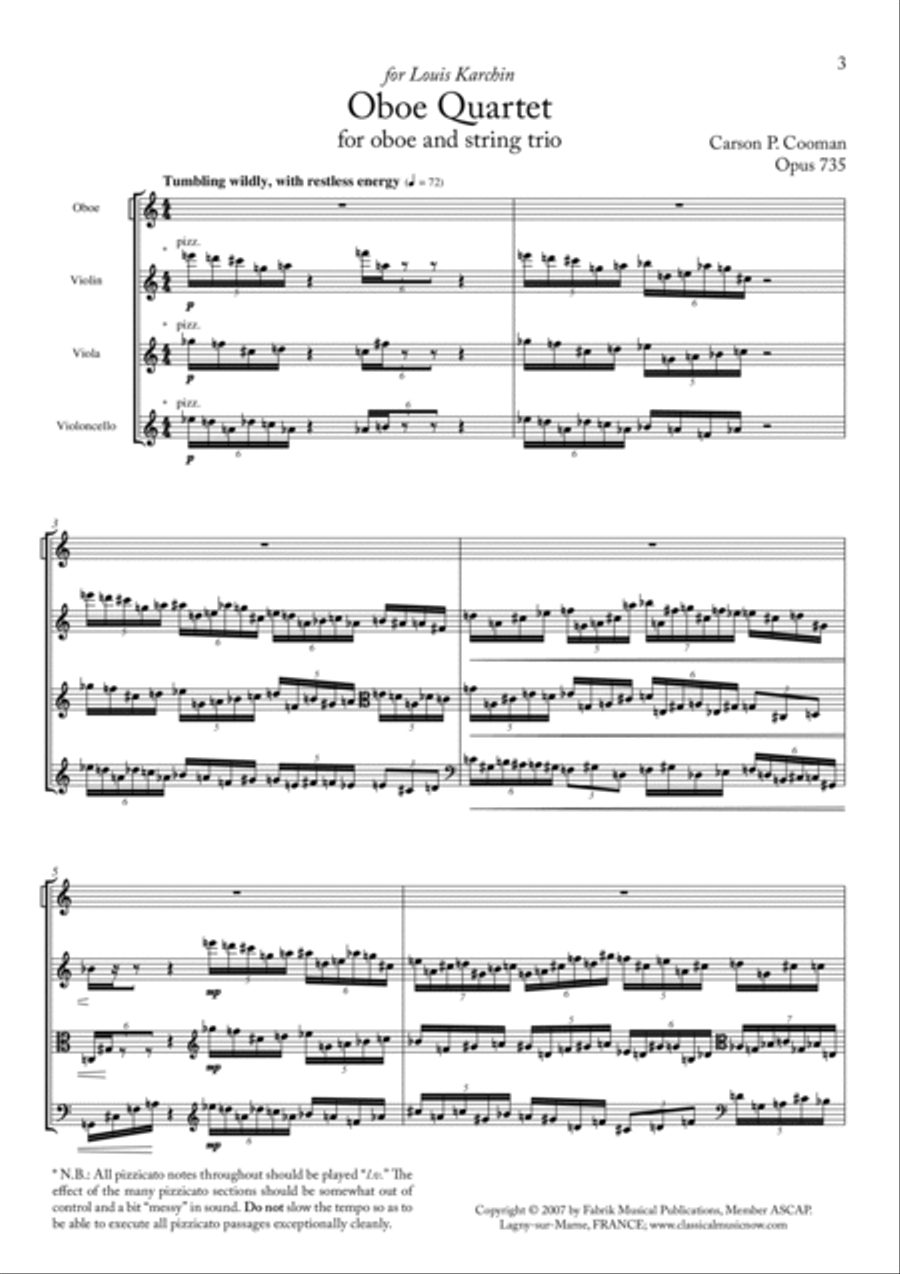
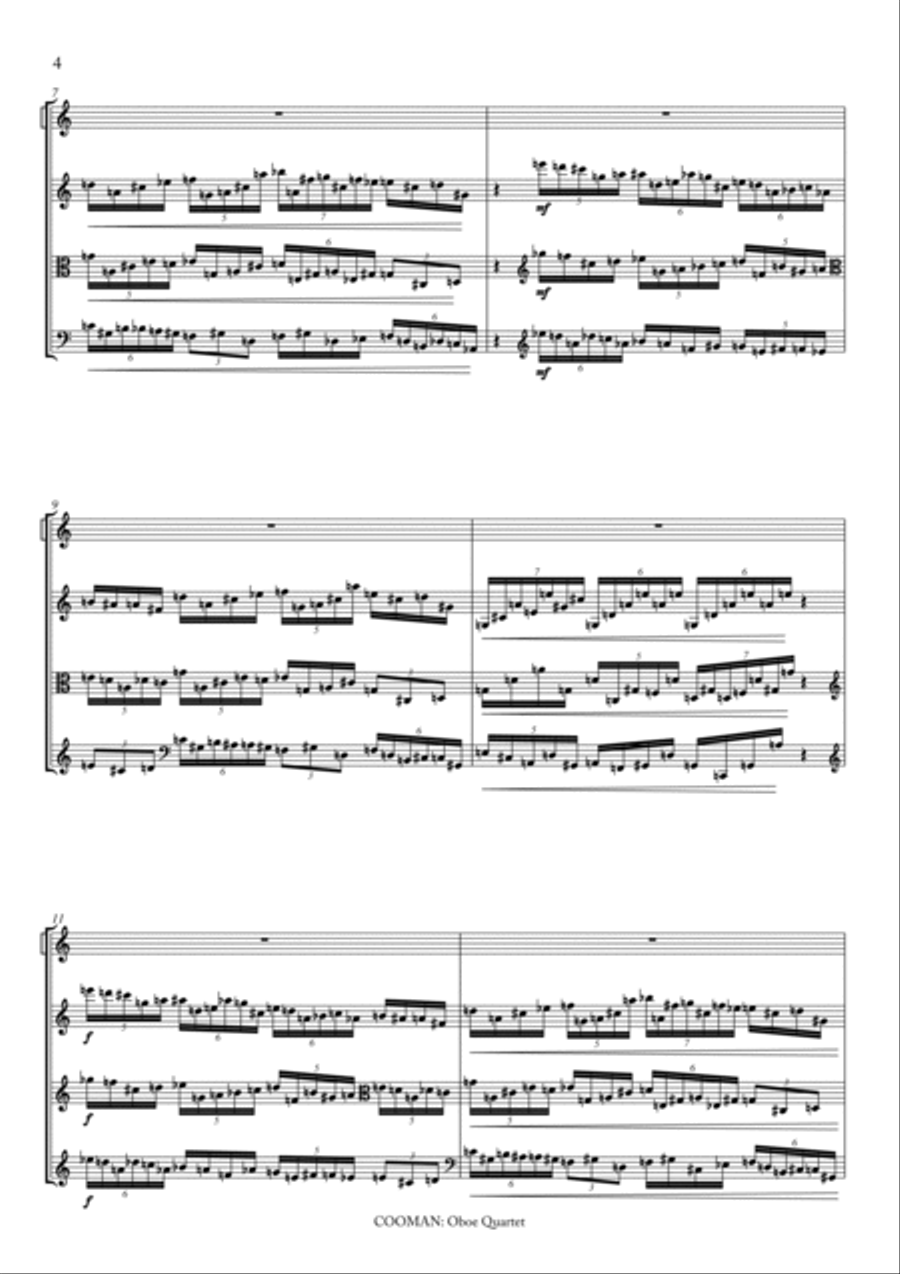
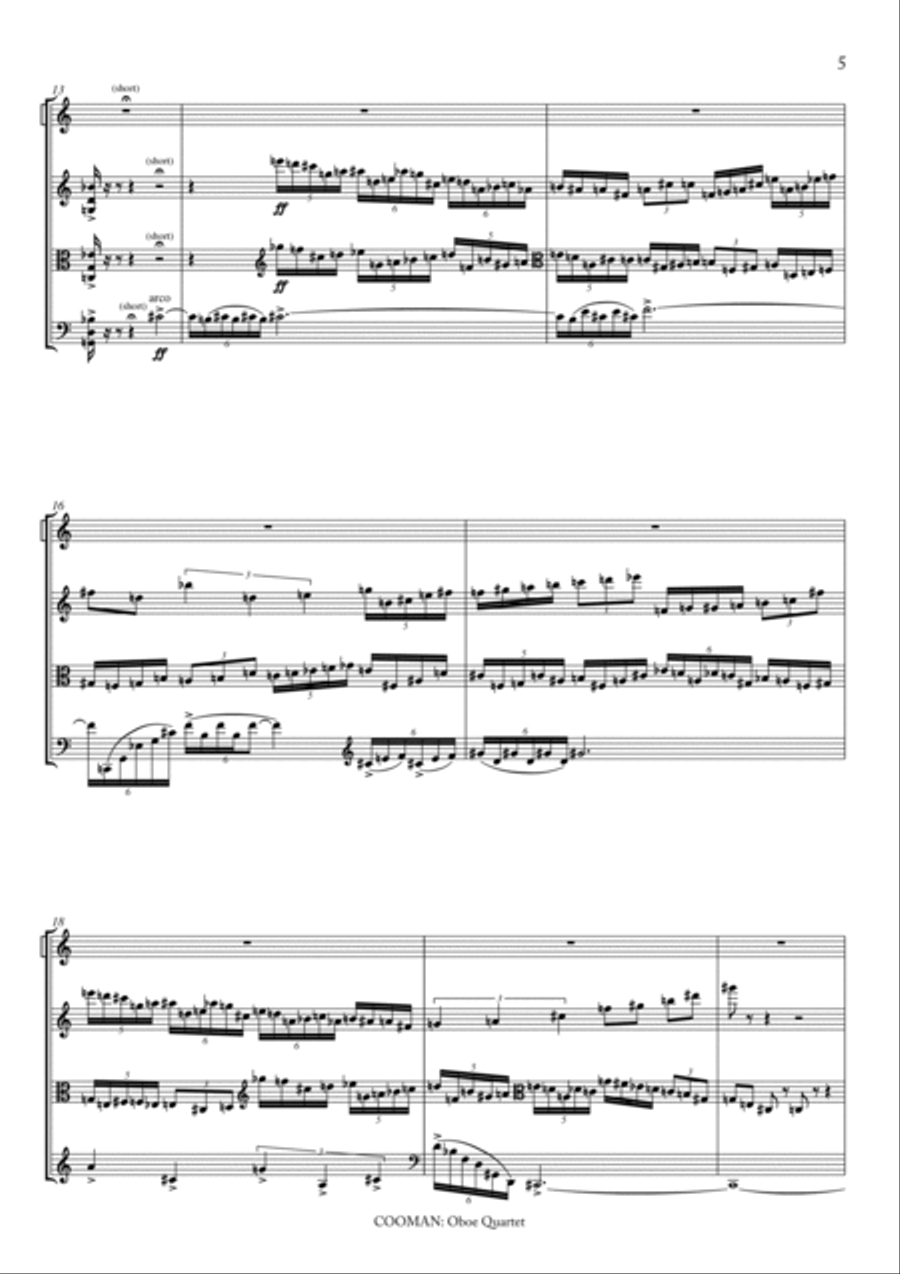
controlled, is also somewhat improvisatory in spirit. The music can be grouped broadly into three sections, each of which is a large-scale variation and each also containing a number of overlapping smaller variations. The opening, with its nervous cascades of pizzicato strings, is marked “tumbling wildly, with restless energy.” Switching to bowed playing, the cello states the basic musical material of the piece: a whirling series of melodic intervals. An oboe cadenza (“colored” by the strings) begins the development and leads into a contrapuntal texture with interplay and flourishes between all four instruments. The next section is marked “keening, fierce lament.” (Keening is defined as a “wailing lament for the dead.”) The underlying pulse of the music is slow, but it is full in sonority and passionate in gesture. The shorter final section contains aspects of both the two preceding sections, as part of the ongoing development. In places, the music moves towards the raw and violent in affect. The final coda, however, is slow and lyrical as the oboe sings a last melody over “bell-like” chords in the strings.
About ArrangeMe
This product was created by a member of ArrangeMe, Hal Leonard's self-publishing community for independent composers, arrangers, and songwriters. Discover unique arrangements of popular titles and original compositions from diverse creators. The length, difficulty, and pricing are determined by the arranger or composer.
About Digital Downloads
Digital Downloads let you instantly access sheet music on your computer, tablet, or mobile device. Print your sheet music anywhere, anytime, or play it straight from your device—no internet connection is required after download.
Each Digital Download includes a watermark with your name, purchase date, and the number of copies purchased. You may only print or use the number of copies purchased. Redistribution or unauthorized printing is prohibited.
- More by this Composer:
- Carson Cooman Carson Cooman Choir Carson Cooman Organ Accompaniment Carson Cooman Piano
- ArrangeMe:
- Musik Fabrik Music Publishing
- Series:
- ArrangeMe
- Artists:
- Carson Cooman
- Ensemble:
- Small Ensemble
- Publisher:
- Musik Fabrik Music Publishing