Order two or more copies of the same title and we'll automatically give you 5% off list price on that title.
To get 2+ Pricing , just add two or more copies of a title to your shopping cart. Your discount will be immediately applied to your order.
Sale titles, hymnals, and ShowKits (MTI's Broadway Junior Collection, Getting to Know... Collection (G2K) and MTI's Kids Collection) do not qualify for 2+ Pricing
If you have any questions or comments regarding 2+ Pricing , please visit our Help Center to find more information or chat with our support team
Composed by Carson Cooman. Baroque,Contemporary,Sacred. Octavo. 82 pages. Musik Fabrik Music Publishing #3043975. Published by Musik Fabrik Music Publishing (A0.535388).
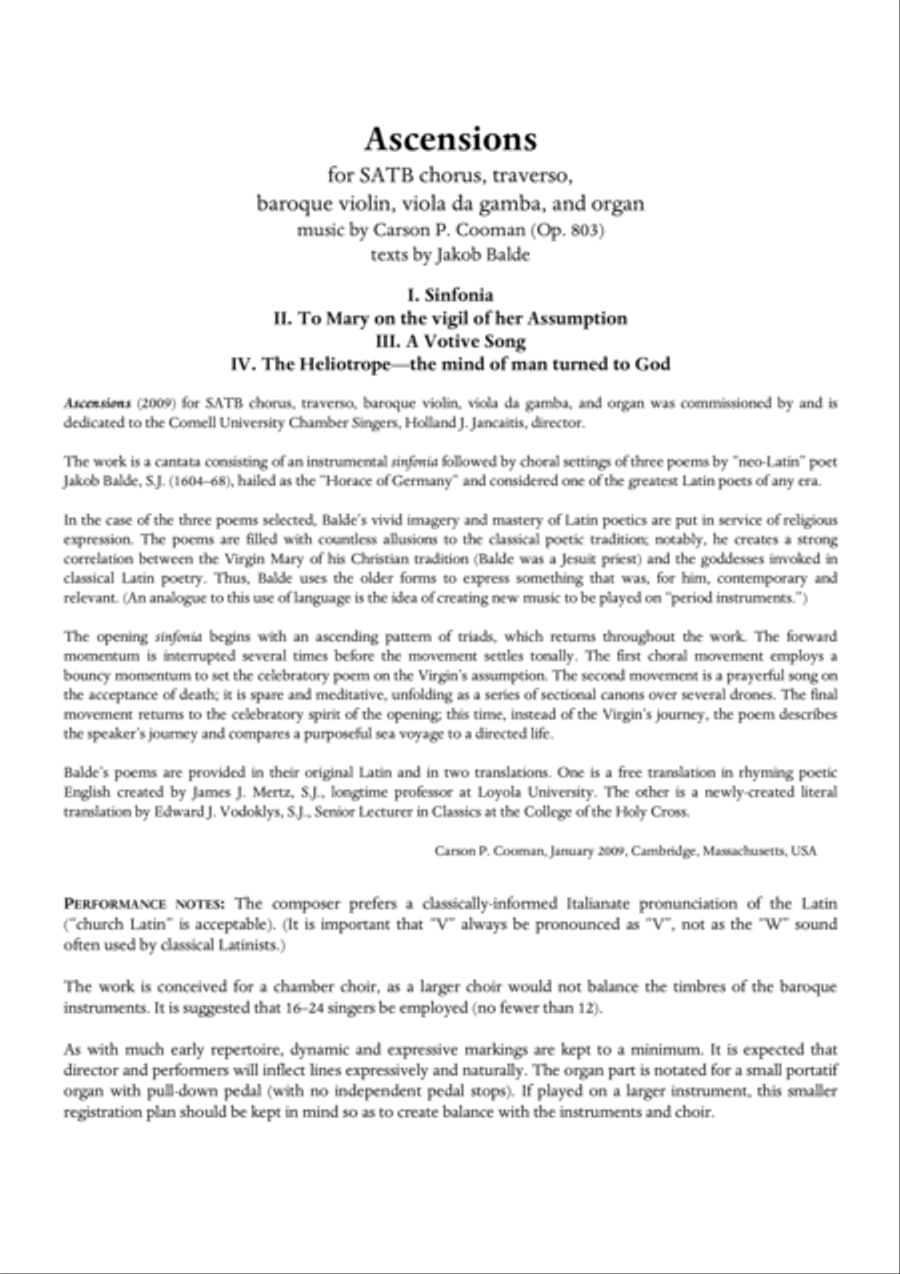
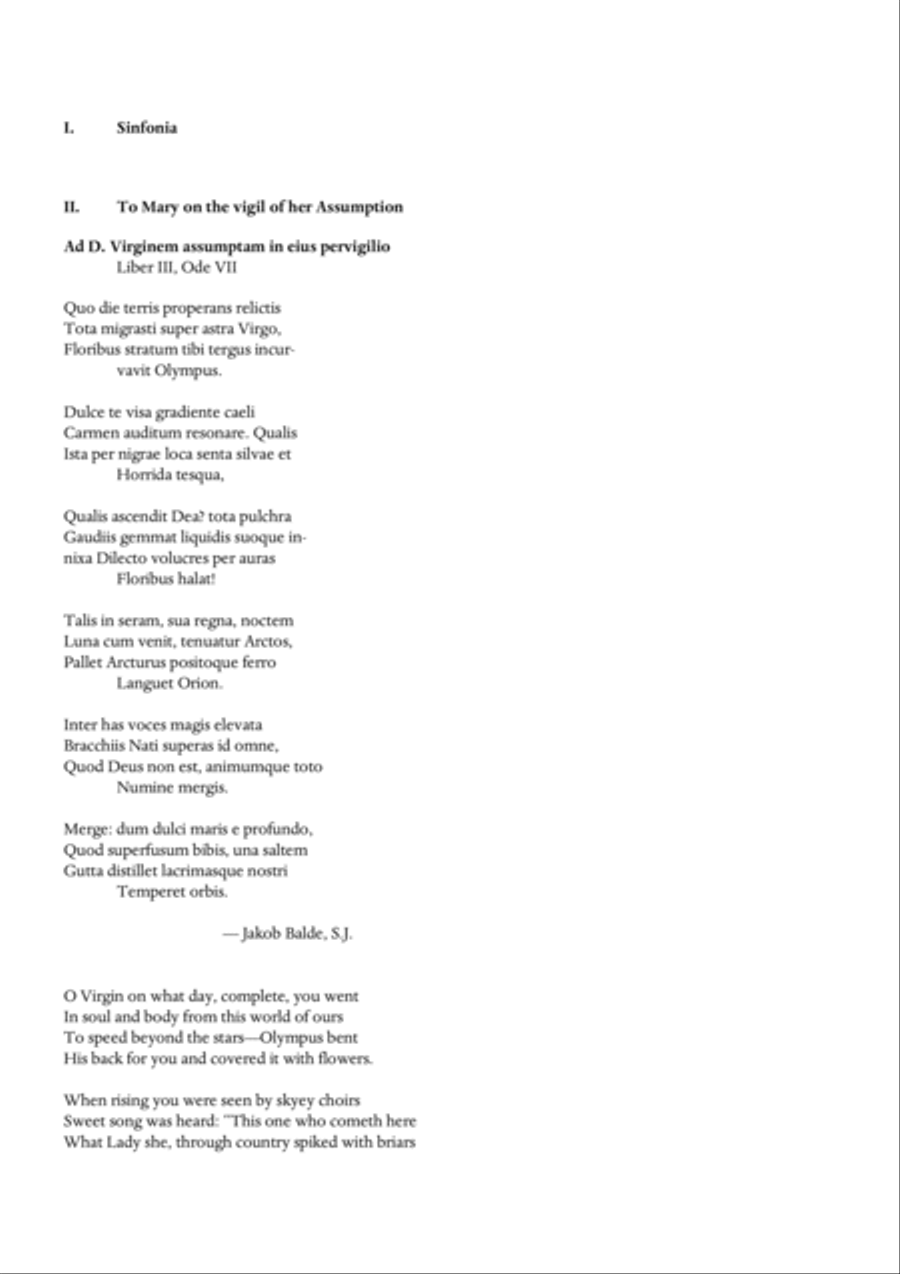
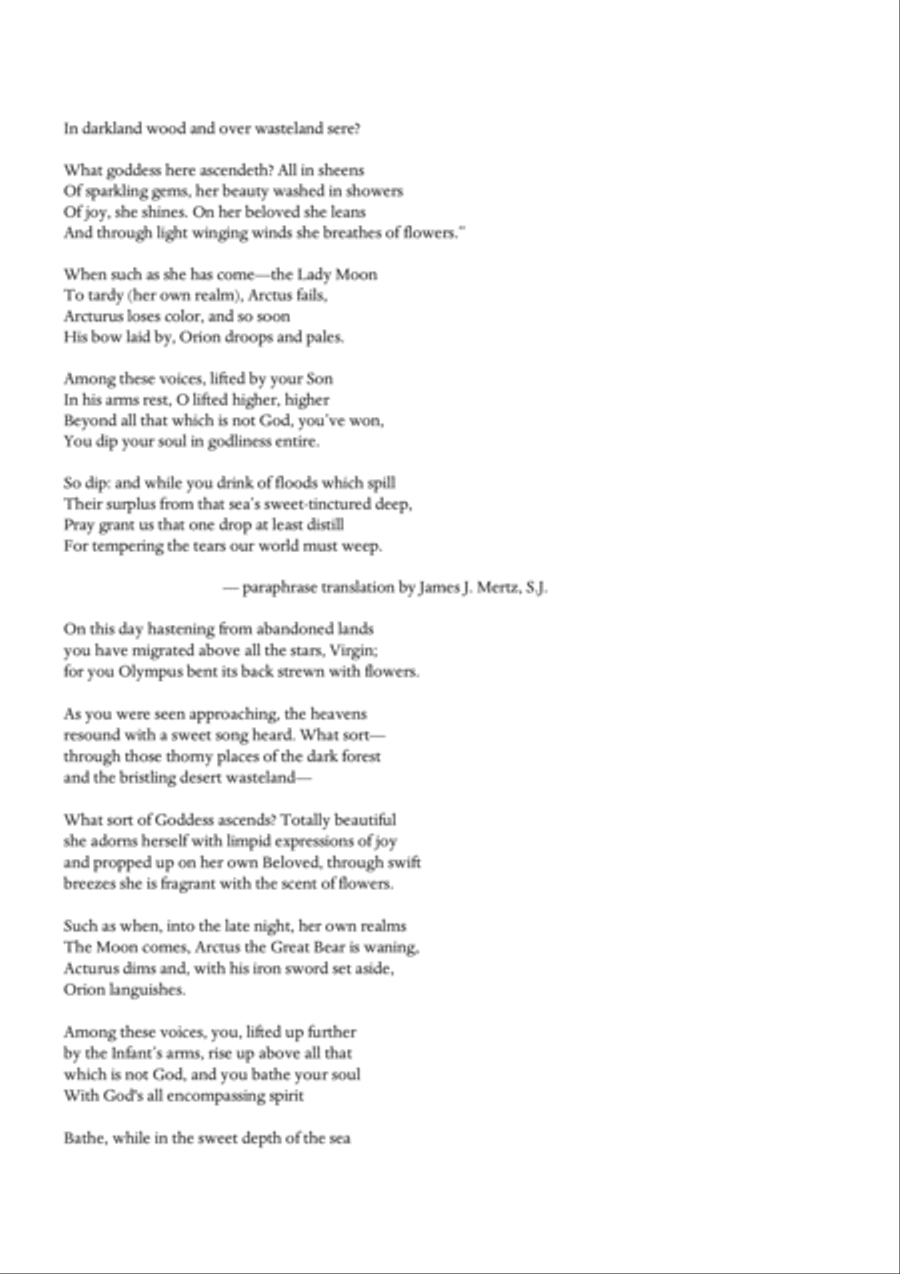
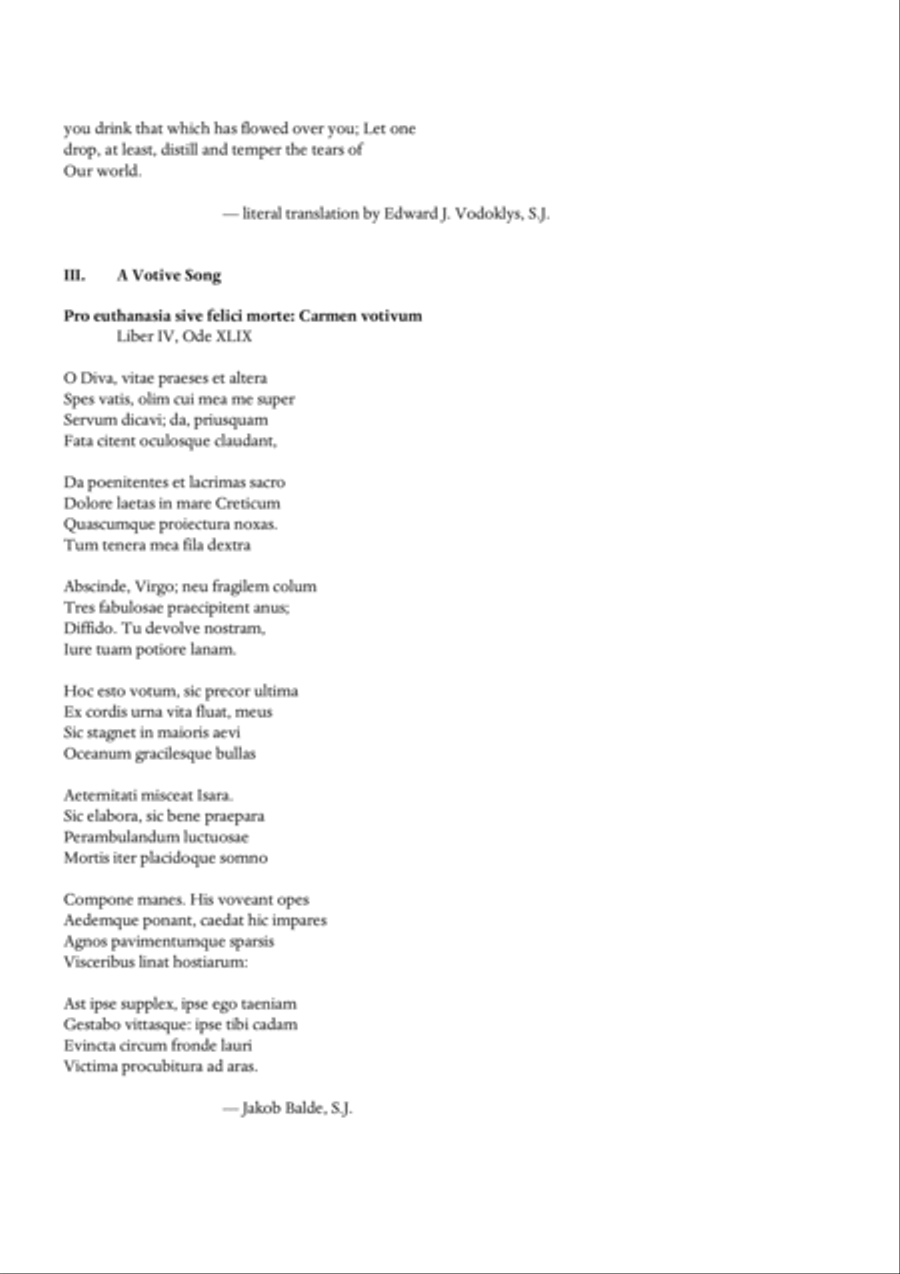
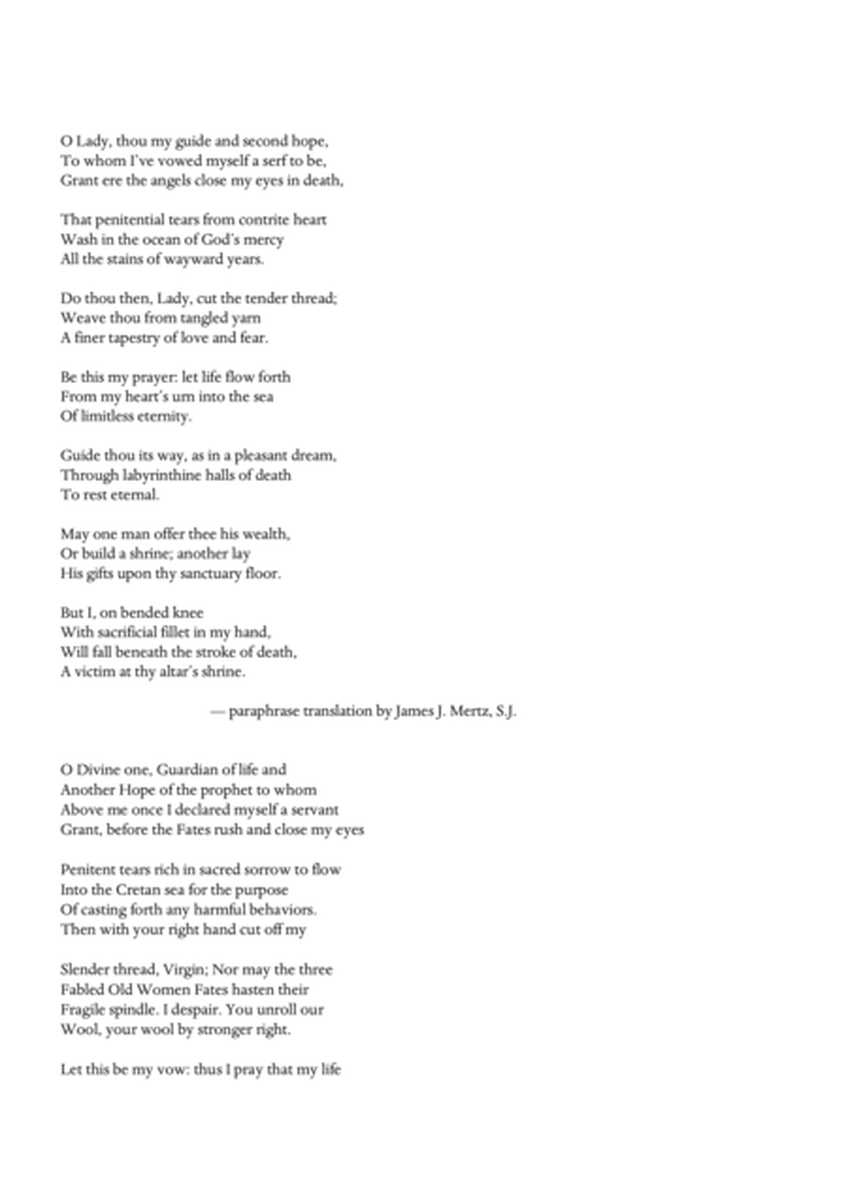
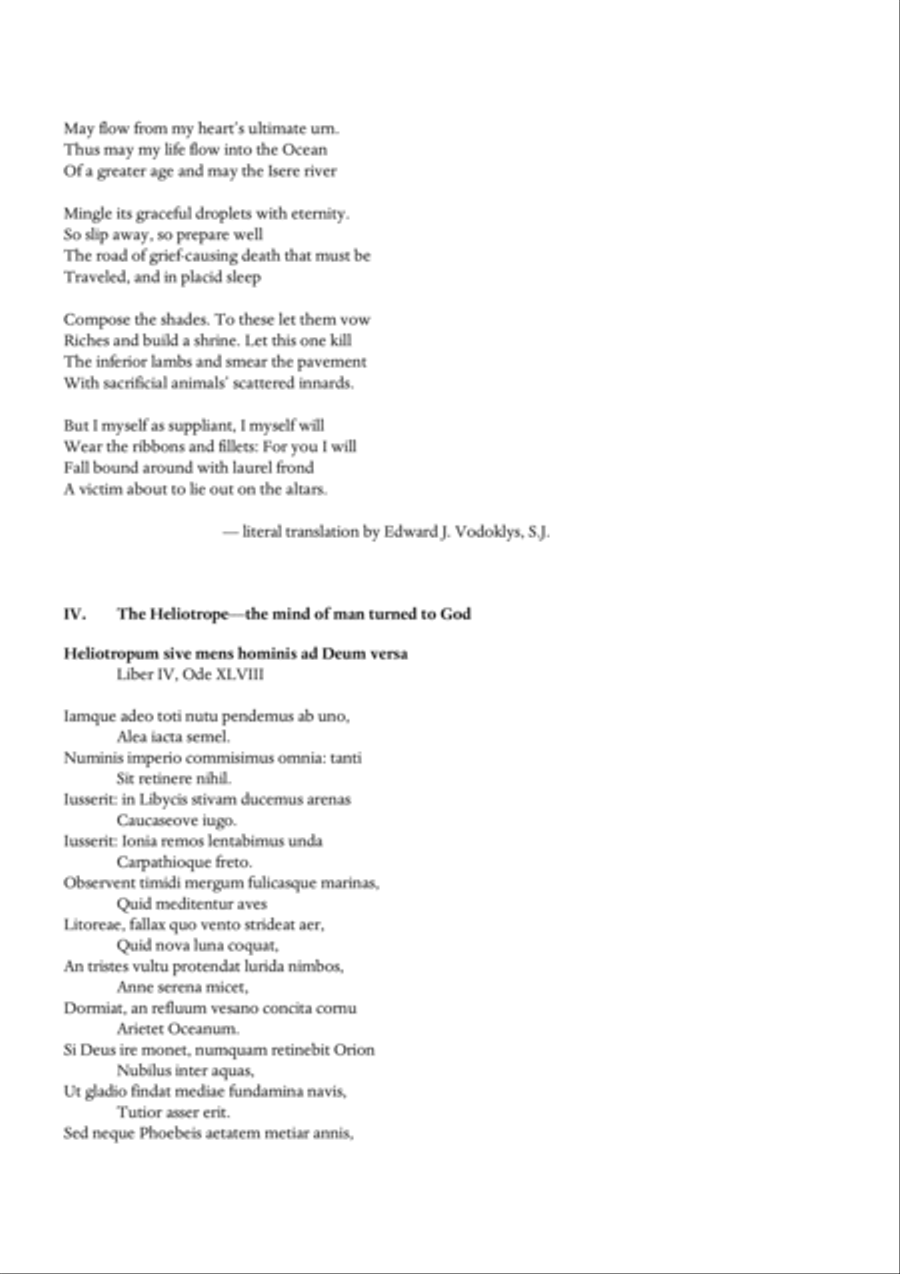
I. Sinfonia II. To Mary on the vigil of her Assumption III. A Votive Song IV. The Heliotrope-the mind of man turned to God Ascensions (2009) for SATB chorus, traverso, baroque violin, viola da gamba, and organ was commissioned by and is dedicated to the Cornell University Chamber Singers, Holland J. Jancaitis, director. The work is a cantata consisting of an instrumental sinfonia followed by choral settings of three poems by "neo-Latin" poet Jakob Balde, S.J. (1604–68), hailed as the "Horace of Germany" and considered one of the greatest Latin poets of any era. In the case of the three poems selected, Balde’s vivid imagery and mastery of Latin poetics are put in service of religious expression. The poems are filled with countless allusions to the classical poetic tradition; notably, he creates a strong correlation between the Virgin Mary of his Christian tradition (Balde was a Jesuit priest) and the goddesses invoked in classical Latin poetry. Thus, Balde uses the older forms to express something that was, for him, contemporary and relevant. (An analogue to this use of language is the idea of creating new music to be played on "period instruments.") The opening sinfonia begins with an ascending pattern of triads, which returns throughout the work. The forward momentum is interrupted several times before the movement settles tonally. The first choral movement employs a bouncy momentum to set the celebratory poem on the Virgin’s assumption. The second movement is a prayerful song on the acceptance of death; it is spare and meditative, unfolding as a series of sectional canons over several drones. The final movement returns to the celebratory spirit of the opening; this time, instead of the Virgin’s journey, the poem describes the speaker’s journey and compares a purposeful sea voyage to a directed life. Balde’s poems are provided in their original Latin and in two translations. One is a free translation in rhyming poetic English created by James J. Mertz, S.J., longtime professor at Loyola University. The other is a newly-created literal translation by Edward J. Vodoklys, S.J., Senior Lecturer in Classics at the College of the Holy Cross. Carson P. Cooman, January 2009, Cambridge, Massachusetts, USA PERFORMANCE NOTES: The composer prefers a classically-informed Italianate pronunciation of the Latin ("church Latin" is acceptable). (It is important that "V" always be pronounced as "V", not as the "W" sound often used by classical Latinists.) The work is conceived for a chamber choir, as a larger choir would not balance the timbres of the baroque instruments. It is suggested that 16–24 singers be employed (no fewer than 12). As with much early repertoire, dynamic and expressive markings are kept to a minimum. It is expected that director and performers will inflect lines expressively and naturally. The organ part is notated for a small portatif organ with pull-down pedal (with no independent pedal stops). If played on a larger instrument, this smaller registration plan should be kept in mind so as to create balance with the instruments and choir.
This product was created by a member of ArrangeMe, Hal Leonard's global
self-publishing community of independent composers, arrangers, and songwriters.
ArrangeMe allows for the publication of unique arrangements of both popular
titles and original compositions from a wide variety of voices and backgrounds.
About Digital Downloads
Digital Downloads are downloadable sheet music files that can be viewed directly on
your computer, tablet or mobile device. Once you download your digital sheet music,
you can view and print it at home, school, or anywhere you want to make music, and
you don't have to be connected to the internet. Just purchase, download and play!
PLEASE NOTE: Your Digital Download will have a watermark at the bottom of each page
that will include your name, purchase date and number of copies purchased. You are
only authorized to print the number of copies that you have purchased. You may not
digitally distribute or print more copies than purchased for use (i.e., you may not
print or digitally distribute individual copies to friends or students).
Composed by Carson Cooman. Baroque,Contemporary,Sacred. Octavo. 82 pages. Musik Fabrik Music Publishing #3043975. Published by Musik Fabrik Music Publishing (A0.535388).
I. Sinfonia II. To Mary on the vigil of her Assumption III. A Votive Song IV. The Heliotrope-the mind of man turned to God Ascensions (2009) for SATB chorus, traverso, baroque violin, viola da gamba, and organ was commissioned by and is dedicated to the Cornell University Chamber Singers, Holland J. Jancaitis, director. The work is a cantata consisting of an instrumental sinfonia followed by choral settings of three poems by "neo-Latin" poet Jakob Balde, S.J. (1604–68), hailed as the "Horace of Germany" and considered one of the greatest Latin poets of any era. In the case of the three poems selected, Balde’s vivid imagery and mastery of Latin poetics are put in service of religious expression. The poems are filled with countless allusions to the classical poetic tradition; notably, he creates a strong correlation between the Virgin Mary of his Christian tradition (Balde was a Jesuit priest) and the goddesses invoked in classical Latin poetry. Thus, Balde uses the older forms to express something that was, for him, contemporary and relevant. (An analogue to this use of language is the idea of creating new music to be played on "period instruments.") The opening sinfonia begins with an ascending pattern of triads, which returns throughout the work. The forward momentum is interrupted several times before the movement settles tonally. The first choral movement employs a bouncy momentum to set the celebratory poem on the Virgin’s assumption. The second movement is a prayerful song on the acceptance of death; it is spare and meditative, unfolding as a series of sectional canons over several drones. The final movement returns to the celebratory spirit of the opening; this time, instead of the Virgin’s journey, the poem describes the speaker’s journey and compares a purposeful sea voyage to a directed life. Balde’s poems are provided in their original Latin and in two translations. One is a free translation in rhyming poetic English created by James J. Mertz, S.J., longtime professor at Loyola University. The other is a newly-created literal translation by Edward J. Vodoklys, S.J., Senior Lecturer in Classics at the College of the Holy Cross. Carson P. Cooman, January 2009, Cambridge, Massachusetts, USA PERFORMANCE NOTES: The composer prefers a classically-informed Italianate pronunciation of the Latin ("church Latin" is acceptable). (It is important that "V" always be pronounced as "V", not as the "W" sound often used by classical Latinists.) The work is conceived for a chamber choir, as a larger choir would not balance the timbres of the baroque instruments. It is suggested that 16–24 singers be employed (no fewer than 12). As with much early repertoire, dynamic and expressive markings are kept to a minimum. It is expected that director and performers will inflect lines expressively and naturally. The organ part is notated for a small portatif organ with pull-down pedal (with no independent pedal stops). If played on a larger instrument, this smaller registration plan should be kept in mind so as to create balance with the instruments and choir.
This product was created by a member of ArrangeMe, Hal Leonard's global
self-publishing community of independent composers, arrangers, and songwriters.
ArrangeMe allows for the publication of unique arrangements of both popular
titles and original compositions from a wide variety of voices and backgrounds.
About Digital Downloads
Digital Downloads are downloadable sheet music files that can be viewed directly on
your computer, tablet or mobile device. Once you download your digital sheet music,
you can view and print it at home, school, or anywhere you want to make music, and
you don't have to be connected to the internet. Just purchase, download and play!
PLEASE NOTE: Your Digital Download will have a watermark at the bottom of each page
that will include your name, purchase date and number of copies purchased. You are
only authorized to print the number of copies that you have purchased. You may not
digitally distribute or print more copies than purchased for use (i.e., you may not
print or digitally distribute individual copies to friends or students).
Preview: Carson Cooman: Ascensions (2009) for SATB chorus, traverso, baroque violin, viola da gamba, and orga
Tell A Friend
Tell a friend (or remind yourself) about this product. We'll instantly send an email containing product info and a link to it. You may also enter a personal message.
We do not use or store email addresses from this form for any other purpose than sending your share email.
After purchase, you can download your MP3 from your Sheet Music Plus Digital Library - no software installation is necessary! You can also listen to your MP3 at any time in your Digital Library.
Learn about Smart Music
After purchase, you can download your Smart Music from your Sheet Music Plus Digital Library - no software installation is necessary! You can also download at any time in your Digital Library.
Learn about Digital Video
After purchase you can download your video from your Digital Library. Your video is in XX format and is playable on most pre-installed video players.