Order two or more copies of the same title and we'll automatically give you 5% off list price on that title.
To get 2+ Pricing , just add two or more copies of a title to your shopping cart. Your discount will be immediately applied to your order.
Sale titles, hymnals, and ShowKits (MTI's Broadway Junior Collection, Getting to Know... Collection (G2K) and MTI's Kids Collection) do not qualify for 2+ Pricing
If you have any questions or comments regarding 2+ Pricing , please visit our Help Center to find more information or chat with our support team
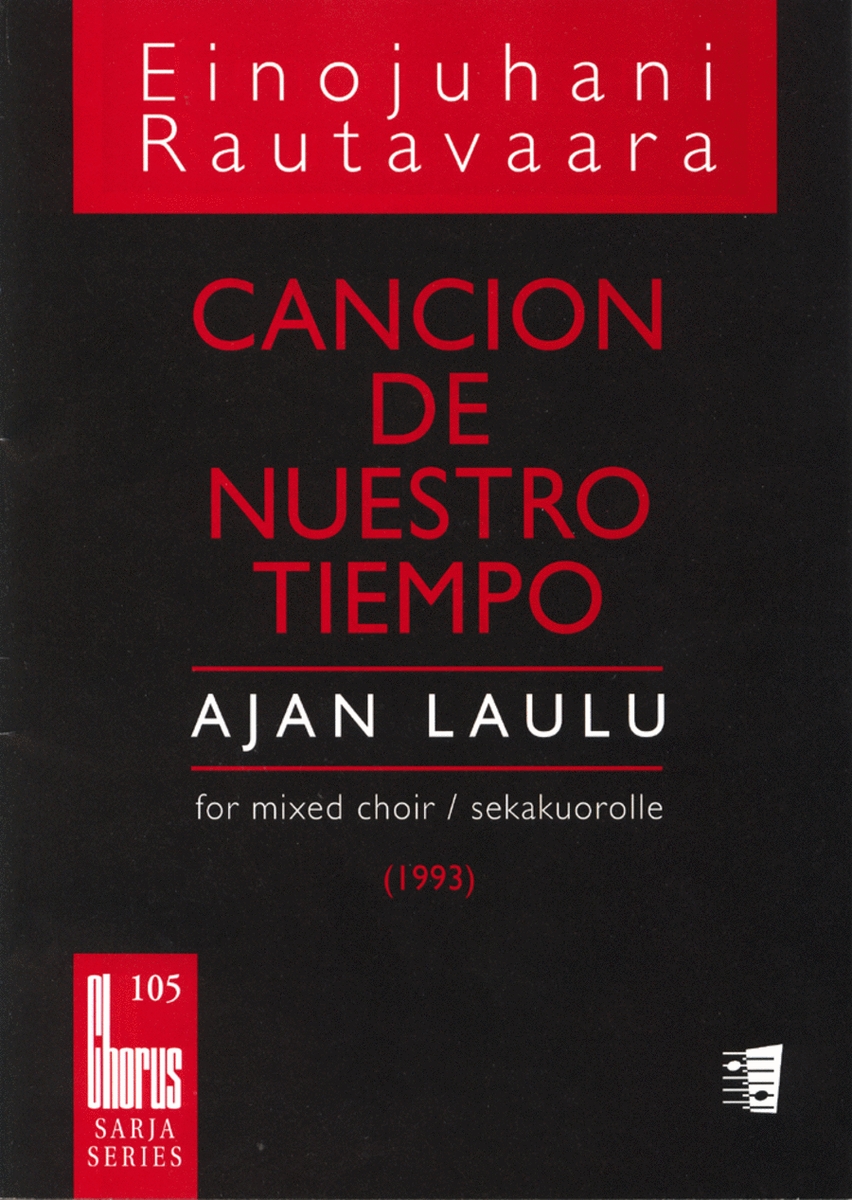
Composed by Einojuhani Rautavaara. Parts. Fennica Gehrman #9790550090026. Published by Fennica Gehrman (FG.9790550090026).
ISBN 9790550090026.
When the Tokyo Philharmonic Chorus approached Rautavaara with a commission for a major choral work, and announced their requirement that it should "relate to the world of today", Rautavaara responded by choosing some poems by Federico Carcia Lorca. Their emotional fabric, along with the way they deal with the themes of mortality and angst, seems to be closer to the present age than to the time in which they were written, the 1920's and 30's. In the opening movement, Fragments of Agony, Lorca paints in his surrealistic fashion the harsh, inhuman world brought into being by industrial society and war. In the second setting, First and Last Meditation, the music symbolises the riddle of time. Dense textural fields are created, and when the poem announces that "Time now slumbers in its tower..." the various choral groups start up and end their contributions at arbitrary times, 'aleatorically'. In the last song, Sleepless City, the poem's outrageous images seemed to connect strongly with the actualities of 1993 that Rautavaara gave this movement the subtitle Nocturno del Sarajevo.
Composed by Einojuhani Rautavaara. Parts. Fennica Gehrman #9790550090026. Published by Fennica Gehrman (FG.9790550090026).
ISBN 9790550090026.
When the Tokyo Philharmonic Chorus approached Rautavaara with a commission for a major choral work, and announced their requirement that it should "relate to the world of today", Rautavaara responded by choosing some poems by Federico Carcia Lorca. Their emotional fabric, along with the way they deal with the themes of mortality and angst, seems to be closer to the present age than to the time in which they were written, the 1920's and 30's. In the opening movement, Fragments of Agony, Lorca paints in his surrealistic fashion the harsh, inhuman world brought into being by industrial society and war. In the second setting, First and Last Meditation, the music symbolises the riddle of time. Dense textural fields are created, and when the poem announces that "Time now slumbers in its tower..." the various choral groups start up and end their contributions at arbitrary times, 'aleatorically'. In the last song, Sleepless City, the poem's outrageous images seemed to connect strongly with the actualities of 1993 that Rautavaara gave this movement the subtitle Nocturno del Sarajevo.
Preview: Cancion de nuestro tiempo
Tell A Friend
Tell a friend (or remind yourself) about this product. We'll instantly send an email containing product info and a link to it. You may also enter a personal message.
We do not use or store email addresses from this form for any other purpose than sending your share email.
After purchase, you can download your MP3 from your Sheet Music Plus Digital Library - no software installation is necessary! You can also listen to your MP3 at any time in your Digital Library.
Learn about Smart Music
After purchase, you can download your Smart Music from your Sheet Music Plus Digital Library - no software installation is necessary! You can also download at any time in your Digital Library.
Learn about Digital Video
After purchase you can download your video from your Digital Library. Your video is in XX format and is playable on most pre-installed video players.