Details
- Instrument:
- Choir
- Ensembles:
- Choir
- Genres:
- Christian Romantic Period
- Composers:
- Johannes Brahms
- Publishers:
- Breitkopf and Haertel
- Series:
- Breitkopf Score Library
- ISBN:
- 9790004200582
- Format:
- Score Vocal Score
- Item types:
- Physical
- Artist:
- Johannes Brahms
- Usages:
- Mass
- Number of Pages:
- 16
- Size:
- 10 x 12.5 inches
- Shipping Weight:
- 0.28 pounds
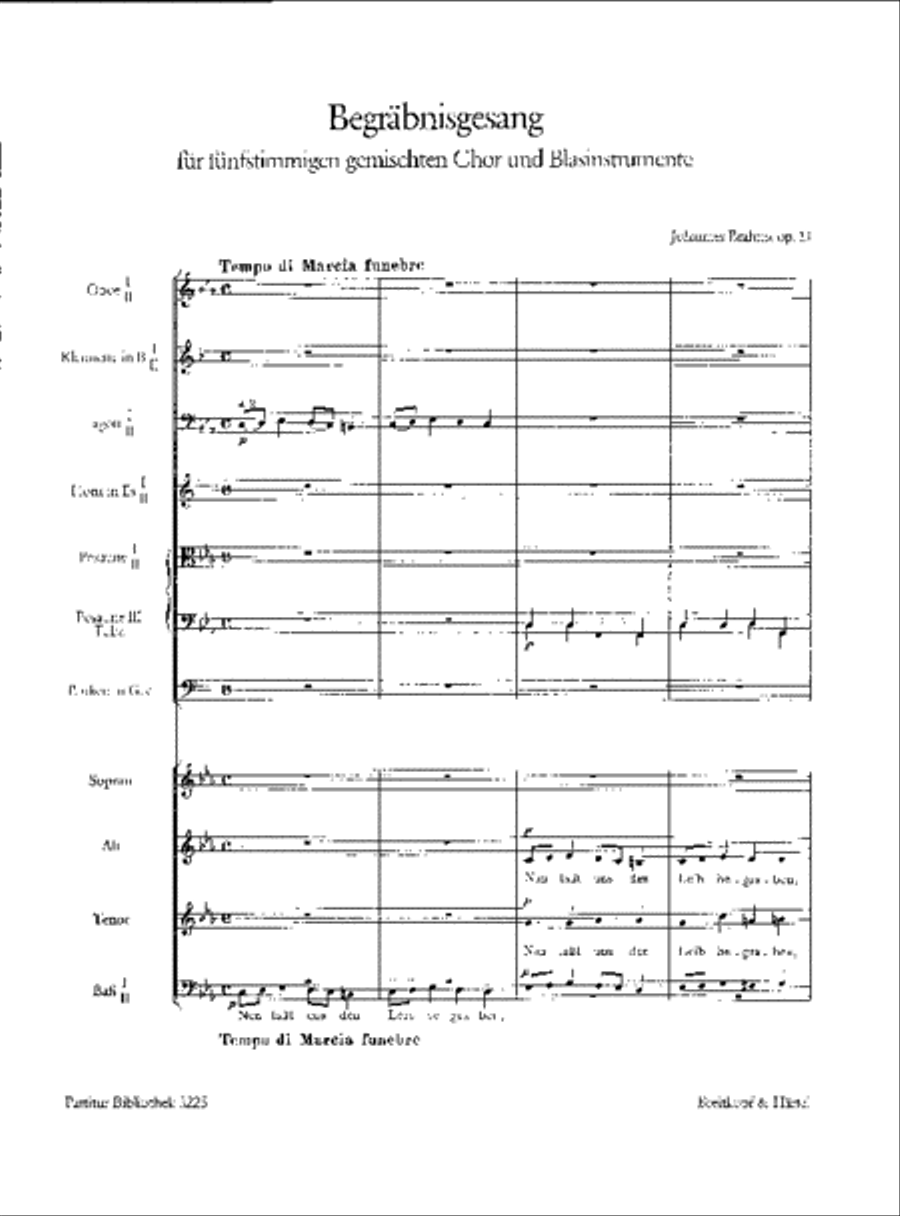
Chorus with inst. (choir: SATBB – 0.2.2.2 – 2.0.3.1 – timp)
SKU: BR.PB-3225
„Nun lasst uns den Leib begraben – Urtext based on the Brahms Complete Edition of the Gesellschaft der Musikfreunde in Vienna. Composed by Johannes Brahms. Choir; stapled. Partitur-Bibliothek (Score Library).Now complete with piano-vocal score
Requiem; Romantic. Full score. 16 pages. Duration 10:00. Breitkopf and Haertel #PB 3225. Published by Breitkopf and Haertel (BR.PB-3225).ISBN 9790004200582. 10 x 12.5 inches.
Brahms' Begrabnisgesang op. 13 has long been one of Breitkopf & Hartel's standard works. Yet while musicians were able to acquire the score, orchestral parts and choral score, there was no piano-vocal score up to now. This gap is now being closed. The piano-vocal score will be a valuable asset to all choirs learning and performing the work, not least because the piano reduction is conceived so as to sound compelling on the organ as well. In his preface, Ulrich Mahlert suggests that the work of the then 25-year-old composer is perhaps to be seen in the light of Robert Schumann's death and Clara Schumann's own thoughts of death.
- More by this Composer:
- Johannes Brahms Johannes Brahms Piano Accompaniment Johannes Brahms Voice Johannes Brahms Piano, Vocal
- Series:
- Breitkopf Score Library
- Artists:
- Johannes Brahms
- Ensemble:
- Choir
- Publisher:
- Breitkopf and Haertel