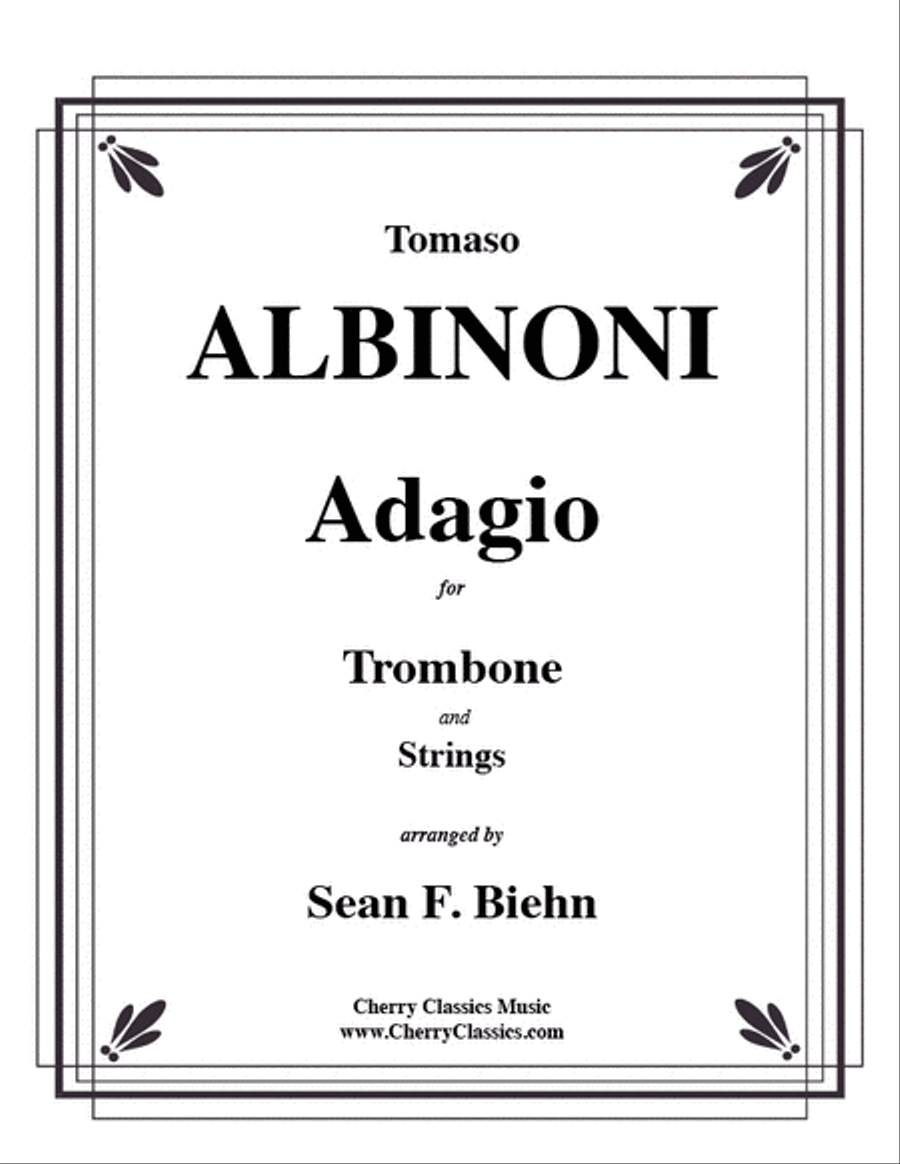
Composed by Tomaso Giovanni Albinoni. Arranged by Sean F. Biehn. Baroque. Score and parts. Cherry Classics #CC2472. Published by Cherry Classics (CY.CC2472).
The Adagio in G minor for Trombone and String Quartet is a wonderful arrangement of the work attributed to Tomaso Albinoni (1671-1751). The work is about 7 minutes in length for advanced performers. Below is a short article about the Adagio by the arranger, Sean F. Biehn. There is much controversy as to who wrote the Adagio for Strings in G minor and whether it was a stolen idea or embellished from a piece of a manuscript. The piece is considered to be a fragment of Tomaso Albinoni's (1671-1751) original manuscript with a few measures of the melodic material and the basso continuo. During World War II, the bombings of Dresdon, which is where the Saxon State Library resided, was destroyed and Remo Giazotto (1910-1998) evacuated most of its documents, being that he was a musicologist-and an Albinoni biographer. Giazotto took the fragment of manuscript and completed what he thought would be the completed piece which in turn makes his completed piece an original composition. In 1958, Giazotto finalized the piece under the title of "Adagio in G minor for Strings and Organ, on Two Thematic Ideas and on a Figured Bass by Tomaso Albinoni." Remo Giazotto never shared the manuscript and after his death in 1998, there has never been a record of the missing manuscript fragment. To this day, the string ensemble with organ is popularly performed. There have been numerous and recent alterations in instrumentation for this piece due to the fact that other soloists wanted to perform the beautiful piece. This particular version of the piece contains a string quartet accompanying a trombone soloist.
Composed by Tomaso Giovanni Albinoni. Arranged by Sean F. Biehn. Baroque. Score and parts. Cherry Classics #CC2472. Published by Cherry Classics (CY.CC2472).
The Adagio in G minor for Trombone and String Quartet is a wonderful arrangement of the work attributed to Tomaso Albinoni (1671-1751). The work is about 7 minutes in length for advanced performers. Below is a short article about the Adagio by the arranger, Sean F. Biehn. There is much controversy as to who wrote the Adagio for Strings in G minor and whether it was a stolen idea or embellished from a piece of a manuscript. The piece is considered to be a fragment of Tomaso Albinoni's (1671-1751) original manuscript with a few measures of the melodic material and the basso continuo. During World War II, the bombings of Dresdon, which is where the Saxon State Library resided, was destroyed and Remo Giazotto (1910-1998) evacuated most of its documents, being that he was a musicologist-and an Albinoni biographer. Giazotto took the fragment of manuscript and completed what he thought would be the completed piece which in turn makes his completed piece an original composition. In 1958, Giazotto finalized the piece under the title of "Adagio in G minor for Strings and Organ, on Two Thematic Ideas and on a Figured Bass by Tomaso Albinoni." Remo Giazotto never shared the manuscript and after his death in 1998, there has never been a record of the missing manuscript fragment. To this day, the string ensemble with organ is popularly performed. There have been numerous and recent alterations in instrumentation for this piece due to the fact that other soloists wanted to perform the beautiful piece. This particular version of the piece contains a string quartet accompanying a trombone soloist.
Tell a friend (or remind yourself) about this product. We'll instantly send an email containing product info and a link to it. You may also enter a personal message.
We do not use or store email addresses from this form for any other purpose than sending your share email.
After purchase, you can download your MP3 from your Sheet Music Plus Digital Library - no software installation is necessary! You can also listen to your MP3 at any time in your Digital Library.
Learn about Smart Music
After purchase, you can download your Smart Music from your Sheet Music Plus Digital Library - no software installation is necessary! You can also download at any time in your Digital Library.
Learn about Digital Video
After purchase you can download your video from your Digital Library. Your video is in XX format and is playable on most pre-installed video players.