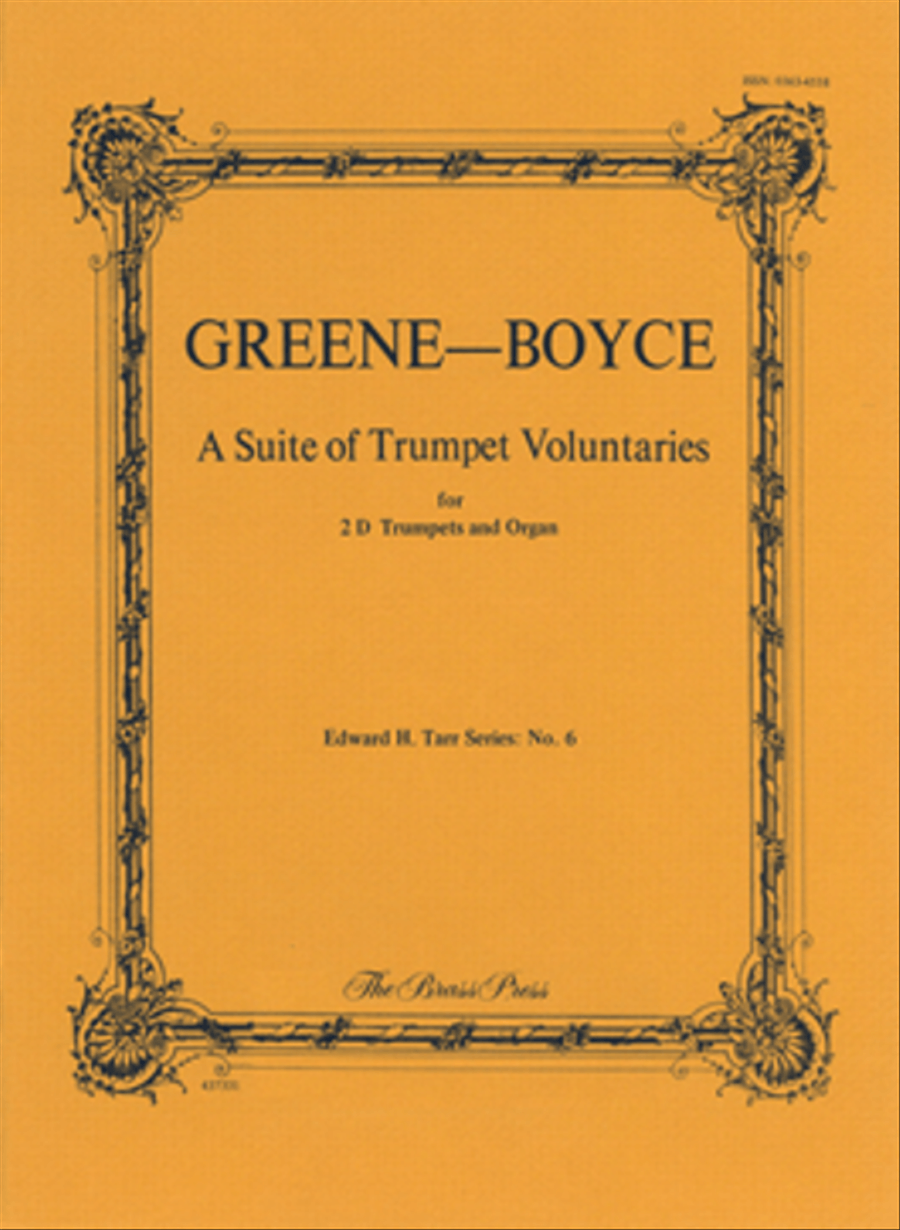
Composed by Greene / Boyce. Arranged by Edward H. Tarr. Baroque.
ISBN 9790207007162.
Maurice Greene (1695-1775) was England's most important church musician of the 18th century, holding the positions of organist at St. Paul's Cathedral (from 1718), organist and composer of the Chapel Royal (from 1727), professor of music at Cambridge (from 1730), and master of the King's Band of Music (from 1735).
William Boyce (c. 1710-1779), a pupil of Greene, was composer for the King's Chapel (from 1736), director of the Three Choirs Festival (from 1737), and his teacher's successor as master of the King's Band of Music (from 1755). In 1760-62 he brought out the important publication Cathedral Music, prepared by Greene. Their trumpet voluntaries, together with those of John Stanley (see: John Stanley, Suite No.1 of Trumpet Voluntaries, published by The Brass Press), are among the latest examples of the genre and represent the culmination of virtuosity within it. While Stanley generally contents himself with stark echo effects, Boyce and Greene regularly introduce contrasting material in a middle section, set as a foil to the often marchlike character of the principal theme.
The original sources for this edition are as follows: First movement (Greene) - Ten Voluntarys for the Organ or Harpsichord Composed by Jr. Green (London, c. 1767). Second and third movements (Boyce) - Ten Voluntaries for the Organ or Harpsichord Composed by the Late Dr. William Boyce (London, 1785). Edward H. Tarr.
Composed by Greene / Boyce. Arranged by Edward H. Tarr. Baroque.
ISBN 9790207007162.
Maurice Greene (1695-1775) was England's most important church musician of the 18th century, holding the positions of organist at St. Paul's Cathedral (from 1718), organist and composer of the Chapel Royal (from 1727), professor of music at Cambridge (from 1730), and master of the King's Band of Music (from 1735).
William Boyce (c. 1710-1779), a pupil of Greene, was composer for the King's Chapel (from 1736), director of the Three Choirs Festival (from 1737), and his teacher's successor as master of the King's Band of Music (from 1755). In 1760-62 he brought out the important publication Cathedral Music, prepared by Greene. Their trumpet voluntaries, together with those of John Stanley (see: John Stanley, Suite No.1 of Trumpet Voluntaries, published by The Brass Press), are among the latest examples of the genre and represent the culmination of virtuosity within it. While Stanley generally contents himself with stark echo effects, Boyce and Greene regularly introduce contrasting material in a middle section, set as a foil to the often marchlike character of the principal theme.
The original sources for this edition are as follows: First movement (Greene) - Ten Voluntarys for the Organ or Harpsichord Composed by Jr. Green (London, c. 1767). Second and third movements (Boyce) - Ten Voluntaries for the Organ or Harpsichord Composed by the Late Dr. William Boyce (London, 1785). Edward H. Tarr.
Preview: A Suite of Trumpet Voluntaries (in D)
Tell A Friend
Tell a friend (or remind yourself) about this product. We'll instantly send an email containing product info and a link to it. You may also enter a personal message.
We do not use or store email addresses from this form for any other purpose than sending your share email.
After purchase, you can download your MP3 from your Sheet Music Plus Digital Library - no software installation is necessary! You can also listen to your MP3 at any time in your Digital Library.
Learn about Smart Music
After purchase, you can download your Smart Music from your Sheet Music Plus Digital Library - no software installation is necessary! You can also download at any time in your Digital Library.
Learn about Digital Video
After purchase you can download your video from your Digital Library. Your video is in XX format and is playable on most pre-installed video players.