Details
- Format:
- Theory Worksheets
- Item types:
- Digital
- Instructionals:
- Methods and More
- Level:
- Beginning
- Usages:
- School and Community
- Number of Pages:
- 9
SKU: A0.1370027
Composed by Brian Streckfus. This edition: pdf. Instructional, Singer/Songwriter. Theory Worksheet. 9 pages. Brian Streckfus #954402. Published by Brian Streckfus (A0.1370027).Pages: 9
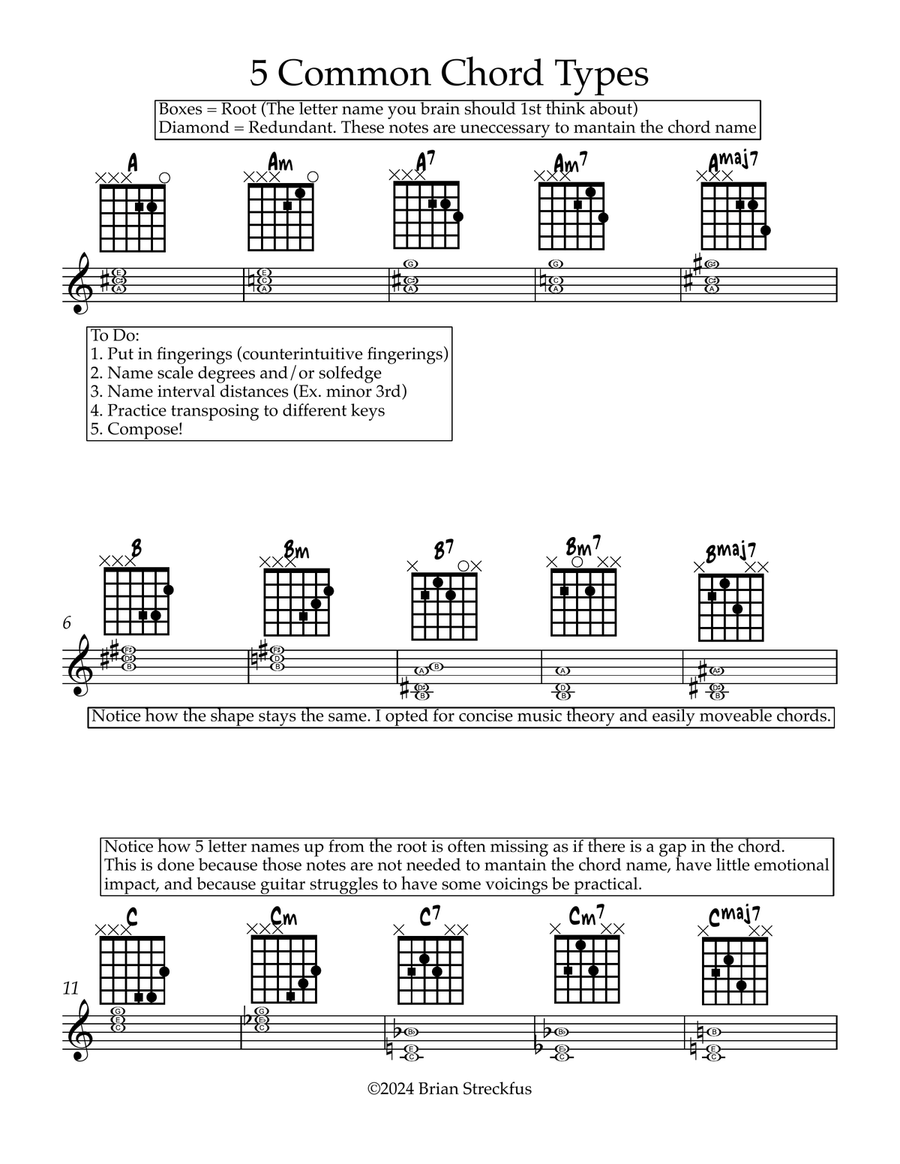
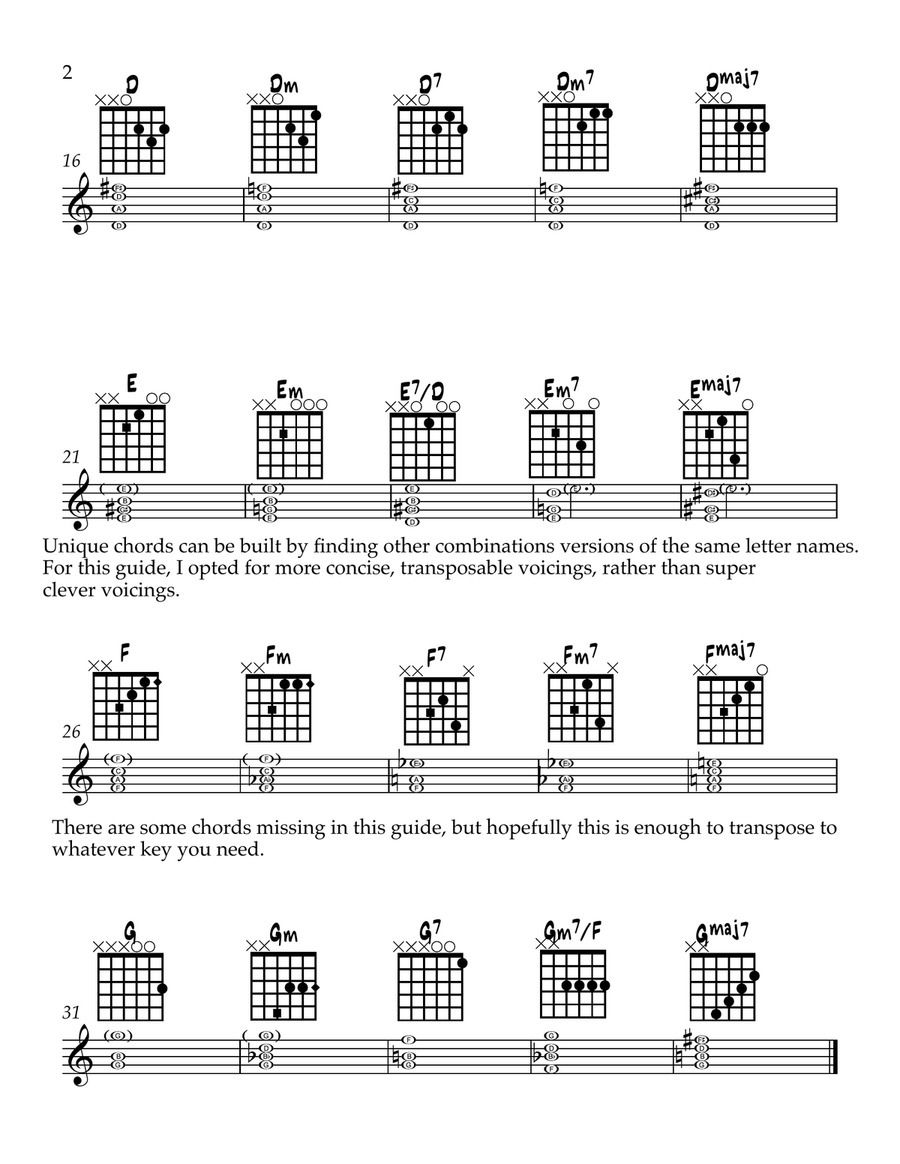
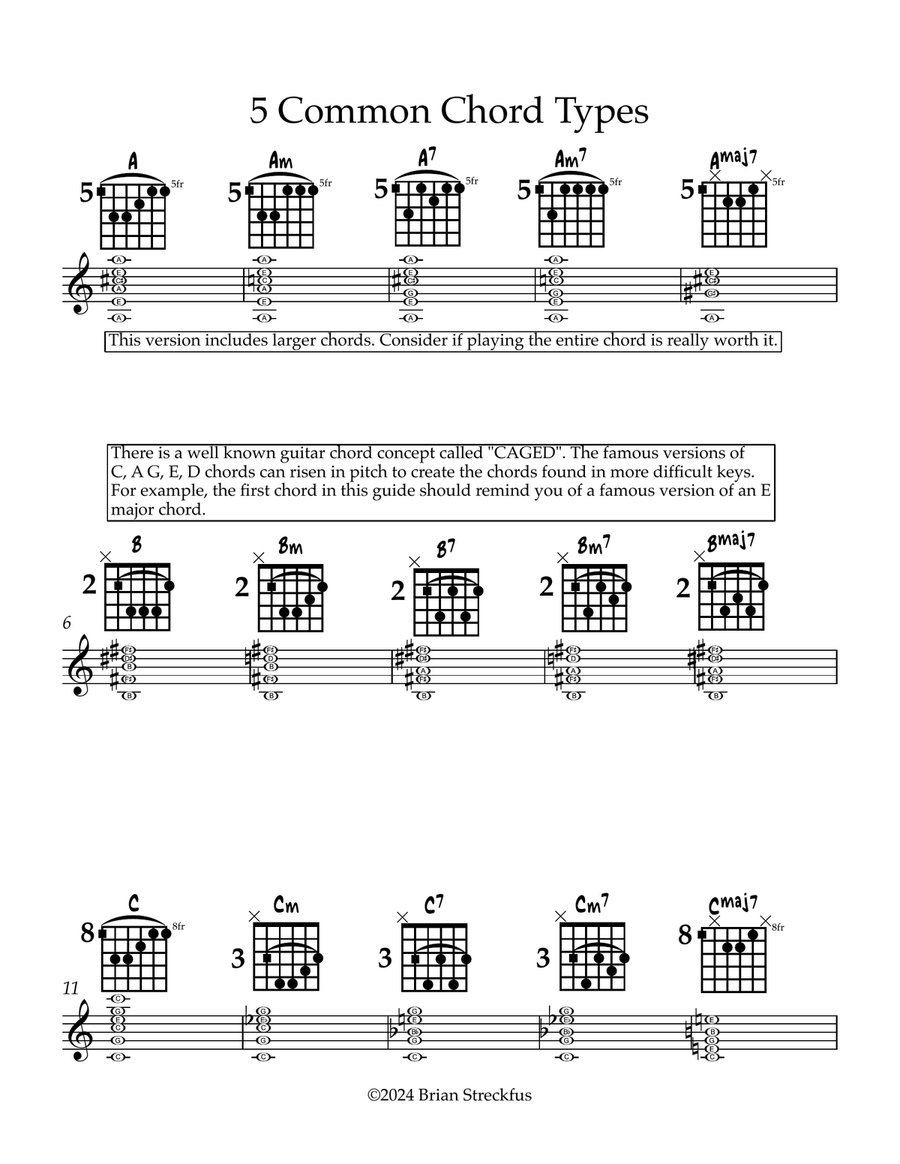
Learning chords on guitar is quite difficult. Fret numbers are usually arbitary (and indeed counter-intuitive) to what the chord actually is (unless it is on a single string). There are patterns to follow, but they are buried in a convoluted foggy swamp. The tuning of guitar strings essentially puts the music theory in a blender and one has to study for a long time to decode it. This is why I think adding a staff line of sheet music is beneficial to help anaylze what is actually happening. It is my hope that this PDF will shine some light on how chords are built so that you don't have to memorize them on by one, instead you memorize how they are built and their shape. This PDF shows chords that commonly happen, so it is by no means an exhaustive list.
I included complementary empty chord charts, tabs, sheet music to take notes, compose, create custom voicings, and practicing transposing to other keys.
For knowing how to use chords, see my chord progression generator uploads.
Tips:
1. The first two pages are for the music theory purists in that there is hardly ever an uneccesary note to mantain the name of the chord. This is useful for understanding what notes are needed for a chord (it's a cliche for guitarists to have overly large chords).
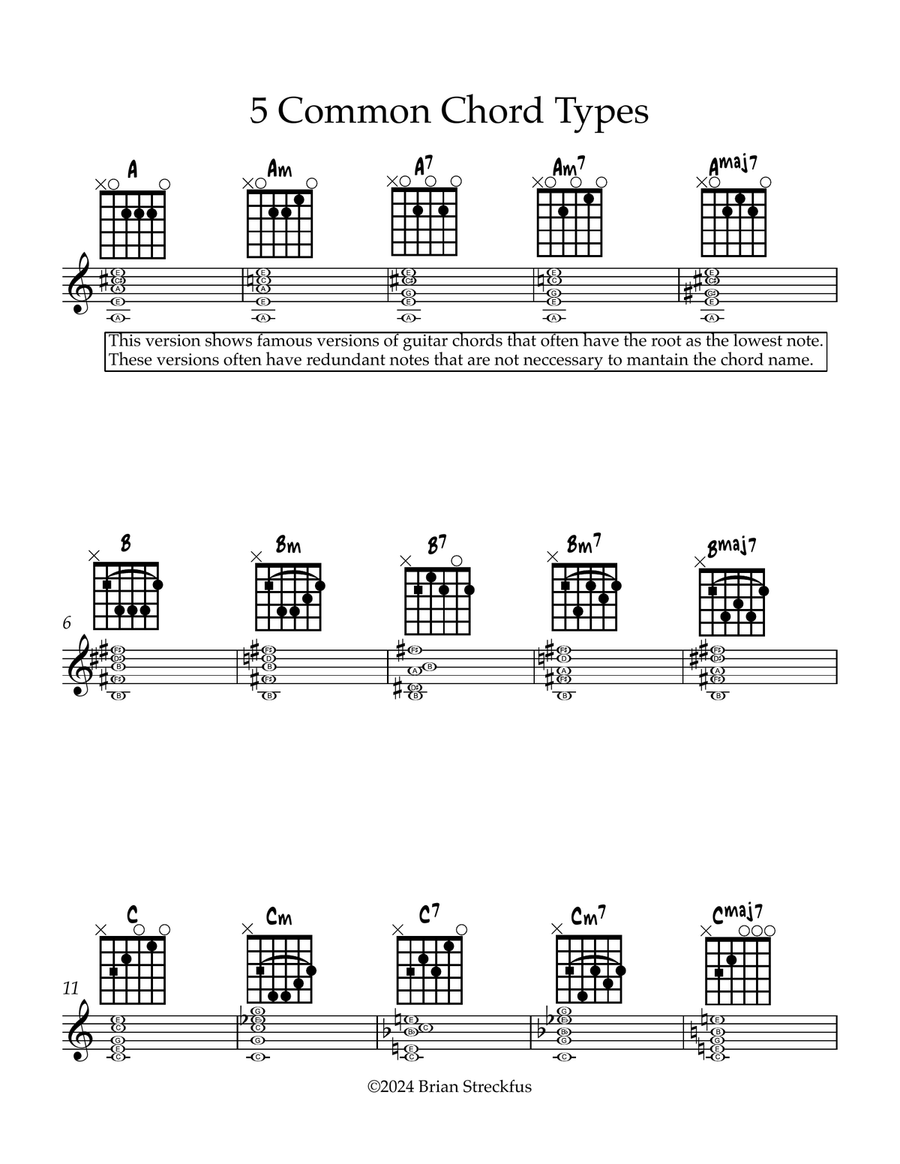
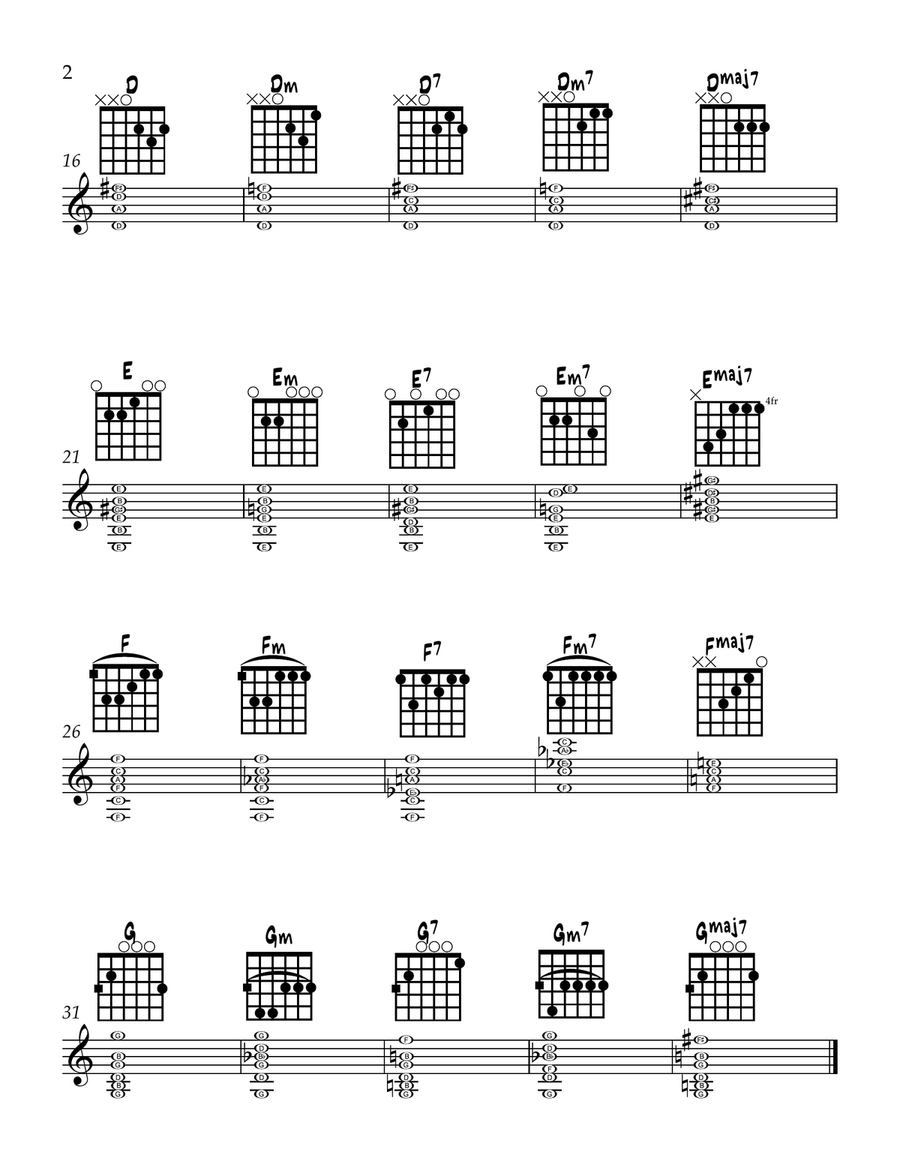
2. Pages 3 and 4 are the famous voicings.
3. Pages 5 and 6 are the bar chord versions. These versions are physically harder to play, but they can add a lot of clarity and simplicity to your playing (the famous voicings on pages 3 and 4 seem more random compared to bar chord versioons). They are much easier to slide to any key you want and much easier to see similiarities and patterns between chords.
4. Voicings typically sound better if the largest, most stable intervals are the lower pitches and the higher pitches are smaller, more colorful intervals. The overtone series also does this which is probably why it is like this.
5. Less is more. Redudant letter names that comprise a chord can be removed without too much of a difference in affect or chord name. Overly large chords can often conflict with ensemble members, be too unwieldy to preform, be too stereotypical, lead to clunkier voice leading, and leave no room for ornamentation. Less is more when studying the music theory as well, since the redundant notes make things more complicated to understand than they should be.
6. Sure there are more chords than these types, but these kinds of chords will you get pretty far in pop music as they are currently in vogue.
Social Media:
https://allmylinks.com/brianstreckfus
https://www.facebook.com/profile.php?id=100078682133421
https://www.patreon.com/brianstreckfus
https://www.brianstreckfus.com
https://www.facebook.com/classicalguitar2015/
https://twitter.com/BrianStreckfus
https://www.instagram.com/brianstreckfus/
https://www.youtube.com/user/woodenboxengineer
https://www.facebook.com/Doppelganger-106026062029620/
https://www.linkedin.com/in/brian-streckfus-9b334a92/
https://steemit.com/@boxengineer
https://d.tube/#!/c/brian0streckfus0guitar
https://www.sheetmusicdirect.com/en-US/Search.aspx?query=Brian%2BStreckfus
https://www.sheetmusicplus.com/publishers/brian-streckfus-sheet-music/3027331
https://belairmusicstudios.com/product/brian-streckfus/
https://soundcloud.com/streckfusclassicalguitar.
About ArrangeMe
This product was created by a member of ArrangeMe, Hal Leonard's self-publishing community for independent composers, arrangers, and songwriters. Discover unique arrangements of popular titles and original compositions from diverse creators. The length, difficulty, and pricing are determined by the arranger or composer.
About Digital Downloads
Digital Downloads let you instantly access sheet music on your computer, tablet, or mobile device. Print your sheet music anywhere, anytime, or play it straight from your device—no internet connection is required after download.
Each Digital Download includes a watermark with your name, purchase date, and the number of copies purchased. You may only print or use the number of copies purchased. Redistribution or unauthorized printing is prohibited.