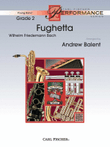
About Wilhelm Friedemann Bach
Wilhelm Friedemann Bach, the eldest son of the illustrious Johann Sebastian Bach, was a German composer, organist, and harpsichordist who navigated the fascinating transition between the late Baroque and early Classical periods. Born in Weimar in 1710, his music uniquely blends the rigorous contrapuntal mastery inherited from his father with the expressive and often unpredictable characteristics of the emerging "Empfindsamer Stil," or sensitive style. Friedemann's significance lies in his bold originality and his role as a bridge between musical eras, though his career was marked by instability despite his prodigious talent.
- Wilhelm Friedemann received an intensive musical education directly from his father, J. S. Bach, who considered him his most gifted child and dedicated the "Klavierbüchlein vor Wilhelm Friedemann Bach" to him as a pedagogical tool.
- He was widely renowned during his lifetime for his exceptional improvisational skills as an organist and harpsichordist, often blending complex counterpoint with a highly individual and expressive flair.
- Despite his acknowledged genius, Friedemann Bach's career was often unstable due to a reportedly difficult personality and professional restlessness, leading him to resign from significant posts and ultimately die in poverty in Berlin.
- His compositions, though fewer in number than some of his brothers', are characterized by surprising harmonic shifts, rhythmic complexity, and impassioned melodies, making his style distinctive and unpredictable.
Performing Wilhelm Friedemann Bach's sheet music offers a profoundly rewarding experience for intermediate to advanced musicians, particularly keyboardists (pianists, harpsichordists, and organists) and chamber ensembles, such as those featuring flutes. His works, including numerous fantasias, fugues, sonatas, and concertos, demand both technical precision and deep musical insight. They provide an excellent opportunity to explore the intellectual rigor of late Baroque counterpoint fused with the emotional depth and stylistic freedoms of the nascent Classical era, allowing performers to develop a nuanced understanding of a pivotal moment in music history.