About Vincenz Goller
Vincenz Goller (1873-1953) was an influential Austrian composer and church musician, primarily recognized for his extensive contributions to sacred vocal music. His work, deeply rooted in the traditions of Catholic church music, includes numerous Masses, offertories, and other liturgical compositions. Goller played a significant role in the development of church music education, leaving a lasting legacy through his compositions and his efforts in establishing and leading the Department of Catholic Church Music in Vienna/Klosterneuburg.
- Born into a musical family, Goller's father was a primary school teacher, sacristan, and organist, while his mother sang in the church choir, providing him with an early and rich musical environment.
- During World War I, Goller served as a captain on the Dolomite Front, notably leading the recapture of the Forame-Gipfel in the Cristallo group in 1916. He later successfully escaped from a prisoner-of-war camp.
- Beyond his musical career, Goller was politically active, serving as a municipal council member and eventually as mayor of Klosterneuburg. He was removed from office by the National Socialists in 1938, and two of his children subsequently joined the resistance.
- In 1910, he was instrumental in founding the Department of Catholic Church Music at the Vienna Music Academy in Klosterneuburg, where he also taught counterpoint and sacred composition until 1937. He was posthumously named an honorary member of the Academy of Music and Performing Arts in Vienna in 1953.
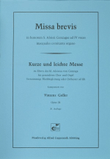
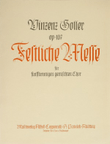
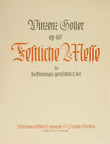
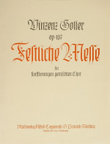
Vincenz Goller's sheet music is particularly well-suited for amateur choirs, church musicians, and organists seeking accessible yet profoundly spiritual repertoire. His numerous liturgical compositions, including a wide array of Masses and offertories, are known for their practicality and devotional quality, making them ideal for church services and choral performances across various skill levels. Performing Goller's music offers a rewarding experience, allowing musicians to engage with a vital body of traditional sacred music that remains widely performed and cherished.