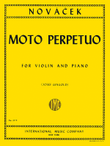
Ottokar Novacek Sheet Music

About Ottokar Novacek

Ottokar Nováček (1866–1900) was an accomplished Austro-Hungarian violinist, violist, and composer of Czech descent whose relatively brief life left a lasting mark on the classical music repertoire. He excelled in the late Romantic style, particularly with his virtuosic and technically demanding compositions for string instruments. Nováček's overall significance in music history rests largely on his enduring work, "Perpetuum Mobile," which continues to be a staple in the violin concert repertoire and a testament to his compositional skill and understanding of string performance.

  • Nováček's early musical education was rigorous, starting with his father, Martin Joseph Nováček, and continuing with esteemed teachers like Jakob Dont in Vienna and Henry Schradieck and Adolf Brodsky at the Leipzig Conservatory, where he won the Mendelssohn Prize in 1885.
  • As a performer, he held prominent positions, including playing in the Leipzig Gewandhaus Orchestra, performing with the re-formed Brodsky Quartet, and serving as principal viola in the Damrosch Orchestra in New York.
  • A severe heart condition forced Nováček to retire from performing in 1899, leading him to dedicate his final year of life entirely to composition.
  • His most renowned composition, "Perpetuum Mobile" (Perpetual Motion), written in 1895, remains a celebrated and challenging work for violinists worldwide, showcasing his mastery of virtuosic writing.

Performing Ottokar Nováček's music offers a rewarding experience for musicians seeking works that blend technical brilliance with late Romantic expression. His sheet music, particularly pieces like the "Perpetuum Mobile" and his eight Concerto Caprices, is ideally suited for intermediate to advanced violinists and pianists who relish a challenge and wish to explore the rich tradition of virtuoso string playing. Chamber musicians will also find his string quartets engaging. Playing Nováček's compositions provides not only an excellent opportunity to hone technical precision and agility but also to connect with the dramatic and lyrical qualities characteristic of the late 19th-century Romantic era.

Search all Ottokar Novacek