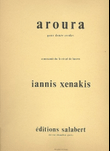
About Iannis Xenakis
Iannis Xenakis was a Greek-French composer, architect, and theorist who stands as a monumental figure in 20th-century avant-garde music. Born in Romania of Greek ancestry, he pioneered the concept of "stochastic music," utilizing mathematical probability and set theory to create dense, often visceral soundscapes that challenged traditional notions of melody, harmony, and rhythm. His work is characterized by its innovative use of sound masses, glissandi, and complex textures, profoundly influencing experimental and electronic music.
- Xenakis was also a trained architect, working for 12 years with the renowned architect Le Corbusier in Paris. He contributed to significant projects, including the design of the Philips Pavilion for the 1958 Brussels World's Fair, for which he also composed the electronic music piece Concret PH.
- During World War II, Xenakis was an active member of the Greek Resistance, where he sustained a severe injury that led to the loss of an eye and facial disfigurement. He later fled Greece and became a French citizen.
- He developed his own graphic notation system and invented the UPIC (Unité Polyagogique Informatique de CEMAMu) system, which allowed composers to draw waveforms directly onto a graphic tablet to generate music.
- His seminal orchestral work Metastaseis (1953-54) applied mathematical concepts directly to musical structure, notably employing glissandi inspired by the hyperbolic paraboloids he encountered in his architectural work.
Iannis Xenakis's sheet music offers a profoundly rewarding, albeit challenging, experience for advanced musicians and contemporary music enthusiasts. His compositions are often suited for virtuoso instrumentalists and specialized ensembles across various instruments, including percussion, piano, strings, and full orchestra. Performing Xenakis's music demands not only technical prowess but also a deep engagement with his unique mathematical and architectural approaches to sound, pushing performers to explore extended techniques and unconventional rhythmic and textural demands. It is an ideal repertoire for those seeking to expand their musical horizons and delve into some of the most innovative and powerful works of the 20th century.