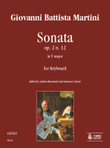
About Giovanni Battista Martini
Giovanni Battista Martini (often known as Padre Martini) was a towering figure in 18th-century Italian music, serving as a pivotal bridge between the late Baroque and early Classical eras. As a prolific composer, esteemed music historian, and influential teacher, his impact on the musical landscape of his time was profound. Martini's compositions span sacred and secular genres, characterized by their elegant melodic lines and masterful contrapuntal craftsmanship, while his theoretical writings laid foundational groundwork for future generations of musicians.
- Giovanni Battista Martini was a Conventual Franciscan friar, which led to his common appellation, "Padre Martini".
- He was an exceptionally influential teacher, numbering among his pupils some of the most celebrated composers of the era, including the young Wolfgang Amadeus Mozart and Johann Christian Bach.
- Martini amassed one of the most extensive musical libraries of his time, estimated at 17,000 volumes, a significant portion of which now forms the basis of the International Museum and Library of Music in Bologna.
- His most significant literary works include the multi-volume "Storia della musica" (History of Music) and "Esemplare di contrappunto" (Examples of Counterpoint), both highly regarded treatises on music theory and history.
For those seeking to delve into the rich tapestry of 18th-century music, Padre Martini's sheet music offers a rewarding experience. His works, including numerous sonatas for organ and harpsichord, sacred vocal pieces, and chamber music, are well-suited for intermediate to advanced musicians. Students of counterpoint will find his compositions particularly invaluable for their pedagogical clarity and structural integrity, while keyboardists can explore the stylistic nuances that link the Baroque and Classical periods. Performing Martini's music provides a direct connection to the intellectual and spiritual depth of an era that shaped Western music, offering both technical challenge and profound artistic satisfaction.